Hardness is a measure of a coating's resistance to deformation, scratching, and indentation. In powder coating, hardness is directly related to the degree of cure — under-cured coatings are softer than fully cured coatings of the same formulation. This makes hardness testing a practical and widely used method for verifying cure quality, in addition to its role in assessing the coating's resistance to mechanical damage in service.
Guides
How to Test Powder Coating Hardness: Pencil, Buchholz, and König Pendulum Methods
Sundial Powder Coating·April 22, 2026·13 min
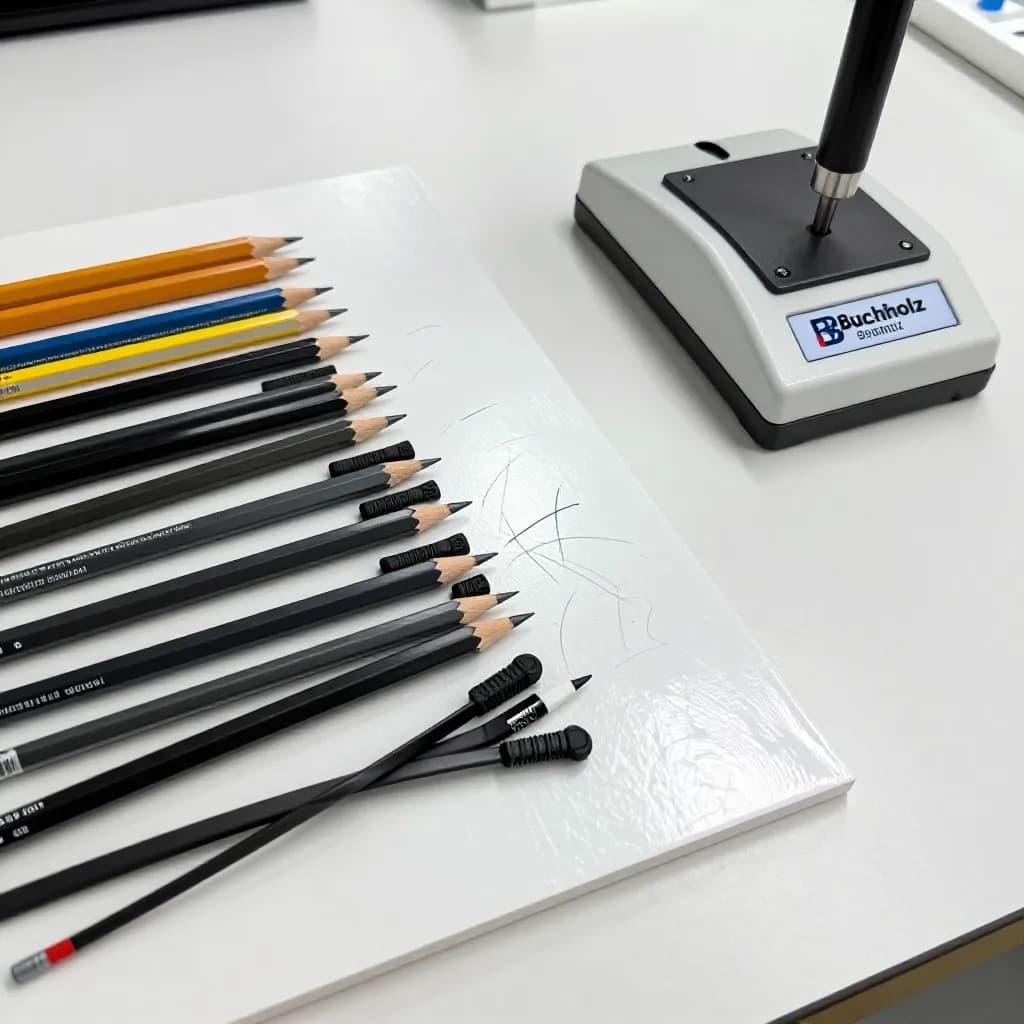
Hardness also correlates with other coating properties. Harder coatings generally offer better scratch resistance, abrasion resistance, and chemical resistance. However, hardness must be balanced against flexibility — an extremely hard coating may be brittle and crack under impact or bending, while a softer coating may flex without cracking but scratch more easily. The powder manufacturer formulates the coating to achieve the optimal balance for the intended application.
Ready to Start Your Project?
From one-off customs to 15,000-part production runs — get precise pricing in 24 hours.
On This Page
Understanding Coating Hardness and Why It Matters
Three hardness test methods are commonly used in the powder coating industry, each measuring a different aspect of hardness. Pencil hardness (ASTM D3363) measures scratch resistance using calibrated pencils. Buchholz indentation (ISO 2815) measures resistance to indentation under a defined load. König pendulum hardness (ISO 1522) measures the damping characteristics of the coating surface, which correlate with surface hardness and cure level.
Each method has its strengths and limitations, and the choice of method depends on the specification requirements, the coating type, and the information needed. This guide covers all three methods with step-by-step procedures, result interpretation, and practical guidance for production use.
Pencil Hardness Test: ASTM D3363
The pencil hardness test is the simplest and most widely used hardness test for powder coatings. It requires only a set of calibrated drawing pencils and a pencil hardness tester (or steady hand technique) to perform. The test determines the hardest pencil that will not scratch or gouge the coating surface, expressed on the standard pencil hardness scale from 6B (softest) through HB to 9H (hardest).
The pencil hardness scale for coatings testing uses the following grades in order of increasing hardness: 6B, 5B, 4B, 3B, 2B, B, HB, F, H, 2H, 3H, 4H, 5H, 6H, 7H, 8H, 9H. Most powder coatings fall in the range of HB to 3H, with the specific hardness depending on the resin chemistry, pigmentation, and degree of cure.
To perform the test, sharpen the pencil to expose a flat, cylindrical lead tip — do not sharpen to a point. Use a pencil sharpener to expose the lead, then flatten the tip by rubbing it perpendicular to fine sandpaper (400 grit) until the lead end is flat and circular with a sharp edge. This flat tip is essential for consistent results; a pointed or rounded tip will give different readings.
Hold the pencil at a 45-degree angle to the coating surface with the flat tip trailing (the pencil leans away from the direction of travel). Apply firm, consistent downward pressure and push the pencil across the coating surface for a distance of at least 6 mm. A pencil hardness tester provides a mechanical guide that maintains the correct angle and applies consistent force, producing more repeatable results than freehand technique.
Start with the hardest pencil and work down the scale. After each stroke, examine the coating surface under good lighting. If the pencil has cut through or gouged the coating, move to the next softer pencil. If the pencil has left only a graphite mark without cutting the coating, that pencil grade represents the pencil hardness of the coating.
Interpreting Pencil Hardness Results
The pencil hardness result is reported as the hardest pencil grade that did not cut or gouge the coating. For example, if a 2H pencil gouges the coating but an H pencil leaves only a graphite mark, the pencil hardness is H. Some specifications report two values: the gouge hardness (the softest pencil that gouges) and the scratch hardness (the softest pencil that scratches without gouging).
Typical pencil hardness values for common powder coating types are: polyester powder coatings typically achieve H to 2H; polyester-epoxy (hybrid) coatings achieve H to 3H; epoxy coatings achieve 2H to 4H; and polyurethane coatings achieve H to 2H. These are general ranges — specific products may fall outside these ranges depending on formulation.
Pencil hardness that is lower than the powder manufacturer's specification indicates potential under-cure. If the specification calls for a minimum of H and the test result is HB or F, the coating has not achieved its full hardness, which strongly suggests incomplete cross-linking. Investigate the cure process — check oven temperature profiles, verify that metal temperature reached the specified cure temperature for the required time, and perform a solvent rub test to confirm the under-cure diagnosis.
Pencil hardness that is significantly higher than expected may indicate over-cure, which can make the coating brittle. However, pencil hardness alone is not a reliable indicator of over-cure — flexibility and impact testing provide better information about brittleness. A coating that passes pencil hardness but fails impact or bend testing may be over-cured.
Repeatability of pencil hardness testing is inherently limited — results can vary by one pencil grade between operators and between tests on the same coating. This is acceptable for production quality control, where the test is used to confirm that hardness is within a general range rather than to measure an exact value. For more precise hardness measurement, use the Buchholz or König methods.
Buchholz Indentation Hardness: ISO 2815
The Buchholz indentation test measures the resistance of a coating to indentation under a defined static load. A standardized indenter — a metal wheel with a sharp edge — is placed on the coating surface under a 500-gram load for 30 seconds. After the load is removed, the length of the indentation mark is measured under magnification, and the Buchholz hardness value is calculated from the indentation length.
The Buchholz hardness value is inversely proportional to the indentation length — a shorter indentation indicates a harder coating. The calculation is: Buchholz hardness = 100 / indentation length (in mm). Typical values for powder coatings range from 80 to 120, with harder coatings producing higher values.
To perform the test, place the Buchholz indenter on a flat, horizontal coating surface. The coating must be on a rigid substrate — thin or flexible substrates will deflect under the load, producing artificially long indentations and low hardness values. The minimum recommended substrate thickness is 0.5 mm for steel. Ensure the test surface is flat and level; curved surfaces produce asymmetric indentations that are difficult to measure accurately.
Apply the 500-gram load and start the timer. After exactly 30 seconds, remove the load and immediately measure the indentation length using the calibrated magnifying glass supplied with the instrument. Measure the length of the indentation parallel to the direction of the indenter edge. The measurement must be taken within 30 seconds of load removal because the coating may recover (the indentation may shrink) over time, particularly for softer coatings.
The Buchholz test is more quantitative than pencil hardness and provides better discrimination between coatings of similar hardness. It is particularly useful for monitoring cure consistency across production batches — small changes in cure level that do not change the pencil hardness grade may produce measurable changes in Buchholz hardness.
König Pendulum Hardness: ISO 1522
The König pendulum hardness test measures the damping characteristics of the coating surface by timing the oscillation decay of a standardized pendulum resting on the coating. A harder coating surface damps the pendulum oscillations less, resulting in a longer oscillation time and a higher hardness value. A softer coating damps the oscillations more quickly, producing a shorter time and a lower value.
The König pendulum consists of a frame supporting two stainless steel balls that rest on the coating surface, with a pendulum arm that swings between the balls. The pendulum is displaced to a starting angle of 6 degrees and released. The time for the oscillation amplitude to decay from 6 degrees to 3 degrees is measured in seconds — this time is the König hardness value.
Typical König hardness values for powder coatings range from 80 to 180 seconds, depending on the resin chemistry and cure level. Epoxy coatings tend to produce higher values (120-180 seconds) due to their rigid cross-linked structure. Polyester coatings produce moderate values (80-140 seconds). Flexible coatings and under-cured coatings produce lower values.
The König test is highly sensitive to cure level, making it an excellent tool for monitoring cure consistency. A change of 10-15 seconds in König hardness between batches of the same powder often indicates a change in cure conditions, even when pencil hardness and visual appearance are unchanged. This sensitivity makes the König test valuable for process control and early detection of cure drift.
The test surface must be flat, horizontal, and free of dust or contamination. The pendulum balls must be clean — contamination on the balls affects the damping and produces inaccurate results. Clean the balls with solvent before each test. Perform at least three measurements at different locations on the test surface and report the average. The test is non-destructive in the sense that it does not visibly damage the coating, though the ball contact points may leave faint marks on very soft coatings.
Choosing the Right Hardness Test for Your Application
The choice of hardness test method depends on the specification requirements, the information needed, and the practical constraints of the testing environment.
Pencil hardness is the best choice for routine production quality control where a quick, simple pass/fail assessment is needed. It requires minimal equipment, can be performed anywhere, and provides results in seconds. Its limitations are relatively low precision (one pencil grade resolution) and operator dependence. Use pencil hardness when the specification calls for it or when a fast screening test is needed to verify cure.
Buchholz indentation is appropriate when a more quantitative hardness measurement is needed than pencil hardness can provide, particularly for monitoring cure consistency across batches. It requires a flat test surface and a rigid substrate, which limits its use on curved or thin parts. The test is relatively quick — about 2 minutes including setup and measurement — and provides numerical data suitable for statistical process control.
König pendulum hardness provides the highest sensitivity to cure level changes and is the preferred method for process control and cure optimization studies. It requires a dedicated instrument and a flat, horizontal test surface, making it more of a laboratory test than a production floor test. The high sensitivity of the König test makes it valuable for detecting subtle cure variations that other methods miss.
Many specifications require more than one hardness test. A typical architectural powder coating specification might require pencil hardness of minimum H per ASTM D3363 and König hardness of minimum 100 seconds per ISO 1522. When multiple tests are specified, all must pass for the coating to be accepted.
Regardless of the method chosen, hardness testing should be performed on coatings that have been allowed to reach full hardness after curing. Most powder coatings continue to develop hardness for 24-48 hours after curing as the cross-linking reaction completes and the coating cools to ambient temperature. Testing immediately after the part exits the oven may produce lower hardness values than testing the next day.
Troubleshooting Low Hardness Results
Low hardness results — pencil hardness below specification, low Buchholz values, or short König times — almost always indicate under-cure. The cross-linking reaction that develops hardness requires both sufficient temperature and sufficient time. If either is inadequate, the coating will be softer than specified.
The first step in troubleshooting low hardness is to verify the cure profile. Attach thermocouples to a test part and run it through the oven to confirm that the metal temperature reaches the specified cure temperature for the required time. Compare the profile against the powder manufacturer's cure window. If the profile shows that the part did not reach temperature or did not hold temperature long enough, adjust the oven settings or cycle time accordingly.
If the cure profile is correct but hardness is still low, investigate the powder material. Check the powder batch number against the manufacturer's quality certificate to verify that the specified hardness is achievable with that batch. Some powder formulations are inherently softer than others, and a change in powder batch may explain a change in hardness results. Contact the powder supplier if the hardness values do not match the technical data sheet.
Contamination can also affect hardness. Silicone contamination on the substrate or in the powder can interfere with cross-linking and produce soft spots in the coating. If low hardness is localized rather than uniform across the part, contamination is a likely cause. Investigate the source of contamination — silicone sealants, mold release agents, and lubricants are common culprits in manufacturing environments.
Film thickness affects hardness test results. Excessively thick coatings may test softer than thinner coatings of the same material because the outer surface of a thick film may not reach the same degree of cure as a thinner film. If hardness is low on thick areas but acceptable on areas at the specified thickness, the issue is over-application rather than under-cure. Adjust the application process to achieve the specified film thickness range.
Frequently Asked Questions
What pencil hardness should powder coating achieve?
Most powder coatings should achieve H to 3H pencil hardness when fully cured. Polyester coatings typically reach H to 2H, hybrids achieve H to 3H, and epoxies reach 2H to 4H. Check the powder manufacturer's technical data sheet for the specific hardness specification for your product.
What does low hardness indicate in powder coating?
Low hardness almost always indicates under-cure — the coating has not reached sufficient temperature for sufficient time to complete the cross-linking reaction. Verify the cure profile with thermocouples, check oven temperature uniformity, and confirm that metal temperature (not air temperature) meets the cure schedule.
How long after curing should you test hardness?
Allow at least 24 hours after curing before performing hardness testing. Most powder coatings continue to develop hardness for 24-48 hours as the cross-linking reaction completes and the coating reaches ambient temperature. Testing immediately after curing may produce lower values than the fully developed hardness.
What is König pendulum hardness?
König pendulum hardness measures the time for a standardized pendulum to decay from 6 degrees to 3 degrees of oscillation while resting on the coating surface. Harder coatings produce longer times (higher values). Typical powder coating values range from 80 to 180 seconds. The test is highly sensitive to cure level, making it excellent for process control.
Can you test hardness on curved surfaces?
Pencil hardness can be tested on moderately curved surfaces with careful technique. Buchholz and König tests require flat, horizontal surfaces for accurate results. For curved parts, test on the flattest available area or prepare flat test panels coated alongside the production parts under identical conditions.
Ready to Start Your Project?
From one-off customs to 15,000-part production runs — get precise pricing in 24 hours.