Abrasive blasting — commonly called sandblasting, though actual sand is rarely used in modern operations — is the most effective method for preparing metal surfaces for powder coating. It accomplishes two things simultaneously: it removes surface contaminants such as mill scale, rust, old coatings, and oxides, and it creates a controlled surface profile that dramatically improves the mechanical adhesion of the powder coating to the substrate.
Guides
How to Sandblast for Powder Coating: Media Selection, Profiles, and Surface Standards
Sundial Powder Coating·April 22, 2026·14 min
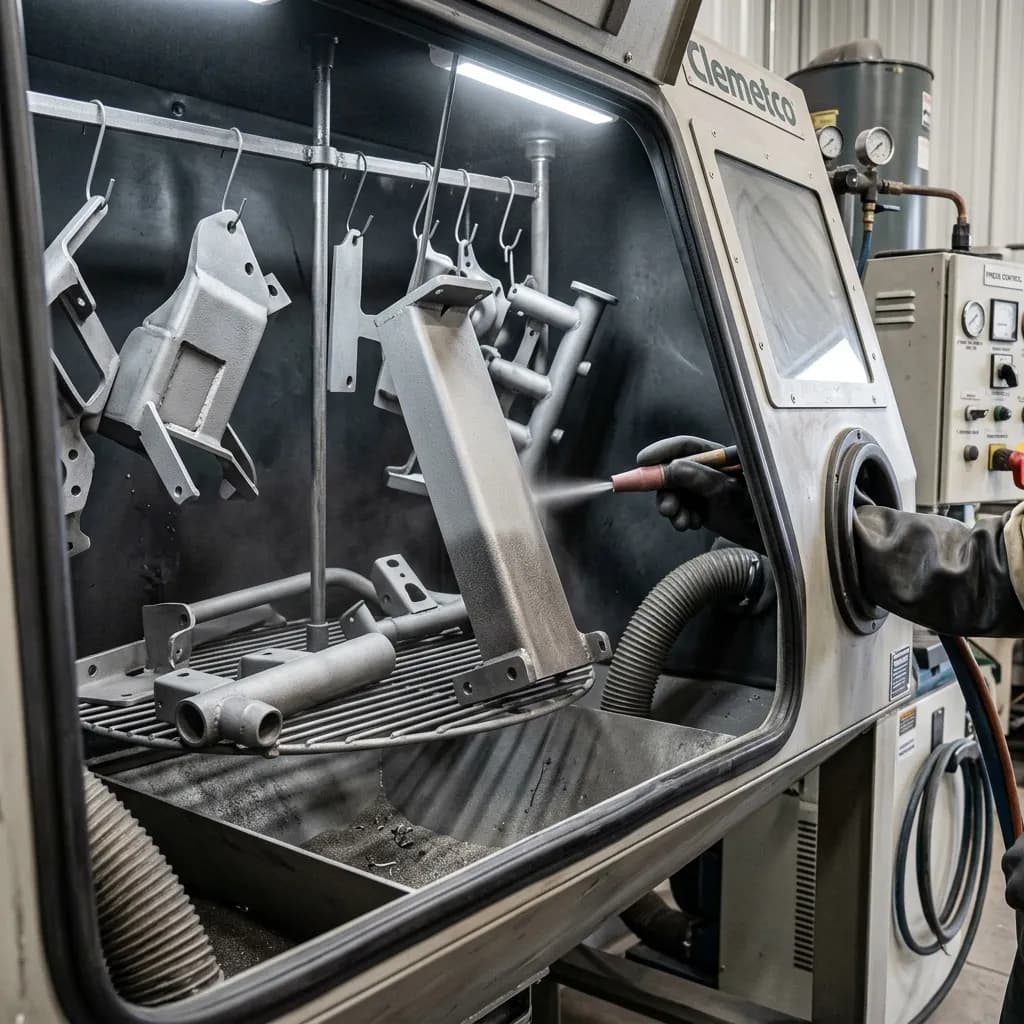
The surface profile created by blasting consists of thousands of microscopic peaks and valleys per square centimeter. This roughened surface increases the effective bonding area between the metal and the coating by a factor of three to five compared to a smooth surface. The powder particles flow into the valleys during curing, creating a mechanical interlock that resists delamination under thermal cycling, impact, and flexing.
Ready to Start Your Project?
From one-off customs to 15,000-part production runs — get precise pricing in 24 hours.
On This Page
Why Abrasive Blasting Is Essential for Powder Coating
Without proper blasting, powder coatings rely primarily on chemical adhesion to the substrate, which is inherently weaker than the combination of mechanical and chemical bonding achieved on a blasted surface. Parts that are merely wiped clean or lightly sanded before coating are far more likely to experience adhesion failures, particularly in demanding service environments involving moisture, temperature extremes, or mechanical stress.
This guide covers the complete blasting process for powder coating preparation, from media selection and equipment setup through blast execution, quality verification, and safety requirements. Whether you operate a production blast room or a small cabinet blaster, the principles are the same.
Blast Media Selection: Matching Media to Substrate and Application
Choosing the correct blast media is one of the most important decisions in the blasting process. The media type determines the surface profile depth, the cleanliness achieved, the blasting speed, and whether the substrate will be damaged or contaminated during the process. There is no single media that is optimal for all substrates and applications.
Steel grit is the workhorse media for blasting ferrous substrates. Available in grades from G10 (coarse) to G200 (fine), steel grit produces an angular surface profile that is ideal for powder coating adhesion. G40 to G50 grades are most commonly used for general powder coating preparation, producing profiles in the 50-75 micron range. Steel grit is durable, recyclable through multiple cycles, and cost-effective for high-volume operations. However, it must never be used on non-ferrous substrates because embedded steel particles cause galvanic corrosion.
Aluminum oxide is the preferred media for non-ferrous substrates including aluminum, stainless steel, and copper alloys. It is extremely hard — 9 on the Mohs scale — and produces a clean, angular profile without ferrous contamination. Common grades for powder coating preparation are 60 to 120 mesh. Aluminum oxide is more expensive than steel grit but can be recycled multiple times before it breaks down.
Glass bead produces a peened, dimpled profile rather than the angular profile created by grit media. It is used where a smoother finish is desired or where the substrate is too thin or delicate for aggressive angular media. Glass bead is also used for cleaning without significant material removal. Garnet, silicon carbide, and plastic media serve specialized roles — garnet for one-pass disposable blasting, silicon carbide for extremely hard substrates, and plastic media for stripping coatings without damaging the base metal.
Understanding Blast Profiles and Surface Standards
The blast profile — also called anchor pattern or surface roughness — is the pattern of peaks and valleys created on the metal surface by the impact of blast media. Profile depth is measured in microns and is one of the critical parameters that determines coating adhesion performance. Too shallow a profile provides insufficient mechanical keying; too deep a profile wastes coating material filling the valleys and can create stress concentrations that initiate cracking.
For most powder coating applications, the target profile depth is 25-75 microns (1.0-3.0 mils). Thinner powder coatings in the 50-80 micron range require profiles at the lower end of this range to ensure complete coverage of the peaks. Thicker coatings of 100 microns or more can accommodate deeper profiles. The general rule is that the profile depth should not exceed one-third of the intended dry film thickness.
Surface cleanliness after blasting is classified according to ISO 8501-1 (international) or SSPC/NACE (North American) standards. The most commonly specified standard for powder coating is SA 2.5 (ISO) or SSPC-SP 10 / NACE No. 2 (Near-White Blast Cleaning). This standard requires that at least 95% of the surface area is free of all visible oil, grease, dust, mill scale, rust, paint, oxides, and other foreign matter. The remaining 5% may show only slight shadows, streaks, or discoloration.
SA 3 (ISO) or SSPC-SP 5 / NACE No. 1 (White Metal Blast Cleaning) requires 100% removal of all visible contaminants and is specified for the most demanding applications such as immersion service or critical structural components. Achieving and maintaining SA 3 is significantly more time-consuming and expensive than SA 2.5, so it should only be specified when genuinely required by the application.
Equipment Setup and Blast Parameters
Blast equipment ranges from small suction-feed cabinet blasters for individual parts to large pressure-feed blast rooms with automated media recovery for production operations. Regardless of scale, the fundamental parameters that control blast quality are the same: air pressure, nozzle size, standoff distance, blast angle, and media flow rate.
Air pressure at the nozzle is the primary variable controlling blast aggressiveness. For most powder coating preparation work, nozzle pressures of 80-100 psi (5.5-7.0 bar) are appropriate for steel substrates with steel grit media. Aluminum and other soft metals require reduced pressures of 40-60 psi (2.8-4.1 bar) to avoid excessive material removal and surface damage. Pressure should be measured at the nozzle, not at the compressor — pressure losses through hoses, fittings, and moisture separators can be significant.
Nozzle size determines the blast pattern width and the air volume required. Common nozzle sizes for manual blasting are No. 5 (5/16 inch) through No. 8 (1/2 inch). Larger nozzles cover more area per pass but require proportionally larger compressors. A No. 6 nozzle at 100 psi requires approximately 150 CFM of clean, dry air — undersized compressors are one of the most common causes of poor blast performance.
Standoff distance — the distance from the nozzle to the work surface — is typically 150-300 mm (6-12 inches) for manual blasting. Closer distances increase blast intensity but reduce the pattern size, while greater distances reduce intensity and increase coverage area. The blast angle should be 45-80 degrees to the surface for contaminant removal and profile creation. Blasting at 90 degrees (perpendicular) is less efficient for material removal and can peen contaminants into the surface rather than removing them.
Blasting Technique for Consistent Results
Consistent blasting technique is essential for achieving uniform surface preparation across the entire part. Inconsistent technique — varying the standoff distance, travel speed, or overlap between passes — creates areas of over-blasting and under-blasting that result in uneven coating adhesion and appearance.
The basic technique for manual blasting is to work in systematic, overlapping passes across the surface. Each pass should overlap the previous one by approximately 50% to ensure uniform coverage. Maintain a consistent standoff distance and travel speed throughout each pass. Move the nozzle at a steady rate that achieves the required cleanliness in two to three passes rather than trying to clean the surface in a single slow pass, which risks over-blasting and substrate damage.
Start blasting at the top of the part and work downward so that spent media and removed contaminants fall away from areas yet to be blasted. On complex geometries, blast recessed areas, inside corners, and hard-to-reach features first, then blend into the surrounding flat surfaces. These areas require more attention because the blast stream is less effective in confined spaces and at oblique angles.
For thin materials — sheet metal below 1.5 mm thickness — reduce blast pressure, increase standoff distance, and use finer media to prevent warping and distortion. Consider blasting from both sides simultaneously on very thin panels to balance the peening stresses. If distortion occurs despite careful technique, the part may need to be straightened before coating, which adds cost and risks damaging the prepared surface.
After blasting, blow off the surface with clean, dry compressed air to remove residual dust and media fragments. Do not touch the blasted surface with bare hands — skin oils will contaminate the prepared surface and create adhesion defects. Handle blasted parts with clean cotton or nitrile gloves.
Quality Verification: Measuring Profile and Cleanliness
Verifying blast quality is not optional — it is a required step that confirms the surface meets specification before the part proceeds to pretreatment or coating. Two parameters must be verified: surface cleanliness and profile depth.
Surface cleanliness is assessed visually by comparing the blasted surface against the reference photographs in ISO 8501-1 or the SSPC-VIS 1 standard. These photographic standards show the appearance of steel surfaces at each cleanliness grade (SA 1 through SA 3) for four initial rust grades (A through D). The assessment should be performed under good lighting — at least 500 lux — and the assessor should be trained in the use of the visual standards. For critical work, cleanliness assessment should be documented with the assessor's name, the standard used, and the grade achieved.
Profile depth is measured using one of three methods. Replica tape (Testex Press-O-Film) is the most common field method: a piece of compressible foam tape is pressed against the blasted surface, and the compressed thickness is measured with a spring micrometer. The reading minus the incompressible film thickness gives the peak-to-valley profile depth. Surface profile gauges (stylus instruments) provide more precise measurements and can generate statistical data across multiple readings. Comparator panels provide a quick visual and tactile comparison but are less precise than tape or gauge methods.
A minimum of five profile measurements should be taken per part or per defined area, and all readings must fall within the specified range. If any readings fall outside specification, the area should be re-blasted and re-measured. Document all measurements as part of the quality record — this data is invaluable for process control and troubleshooting.
Safety Requirements for Blasting Operations
Abrasive blasting generates significant hazards that require proper controls to protect operators and nearby workers. The primary hazards are airborne dust containing metal particles and spent media fragments, noise levels that routinely exceed 100 dB, high-velocity ricocheting media, and ergonomic stresses from handling heavy equipment and working in awkward positions.
Respiratory protection is the most critical safety requirement. Blasting operations generate respirable dust concentrations that far exceed occupational exposure limits for most metals. Operators must wear supplied-air respirators — typically Type CE abrasive blast helmets that provide a continuous flow of clean breathing air from an external source. Filtering facepiece respirators and cartridge respirators are not adequate for blasting operations due to the extremely high dust concentrations generated.
Hearing protection is mandatory. Blast operations typically generate noise levels of 100-115 dB at the operator's position, well above the 85 dB threshold for mandatory hearing protection. Earplugs, earmuffs, or both should be worn, and noise exposure should be monitored to ensure compliance with occupational exposure limits.
Protective clothing must cover all exposed skin. Blast operators should wear heavy-duty leather or canvas blast suits, leather gloves, and safety boots. The high-velocity media stream can cause serious injury to exposed skin and eyes. Blast helmets with impact-resistant visors protect the face and eyes from ricocheting media.
Blast rooms and cabinets must have adequate ventilation to capture and contain airborne dust. Blast rooms typically use downdraft or crossdraft ventilation systems that maintain negative pressure to prevent dust from escaping into adjacent work areas. Dust collection systems must be properly sized for the blast operation and maintained regularly — clogged filters reduce airflow and allow dust to accumulate to hazardous levels.
Maintaining Blast Media and Equipment for Consistent Performance
Blast media degrades with use — particles fracture, round off, and accumulate contaminants from the surfaces being blasted. Using degraded media produces inconsistent profiles, reduced cleaning rates, and can introduce contamination onto freshly blasted surfaces. A media maintenance program is essential for consistent blast quality.
Media operating mix should be monitored regularly by sieve analysis. As media breaks down, the particle size distribution shifts toward finer sizes, which reduces the profile depth and cleaning rate. Fresh media should be added to the system at a rate that maintains the target size distribution. Most operations add 10-20% fresh media per shift to replace broken-down particles removed by the classifier.
The media classifier — typically a cyclone separator or air wash separator — removes undersized particles, dust, and contaminants from the recirculating media. A properly functioning classifier is essential for media quality. If the classifier is not removing fines effectively, the media mix becomes contaminated with dust that reduces blast efficiency and can deposit on blasted surfaces.
Moisture in the compressed air supply is one of the most common causes of blast quality problems. Water in the air stream causes media to clump, clogs blast hoses and nozzles, and deposits moisture on freshly blasted surfaces that causes flash rust. The air supply system must include an aftercooler, moisture separator, and desiccant dryer to deliver clean, dry air to the blast equipment. Drain moisture traps daily and replace desiccant on schedule.
Nozzle wear is an ongoing maintenance item. Blast nozzles erode from the inside out, gradually increasing in diameter. A worn nozzle consumes more air, reduces blast velocity, and produces a wider, less focused blast pattern. Tungsten carbide nozzles typically last 200-400 hours, while boron carbide nozzles last 600-1000 hours. Replace nozzles when the bore diameter has increased by 1/16 inch from the original size, and track nozzle hours to predict replacement intervals.
Frequently Asked Questions
What grit media is best for powder coating preparation?
For steel substrates, steel grit in G40 to G50 grades is most commonly used, producing profiles of 50-75 microns ideal for powder coating. For aluminum and non-ferrous metals, aluminum oxide in 60-120 mesh is preferred because it avoids ferrous contamination that causes galvanic corrosion under the coating.
What is SA 2.5 blast standard?
SA 2.5 (Near-White Blast Cleaning) per ISO 8501-1 requires that at least 95% of the surface area is free of all visible oil, grease, mill scale, rust, paint, and other contaminants. It is the most commonly specified cleanliness standard for powder coating preparation and is equivalent to SSPC-SP 10 in North American standards.
What blast profile depth is needed for powder coating?
Most powder coating applications require a profile depth of 25-75 microns (1.0-3.0 mils). The profile should not exceed one-third of the intended dry film thickness. Thinner coatings need shallower profiles to ensure complete peak coverage, while thicker coatings can accommodate deeper profiles.
Can you sandblast aluminum before powder coating?
Yes, but you must use non-ferrous media such as aluminum oxide or glass bead — never steel grit or shot. Blast pressure should be reduced to 40-60 psi to avoid excessive material removal. Aluminum oxide in 80-120 mesh at moderate pressure produces an excellent profile for powder coating adhesion on aluminum.
How do you measure blast profile depth?
The most common field method is replica tape (Testex Press-O-Film), where compressible tape is pressed against the surface and measured with a spring micrometer. Surface profile gauges provide more precise electronic measurements. Take at least five readings per area and verify all fall within the specified range.
Ready to Start Your Project?
From one-off customs to 15,000-part production runs — get precise pricing in 24 hours.