Small and intricate parts present a unique set of challenges for powder coating that are essentially the opposite of those encountered with large parts. Where large parts struggle with thermal mass and coverage area, small parts struggle with excessive film build, Faraday cage effects in tight geometries, maintaining dimensional tolerances with coating thickness, and the economics of handling many small parts efficiently.
Guides
How to Powder Coat Small and Intricate Parts: Faraday Solutions, Thin Film, and Batch Processing
Sundial Powder Coating·April 22, 2026·13 min
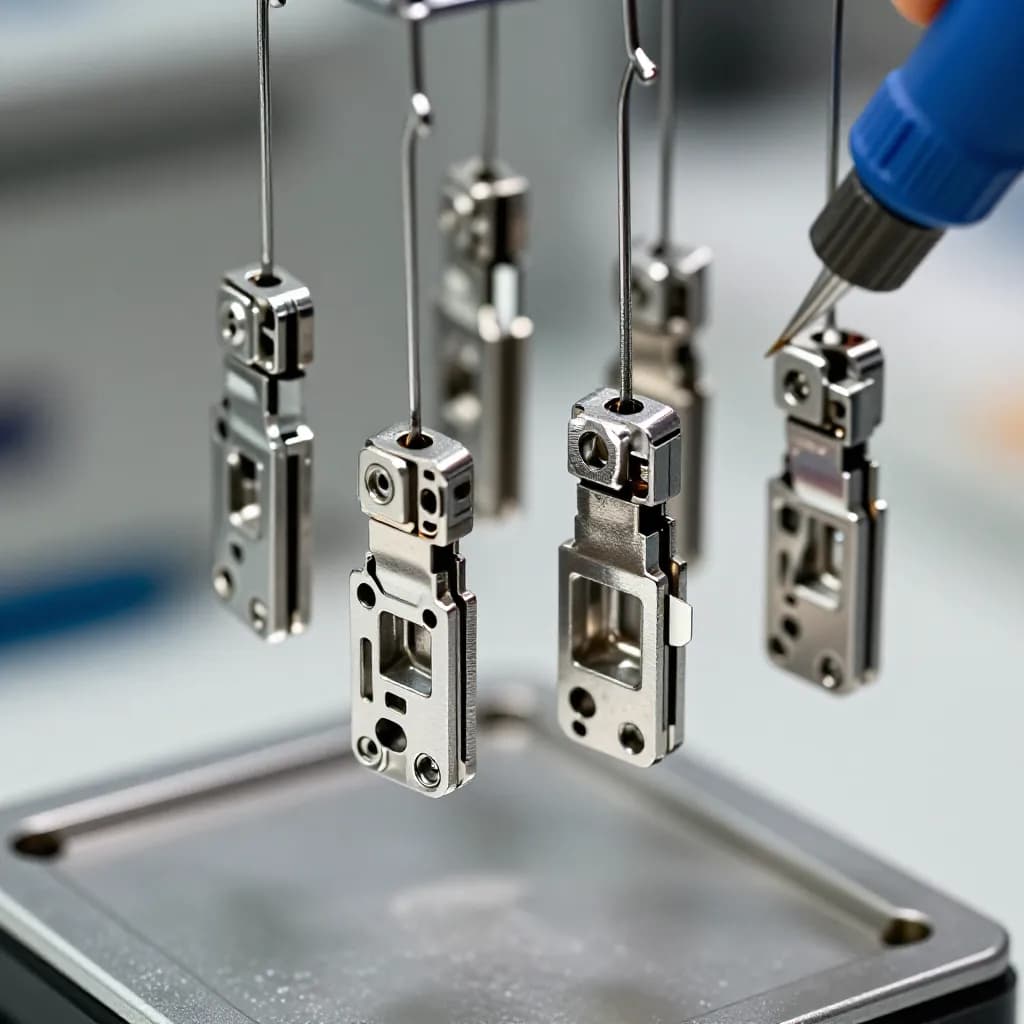
The Faraday cage effect is the dominant challenge for intricate parts. Small parts with deep recesses, narrow channels, fine fins, tight corners, and enclosed spaces create geometries where the electrostatic field cannot penetrate effectively. The field lines concentrate on the outer edges and protruding features, depositing excessive powder on these areas while leaving recesses and interior surfaces bare or thinly coated.
Ready to Start Your Project?
From one-off customs to 15,000-part production runs — get precise pricing in 24 hours.
On This Page
Why Small and Intricate Parts Demand Special Techniques
Dimensional tolerance is another critical concern. On a large part, 60-80 microns of coating thickness is negligible relative to the overall dimensions. On a small precision part with tight tolerances — a connector housing, a small bracket, or a fine-pitched heat sink — 60-80 microns on each surface adds 120-160 microns to the overall dimension, which may exceed the allowable tolerance. These parts may require thin-film application techniques that deposit 30-50 microns or less.
Handling efficiency is the economic challenge. Small parts must be individually hung, coated, cured, and inspected. The handling time per part may exceed the actual coating time, making small parts disproportionately expensive to coat. Batch processing techniques — coating many small parts simultaneously on specialized racks or in fluidized beds — are essential for economic viability.
Overcoming Faraday Cage Effects on Intricate Geometries
The Faraday cage effect on intricate parts is more severe than on larger parts because the recesses are deeper relative to the part size, the openings are narrower, and the field line concentration on edges is more pronounced. Standard corona gun settings that work well on flat surfaces will produce heavy edge buildup and bare recesses on intricate parts.
The most effective approach is to reduce the electrostatic field strength dramatically. Set the corona voltage to 20-40 kV — much lower than the 60-80 kV used for general application. This weaker field reduces the concentration of field lines on edges and allows more powder to drift into recesses. The trade-off is slower deposition rate, which is acceptable for small parts where the total surface area is small.
Reduce the atomizing air pressure to 1.0-2.0 bar to create a soft, slow-moving powder cloud rather than a focused, high-velocity stream. High-velocity air bouncing off the walls of narrow recesses creates turbulence that blows powder back out of the recess. A gentle powder cloud drifts into recesses more effectively.
Increase the gun-to-part distance to 250-350 mm to spread the powder cloud over a wider area and reduce the field intensity at the part surface. The wider cloud wraps around the part more effectively than a focused stream, improving coverage on back surfaces and inside corners.
For the most challenging Faraday geometries — deep narrow channels, enclosed boxes with small openings, and tightly spaced fins — consider using a tribo charging gun instead of a corona gun. Tribo guns charge the powder by friction rather than by an external electric field, producing a charge distribution that does not create the strong directional field responsible for the Faraday effect. Tribo-charged powder penetrates into recesses much more effectively than corona-charged powder.
Tribo Charging: The Intricate Part Specialist
Tribo (triboelectric) charging guns charge powder particles through frictional contact with the interior surfaces of the gun barrel, typically made from PTFE (Teflon). As the powder flows through the barrel, electrons transfer between the powder particles and the PTFE surface, leaving the powder particles with a positive charge. This charge is distributed uniformly across each particle without the strong external electric field generated by corona guns.
The absence of an external electric field is the key advantage of tribo charging for intricate parts. Without the field, there is no Faraday cage effect — the charged particles are attracted to the grounded part surface by their own charge, not by an external field that concentrates on edges. This allows tribo-charged powder to penetrate into recesses, inside corners, and enclosed spaces that corona-charged powder cannot reach.
Tribo charging has several limitations that must be understood. Not all powder chemistries charge well tribologically — the charging efficiency depends on the triboelectric properties of the resin, which vary by chemistry. Polyester and polyester-TGIC powders generally charge well in tribo guns. Epoxy and hybrid powders may charge less effectively. Consult the powder manufacturer for tribo compatibility information.
The deposition rate of tribo guns is typically lower than corona guns because the charge level on each particle is lower. This means longer application times for the same film thickness. For small parts with limited surface area, this is not a significant disadvantage. For large parts, the slower deposition rate makes tribo guns impractical as the primary application tool.
Tribo guns require more maintenance than corona guns. The PTFE barrel wears over time, reducing charging efficiency. Moisture in the compressed air supply degrades tribo charging performance more severely than it affects corona charging. The gun must be kept clean and dry, and the barrel replaced when charging efficiency drops below acceptable levels. Monitor the charging current — a declining current trend indicates barrel wear or moisture contamination.
Thin Film Application Techniques
Many small and intricate parts require thin powder coating films — 30-50 microns rather than the standard 60-80 microns — to maintain dimensional tolerances, preserve fine detail, and avoid bridging of narrow gaps and slots. Achieving thin, uniform films with powder coating requires specific techniques and powder selection.
Powder selection is the first consideration. Standard powder coatings with median particle sizes of 35-45 microns cannot produce uniform films below about 50 microns because the individual particles are too large relative to the target film thickness. For thin film applications, use fine-grind powders with median particle sizes of 20-30 microns. These finer powders produce smoother, more uniform thin films and flow more completely during curing.
Gun settings for thin film application emphasize control over deposition rate. Use low voltage (20-40 kV), low powder flow rate (50-150 grams per minute), and moderate atomizing air pressure. The goal is to deposit a thin, uniform layer in a single pass rather than building thickness through multiple passes. Multiple passes on small parts risk over-building thickness on edges and protruding features.
Application technique for thin films requires a light, quick touch. Move the gun quickly across the part, depositing a thin dusting of powder on each pass. Check coverage visually between passes — the substrate should be just barely visible through the powder layer at the target thickness. On small parts, a single pass from each direction may be sufficient.
Film thickness measurement on thin films requires a gauge with adequate resolution. Standard gauges with ±2-3 micron accuracy are sufficient for standard film thicknesses but may not provide meaningful data at 30-40 microns where the measurement uncertainty is a significant fraction of the total thickness. Use a high-resolution gauge calibrated specifically for thin film measurement, and take multiple readings to improve statistical confidence.
Cure schedules for thin films may need adjustment. Thin films heat through more quickly than thick films, reaching cure temperature faster. However, thin films also have less thermal mass and may be more sensitive to temperature variations. Verify the cure profile on thin-film parts to ensure that the film reaches the cure temperature without over-shooting, which can cause defects on thin coatings.
Protecting Delicate Features During Coating
Intricate parts often have delicate features — thin fins, sharp edges, fine threads, small holes, and precision surfaces — that can be damaged or obscured by the powder coating process. Protecting these features while achieving adequate coating on the rest of the part requires careful planning and technique.
Thin fins and sharp edges attract excessive powder due to the electrostatic field concentration on pointed features. The resulting thick coating on edges can bridge gaps between fins, fill narrow slots, and obscure fine detail. Reducing the voltage is the primary countermeasure — lower voltage reduces the field concentration on edges. For parts with very fine features, tribo charging eliminates the edge concentration entirely.
Small holes and slots can be bridged by powder that spans the opening rather than coating the interior surfaces. If the holes must remain open, they need to be masked with appropriately sized silicone plugs or pins. If the holes are too small for standard plugs, custom wire pins or dental-type silicone can be used. For production volumes, custom masking fixtures with pins that align with all hole locations speed the masking process.
Threads on small parts are particularly vulnerable to coating buildup that interferes with fastener engagement. Even a thin powder coating on thread flanks can prevent proper thread engagement or alter the torque-tension relationship. Mask all functional threads, or plan to chase threads after coating with the appropriate tap or die.
Precision mating surfaces that must maintain specific dimensions or surface finishes require masking to prevent coating buildup. On small parts, the masking area may be a significant fraction of the total surface area, making the masking process time-consuming relative to the coating process. Consider whether the part design can be modified to reduce the number of features requiring masking — for example, by machining mating surfaces after coating rather than masking them during coating.
Batch Processing Strategies for Small Parts
The economics of powder coating small parts depend heavily on batch processing efficiency — how many parts can be coated per hour with acceptable quality. Individual handling of small parts is labor-intensive and slow. Batch processing techniques that coat many parts simultaneously dramatically improve throughput and reduce per-part cost.
Rack-based batch processing uses custom racks designed to hold multiple small parts in positions that provide adequate spacing for powder access and electrical grounding. The rack is loaded with parts, processed through the entire coating line as a single unit, and unloaded after curing. Rack design for small parts must balance part density (more parts per rack = higher throughput) against coating access (parts too close together create mutual Faraday effects and thin spots).
Fluidized bed coating is an alternative to spray application for small parts that require complete, uniform coverage. The part is preheated to above the powder's melting point and then dipped into a fluidized bed of powder. The powder melts on contact with the hot surface, building a coating whose thickness is controlled by the part temperature and the dipping time. Fluidized bed coating provides excellent coverage on complex geometries without Faraday effects, but it produces thicker coatings (typically 150-500 microns) than spray application and is limited to parts small enough to dip.
Barrel or tumble coating is used for very small parts — fasteners, clips, and small stampings — that cannot be individually racked. Parts are loaded into a rotating barrel or drum, heated, and exposed to powder that coats them as they tumble. This method is fast and economical for high volumes of small, simple parts but provides less precise film thickness control than spray application.
For any batch processing method, establish the maximum batch size that maintains acceptable coating quality. Overloading racks, fluidized beds, or barrels reduces coating quality and increases reject rates. The optimal batch size maximizes good parts per hour, not total parts per hour.
Quality Control Adapted for Small Part Production
Quality control procedures for small parts must be adapted to the high volume and small size of the parts. Inspecting every part individually may not be practical when producing thousands of parts per shift, but the quality requirements are no less demanding than for larger parts.
Statistical sampling is the standard approach for small part quality control. Define a sampling plan based on the batch size and the acceptable quality level (AQL). For example, from a batch of 500 parts, inspect a random sample of 50 parts for visual defects, measure film thickness on 20 parts, and perform adhesion testing on 5 parts. If the sample meets all requirements, accept the batch. If any sample fails, increase the inspection to 100% for the failing parameter and investigate the root cause.
Film thickness measurement on small parts can be challenging due to limited flat surface area for gauge placement. Identify the measurement locations during process development and mark them on a reference drawing. Use a gauge with a small probe tip that can access the measurement locations on the specific part geometry. For very small parts, destructive cross-section measurement may be the only reliable thickness measurement method.
Adhesion testing on small parts may require adaptation of the standard cross-hatch test. If the part surface is too small for a standard cross-hatch grid, use a single-line scratch test or a modified cross-hatch with fewer cuts. The pull-off test may not be practical on small parts due to the dolly size relative to the part surface. Document any test method adaptations and ensure they provide equivalent quality assurance.
Visual inspection of small parts benefits from magnification and consistent lighting. A bench-mounted magnifying lamp provides the combination of magnification and illumination needed to detect defects on small surfaces. Establish visual acceptance standards with reference samples showing acceptable and unacceptable conditions for the specific part.
Process control is more important than end-of-line inspection for small part quality. Monitor and control the process parameters — gun settings, film thickness, cure temperature, and grounding — continuously during production. Consistent process parameters produce consistent quality, reducing the reliance on inspection to catch defects after they have occurred.
Frequently Asked Questions
How do you coat inside corners on small parts?
Reduce corona voltage to 20-40 kV, lower atomizing air pressure to 1.0-2.0 bar, and increase gun distance to 250-350 mm. For severe Faraday geometries, use a tribo charging gun which eliminates the external electric field that causes powder to concentrate on edges rather than penetrating into recesses.
What is the thinnest powder coating you can apply?
With fine-grind powder (20-30 micron median particle size) and careful technique, uniform films of 30-40 microns are achievable. Standard-grind powders cannot produce uniform films below about 50 microns. Ultra-thin film powders specifically formulated for thin application can achieve 25-35 microns in controlled conditions.
When should you use tribo charging instead of corona?
Use tribo charging for parts with deep recesses, narrow channels, tightly spaced fins, and enclosed geometries where the Faraday cage effect prevents corona-charged powder from penetrating. Tribo charging is also preferred for thin film applications where the lower charge level reduces edge buildup. Verify that your powder chemistry is compatible with tribo charging.
How do you prevent powder from bridging small holes and slots?
Reduce voltage and powder flow rate to minimize buildup around openings. Mask holes with appropriately sized silicone plugs or custom wire pins. For production volumes, use masking fixtures with pins aligned to all hole locations. If bridging still occurs, clear holes immediately after coating and before curing using a pick or compressed air.
What is fluidized bed coating for small parts?
Fluidized bed coating involves preheating the part above the powder's melting point and dipping it into a bed of fluidized powder. The powder melts on contact, building a uniform coating without Faraday effects. It produces thicker coatings (150-500 microns) than spray application and is best suited for small parts requiring complete, uniform coverage.
Ready to Start Your Project?
From one-off customs to 15,000-part production runs — get precise pricing in 24 hours.