Powder coating large parts — structural steel fabrications, architectural panels, heavy equipment components, large enclosures, and oversized frames — presents challenges that do not exist when coating standard-sized parts. The sheer physical size of these parts affects every stage of the coating process, from surface preparation and handling through application, curing, and quality inspection.
Guides
How to Powder Coat Large Parts: Oversized Items, Batch Ovens, and Multi-Section Coating
Sundial Powder Coating·April 22, 2026·13 min
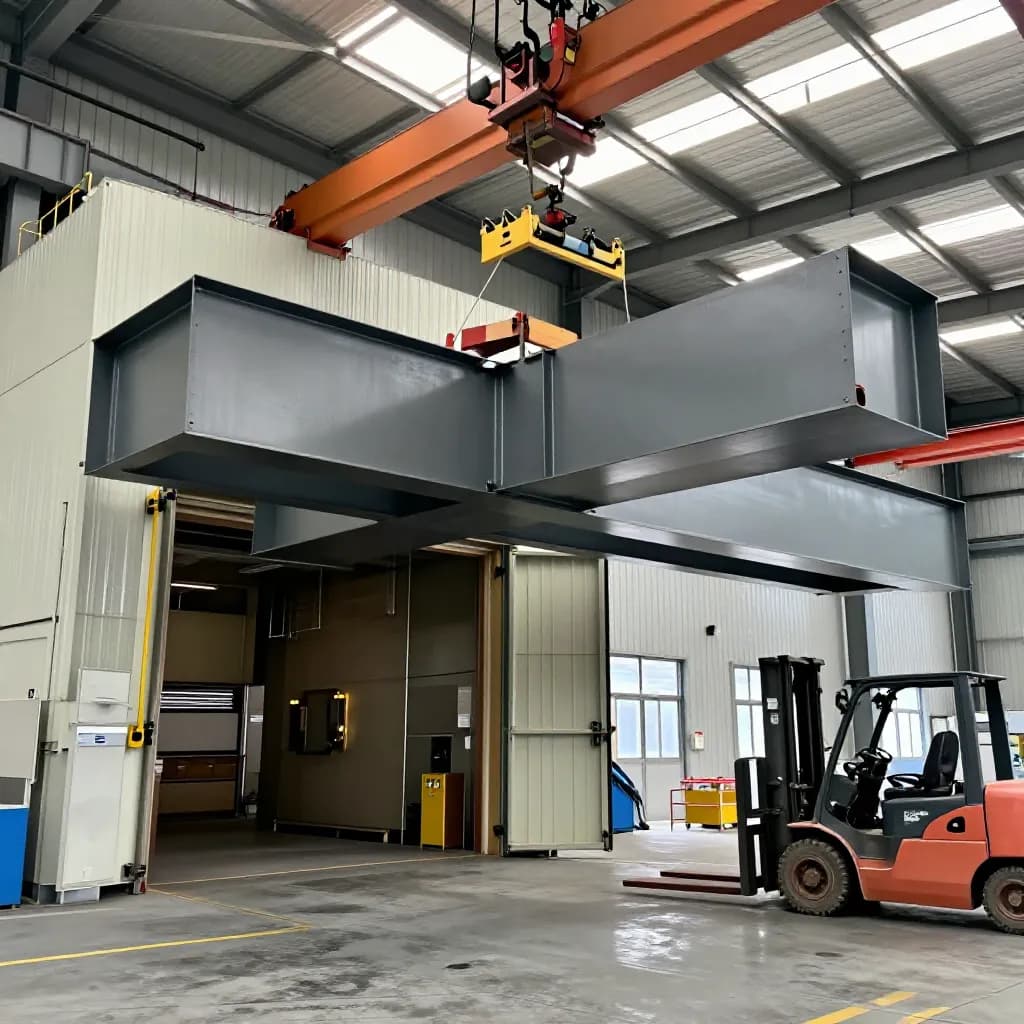
The most fundamental challenge is thermal mass. Large, heavy parts take significantly longer to heat to cure temperature than small, thin parts. A 500 kg steel fabrication may require 45-60 minutes to reach 200°C in a convection oven, compared to 5-10 minutes for a 2 kg sheet metal bracket. This extended heat-up time means longer oven cycles, higher energy consumption, and a greater risk of the powder flowing and sagging on vertical surfaces before the part reaches cure temperature.
Ready to Start Your Project?
From one-off customs to 15,000-part production runs — get precise pricing in 24 hours.
On This Page
The Unique Challenges of Powder Coating Large Parts
Physical handling is another major challenge. Moving parts that weigh hundreds or thousands of kilograms through the preparation, coating, and curing process requires overhead cranes, heavy-duty conveyors, or specialized transport equipment. The handling system must support the part securely without damaging the prepared surface or the applied powder, and it must provide reliable electrical grounding for electrostatic powder application.
Booth and oven size limitations often determine whether a large part can be powder coated at all. If the part does not fit in the available booth or oven, the options are to find a larger facility, to coat the part in sections, or to use alternative coating methods. This guide covers strategies for all of these scenarios.
Batch Oven Strategies for Large Parts
Batch ovens — walk-in or drive-in ovens that process one load at a time — are the standard equipment for curing large powder coated parts. Unlike continuous conveyor ovens that move parts through a heated tunnel at a constant speed, batch ovens allow the operator to control the cure cycle duration based on the specific thermal requirements of each load.
Oven sizing for large parts must account for both the physical dimensions of the part and the thermal capacity needed to heat the part to cure temperature within a reasonable time. The oven must be large enough to accommodate the part with adequate clearance on all sides for air circulation — a minimum of 150-300 mm clearance between the part and the oven walls, ceiling, and floor. Insufficient clearance restricts airflow and creates cold spots where the part may not reach cure temperature.
The oven's heating capacity — measured in BTU per hour or kilowatts — must be sufficient to raise the part temperature to the cure level within the powder's leveling window. If the oven heats the part too slowly, the powder may begin to gel before the part reaches full cure temperature, resulting in under-cure and poor surface quality. As a rough guideline, the oven should be capable of raising the heaviest expected load to cure temperature within 30-45 minutes.
Air circulation in the batch oven is critical for uniform heating of large parts. The oven fans must move enough air volume to maintain uniform temperature throughout the oven chamber, including behind and underneath the part where airflow may be restricted. Large parts can block airflow paths, creating stagnant zones that heat more slowly. Position the part in the oven to minimize airflow obstruction, and verify temperature uniformity with a multi-point thermocouple survey for each new part configuration.
Oven door management affects energy efficiency and temperature uniformity. Opening the oven door to load or unload parts causes significant heat loss. Minimize door open time by having the part staged and ready for loading before opening the door. Some batch ovens have rapid-opening doors or air curtains that reduce heat loss during loading.
Preheating Large Parts Before Powder Application
Preheating — heating the part to an elevated temperature before applying powder — is a valuable technique for large parts that addresses several challenges simultaneously. It improves powder adhesion on the large surface area, reduces the cure oven time by starting the part at an elevated temperature, and can help achieve more uniform film thickness on complex geometries.
The preheating process involves placing the bare, prepared part in the oven and heating it to 80-150°C, then removing it and applying powder while the part is still warm. The warm surface causes the powder particles to begin melting on contact, creating a thermal bond that supplements the electrostatic attraction. This is particularly beneficial for large parts where the electrostatic charge may not be uniform across the entire surface.
The preheat temperature must be carefully controlled. Too low a temperature provides minimal benefit. Too high a temperature causes the powder to melt and flow immediately on contact, making it difficult to build uniform film thickness — the powder gels before the operator can complete the application on a large surface. For most applications, a preheat temperature of 90-120°C provides the best balance between improved adhesion and workable application time.
The working time after preheating is limited by the rate at which the part cools. Large, heavy parts retain heat longer than small parts, providing more working time. A 500 kg steel fabrication preheated to 120°C may remain above 80°C for 20-30 minutes, providing ample time for powder application. A lighter part may cool below the useful temperature range in 10-15 minutes.
Preheating also serves as a degassing step for substrates that tend to outgas during curing — castings, galvanized steel, and parts with trapped moisture. Heating the part before coating drives off gases and moisture that would otherwise cause blistering and pinholes during the cure cycle. For parts with known outgassing tendencies, preheat at the full cure temperature for 10-15 minutes to ensure complete degassing before cooling to the application temperature and coating.
Application Techniques for Large Surface Areas
Coating large parts requires a systematic application approach that ensures uniform coverage across the entire surface within the available working time. Random or unsystematic spraying leads to thickness variations, missed areas, and wasted powder.
Divide the part into manageable sections and coat each section systematically before moving to the next. For a large rectangular enclosure, for example, coat one face at a time — top, bottom, front, back, left side, right side — completing each face before moving to the next. This sectional approach ensures that no area is missed and that the operator can maintain consistent gun distance and travel speed within each section.
Use multiple guns or multiple operators for very large parts where a single operator cannot complete the application within the available working time. Coordinate the operators to avoid overlapping coverage areas, which would create thick spots, and to ensure that all areas receive adequate coverage. Assign each operator a specific section of the part and establish clear boundaries between sections.
Automatic reciprocating guns can be used for large flat surfaces such as panels and enclosures. Position the reciprocators to cover the full height of the surface and move the part past the guns at a controlled speed, or move the guns along the length of a stationary part. Automatic application provides more consistent film thickness than manual application on large flat surfaces.
For parts with both flat surfaces and complex features, use automatic guns for the flat areas and manual guns for the complex areas. This hybrid approach combines the consistency of automatic application with the flexibility of manual technique for difficult geometries.
Monitor film thickness during application using a non-contact thickness gauge or by checking the visual appearance of the applied powder. On large parts, it is easy to lose track of which areas have been coated and which have not, particularly on uniform-colored substrates. Some operators use a systematic marking system — coating in a consistent direction and marking completed sections — to ensure complete coverage.
Multi-Section Coating for Parts That Exceed Equipment Capacity
When a part is too large to fit in the available booth or oven, multi-section coating — coating different sections of the part in separate passes — may be the only option. This approach requires careful planning to achieve acceptable results at the section boundaries.
The basic multi-section approach involves masking the boundary between sections, coating and curing the first section, then masking the cured first section, and coating and curing the second section. The challenge is achieving an invisible or acceptable transition at the boundary where the two sections meet.
The boundary location should be chosen to minimize visibility and to fall on a natural break in the part geometry — a corner, edge, joint, or change in surface plane. A boundary in the middle of a large flat surface will be visible regardless of technique, while a boundary at a corner or edge can be virtually invisible.
For the best boundary quality, overlap the coating slightly at the boundary rather than trying to achieve a perfect butt joint. Mask the first section boundary with tape, coat and cure the first section, then remove the tape and mask the cured first section with tape positioned to allow a 10-20 mm overlap onto the first section. Coat and cure the second section. The overlap area will be slightly thicker than the surrounding coating but will provide a continuous film with no gap at the boundary.
The overlap area receives two cure cycles, which may cause color or gloss differences compared to the single-cured areas. Test the overlap appearance on sample panels before committing to production. If the double-cure causes unacceptable appearance differences, consider using a lower cure temperature for the second pass in the overlap area, or accept a butt joint with careful masking.
Multi-section coating is inherently slower and more labor-intensive than single-pass coating. It should be considered a last resort when the part cannot be processed in a single pass. If multi-section coating is a frequent requirement, investing in larger booth and oven equipment may be more economical in the long run.
Logistics and Handling of Large Coated Parts
The logistics of moving large parts through the coating process — and protecting the finished coating during subsequent handling, transport, and installation — require as much planning as the coating process itself.
Handling equipment must support the part without contacting coated surfaces. Overhead cranes with padded slings, vacuum lifters, and custom cradles are used to move large coated parts without scratching or denting the finish. Identify the lifting and support points during the planning phase and ensure they are located on non-critical surfaces or on areas that will be hidden in the final installation.
Curing large parts generates significant thermal stress as different sections of the part heat and cool at different rates. Thin sections reach temperature faster than thick sections, and exterior surfaces cool faster than interior surfaces. These temperature differentials can cause warping and distortion, particularly on large, thin-walled fabrications. Support the part uniformly during curing to minimize distortion, and allow the part to cool slowly and uniformly after curing.
Transport protection for large coated parts must prevent damage during loading, transit, and unloading. Foam padding, blanket wrapping, and custom shipping fixtures protect the coating from scratches, impacts, and abrasion. For high-value architectural or decorative parts, individual protective wrapping of each coated surface is standard practice.
Storage of coated parts before installation should be in a clean, dry environment protected from UV exposure, moisture, and physical damage. Large parts stored outdoors under tarps can develop condensation damage, UV degradation, and handling damage that compromises the coating before the part is even installed. Plan the production schedule to minimize storage time between coating and installation.
Installation handling is the final risk point for coating damage. Provide installation crews with handling instructions that specify lifting points, protective measures, and acceptable contact methods. Include touch-up materials and instructions for repairing minor installation damage. A small investment in installation protection prevents costly field repairs or part replacement.
Quality Control for Large Part Coating
Quality control for large parts follows the same principles as for standard parts but requires adapted procedures to account for the larger surface area, the greater variation in coating conditions across the part, and the higher cost of rejection and rework.
Film thickness measurement on large parts requires more measurement points than on small parts to ensure representative coverage. Establish a measurement grid that covers all surfaces, with higher density in areas known to be prone to thickness variation — edges, corners, recessed areas, and areas that are difficult to reach with the spray gun. A large structural fabrication may require 50-100 thickness measurements to adequately characterize the coating.
Adhesion testing should be performed at multiple locations representing different areas of the part — areas near the substrate support points (where grounding may be affected), areas that were coated first versus last (where the substrate temperature may have changed during application), and areas with different substrate thicknesses (where cure conditions may vary).
Visual inspection of large parts requires systematic scanning of the entire surface under consistent lighting. It is easy to miss defects on a large surface if the inspection is not methodical. Divide the surface into inspection zones and examine each zone systematically, marking any defects for evaluation and repair. Use raking light (light at a low angle) to reveal surface texture variations and defects that are not visible under direct lighting.
Cure verification through temperature profiling is especially important for large parts because of the significant temperature variation across the part during curing. Place thermocouples on the thinnest and thickest sections, on surfaces facing toward and away from the heat source, and on any areas that may be shielded from airflow. The slowest-heating thermocouple determines whether the cure schedule has been achieved for the entire part.
Document all quality data thoroughly. Large parts represent significant material and labor investment, and quality records provide the traceability needed to resolve any issues that arise during installation or service. Include photographs of the finished coating, thickness measurement maps, adhesion test results, cure profile data, and any repair records in the quality documentation package.
Frequently Asked Questions
How long does it take to cure a large powder coated part?
Cure time depends on the part's thermal mass. A heavy steel fabrication may take 45-60 minutes to reach cure temperature in a batch oven, plus the required hold time (typically 10-20 minutes). Total oven time of 60-90 minutes is common for large parts. Temperature profiling with thermocouples on the thickest sections confirms when cure is achieved.
Should you preheat large parts before powder coating?
Preheating to 90-120°C is highly beneficial for large parts. It improves powder adhesion, reduces cure oven time, provides degassing for substrates prone to outgassing, and helps achieve more uniform film thickness. The warm surface creates a thermal bond that supplements electrostatic attraction across the large surface area.
Can you powder coat a part that does not fit in the oven?
Yes, using multi-section coating. Mask the boundary between sections, coat and cure the first section, then mask the cured section and coat the second. Place boundaries at corners or edges for the least visible transition. This approach is slower and more complex than single-pass coating but is feasible for oversized parts.
How do you prevent warping when curing large parts?
Support the part uniformly during curing to distribute thermal stress. Allow slow, uniform cooling after curing rather than rapid cooling. Thin-walled fabrications are most susceptible to distortion. If warping is a concern, consider lower cure temperatures with extended cure times to reduce thermal gradients across the part.
How many thickness measurements are needed on large parts?
Large parts may require 50-100 measurements to adequately characterize the coating. Establish a measurement grid covering all surfaces with higher density in areas prone to variation — edges, corners, recesses, and hard-to-reach areas. Document measurements on a part diagram for traceability and trend analysis.
Ready to Start Your Project?
From one-off customs to 15,000-part production runs — get precise pricing in 24 hours.