Masking is the process of protecting specific areas of a part from receiving powder coating. Threads, bearing surfaces, mating faces, electrical contact points, ground paths, and precision-machined surfaces all require masking to maintain their function after coating. Unlike liquid paint, where masking tape can be applied and removed at room temperature, powder coating masking materials must withstand curing temperatures of 180-200°C for 10-20 minutes without failing, shifting, or leaving residue.
Guides
How to Mask Parts for Powder Coating: Tapes, Plugs, Caps, and Custom Solutions
Sundial Powder Coating·April 22, 2026·13 min
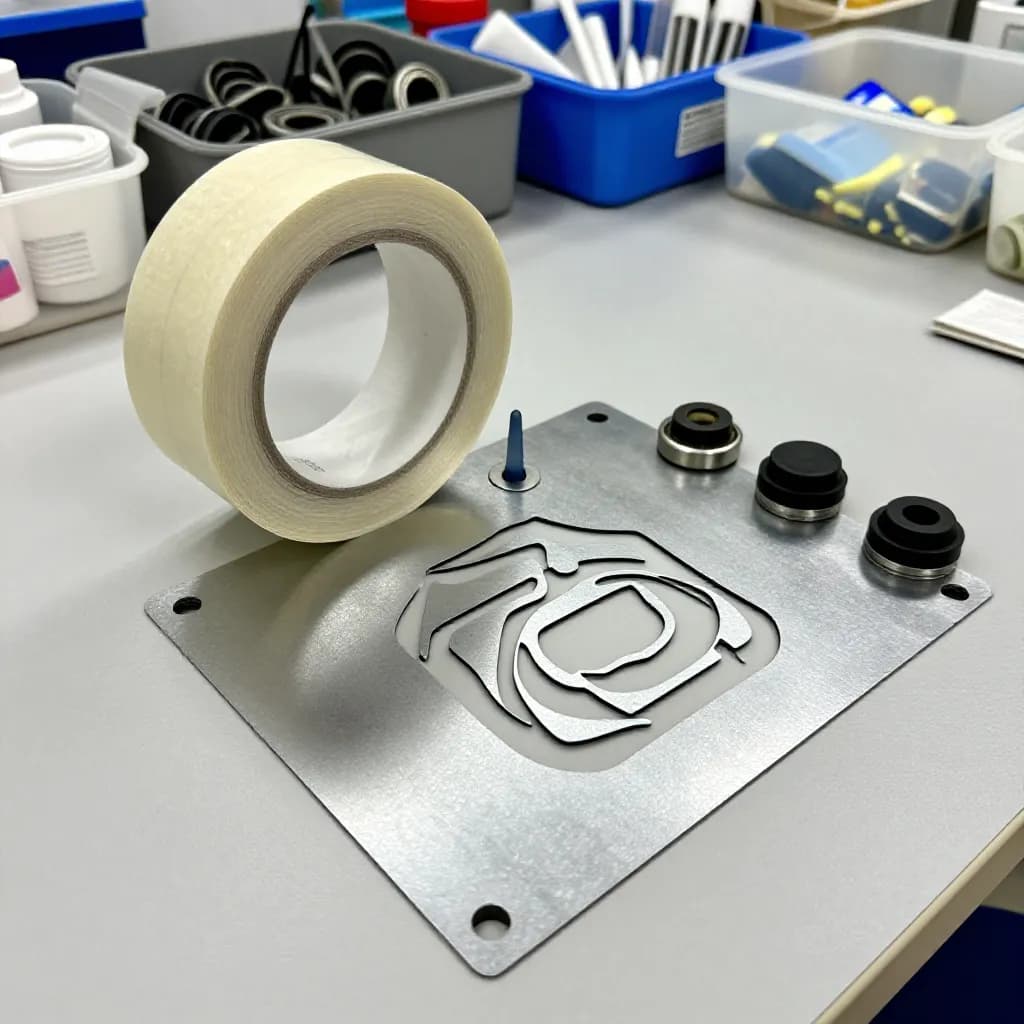
The challenge of powder coating masking goes beyond simple temperature resistance. Electrostatically charged powder particles are attracted to any grounded metal surface, including areas adjacent to masked regions. This means masking must create a clean, defined boundary that prevents powder from migrating under the mask edge during application and curing. Poor masking results in ragged coating edges, powder contamination of protected surfaces, and costly rework.
Ready to Start Your Project?
From one-off customs to 15,000-part production runs — get precise pricing in 24 hours.
On This Page
Why Masking Is Critical in Powder Coating Operations
Masking is also one of the most labor-intensive steps in the powder coating process. On complex parts with multiple masked features, masking and demasking can account for 30-50% of the total processing time. Efficient masking strategies — including the right materials, standardized procedures, and purpose-built tooling — directly impact throughput, quality, and cost.
This guide covers the full range of masking materials and techniques used in production powder coating, from simple tape applications to custom-engineered masking fixtures for high-volume operations.
High-Temperature Masking Tapes
High-temperature masking tape is the most versatile and widely used masking material in powder coating. Several tape types are available, each suited to different applications and temperature requirements.
Polyester (PET) tape is the standard workhorse for powder coating masking. It withstands temperatures up to 204°C (400°F), resists powder adhesion, and removes cleanly without leaving adhesive residue. Available in widths from 3 mm to 50 mm, polyester tape is used for masking flat surfaces, creating straight-line boundaries, and protecting small features. Green polyester tape is the most common variety, though other colors are available for color-coding different masking requirements.
Polyimide (Kapton) tape handles higher temperatures — up to 260°C (500°F) — and is used for applications where standard polyester tape is at its limit, such as high-temperature cure powders or extended cure cycles. It is thinner than polyester tape, making it useful for masking tight tolerances, but it is significantly more expensive.
Crepe paper tape rated for high temperatures is used where conformability is more important than precision. It stretches and conforms to curved surfaces better than film tapes, making it useful for masking irregular shapes and compound curves. However, it does not produce as sharp a coating edge as film tapes and may leave slight adhesive residue at the upper end of its temperature range.
When applying masking tape, press the edges firmly to the substrate to prevent powder from migrating underneath. Burnish the tape edge with a plastic squeegee or fingernail to ensure full contact. On critical masking lines, apply the tape slightly beyond the intended boundary and trim to the exact line with a sharp blade. Overlapping tape strips should overlap by at least 5 mm to prevent gaps.
Silicone Plugs and Caps for Holes and Threads
Silicone plugs and caps are the standard solution for masking holes, threads, bores, and tubular features. Made from high-temperature silicone rubber, they withstand repeated exposure to curing temperatures up to 316°C (600°F) and can be reused hundreds of times before replacement, making them extremely cost-effective for production operations.
Tapered silicone plugs are the most common type, designed to fit a range of hole sizes with a single plug. The tapered shape allows the plug to be pushed into the hole until it seats firmly, creating a seal that prevents powder from entering the bore. Standard taper plugs are available in sizes from 1 mm to over 150 mm diameter. For threaded holes, the plug should seat below the surface to protect the full thread depth.
Silicone caps fit over external features such as studs, pins, and tube ends. Pull-tab caps have a protruding tab that makes removal quick and easy — an important consideration when demasking hundreds of parts per shift. Straight caps, tapered caps, and flanged caps are available to suit different feature geometries.
For high-volume production, custom-molded silicone plugs and caps can be manufactured to fit specific part features exactly. Custom masking eliminates the trial-and-error of finding standard plugs that fit and ensures consistent masking quality across production runs. The tooling cost for custom silicone molds is modest and is quickly recovered through reduced masking time and improved quality.
Silicone masking should be inspected regularly for wear, tearing, and powder buildup. Plugs that have become compressed, torn, or coated with cured powder should be replaced. Clean silicone masking periodically by soaking in a silicone-safe solvent or by burning off accumulated powder in the curing oven at the end of a production run.
Liquid Masking and Peelable Coatings
Liquid masking compounds — also called peelable masks or maskants — are applied as a liquid that dries to form a flexible film, withstands the curing process, and peels off cleanly after coating. They are particularly useful for masking large areas, irregular shapes, and surfaces that are difficult to cover with tape or plugs.
Water-based liquid masks are applied by brushing, dipping, or spraying and dry to form a rubbery film in 15-30 minutes at room temperature or faster with forced air drying. The dried film prevents powder from adhering to the masked surface during application and withstands curing temperatures up to 230°C. After curing, the mask peels off in a continuous sheet, leaving a clean, uncoated surface beneath.
The primary advantage of liquid masking is speed on large or complex areas. Masking an entire face of a large panel with tape requires cutting and applying multiple strips with careful alignment. The same area can be masked with liquid maskant in a fraction of the time by simply brushing or spraying the compound over the area to be protected.
Liquid masks also excel at masking irregular surfaces and complex geometries where tape cannot conform without wrinkling or lifting. Recessed areas, textured surfaces, and compound curves that would require extensive tape work can be quickly masked with a brushed or sprayed liquid application.
The limitations of liquid masking include longer preparation time due to drying requirements, less precise edge definition compared to tape, and higher material cost per square meter of masked area. Liquid masks also require more skill to apply at a consistent thickness — too thin and the mask may not peel cleanly; too thick and it wastes material and extends drying time. For most operations, liquid masking is best used in combination with tape and plugs rather than as a standalone solution.
Custom Masking Tooling and Fixtures
For high-volume production of parts with complex or repetitive masking requirements, custom masking tooling and fixtures offer significant advantages in speed, consistency, and cost over manual masking with tapes and plugs. A well-designed masking fixture can reduce masking time from minutes to seconds per part while eliminating operator variability.
Metal masking fixtures are typically fabricated from mild steel or aluminum and designed to clamp, clip, or magnetically attach to the part, covering the areas that must remain uncoated. The fixture surfaces that contact the part are often lined with high-temperature silicone or PTFE to prevent powder from bridging between the fixture and the part. Metal fixtures are durable and can process thousands of parts before requiring maintenance.
Magnetic masking uses flexible magnetic sheets or rigid magnetic blocks to cover flat ferrous surfaces. The magnetic attraction holds the mask firmly in place without clips or adhesive, and removal is instantaneous. Magnetic masks are particularly effective for masking large flat areas on steel parts, such as mating flanges or mounting surfaces. They are not suitable for non-ferrous substrates.
Three-dimensional printed masking tools have become increasingly practical as high-temperature 3D printing materials have improved. Parts can be printed in heat-resistant polymers that withstand curing temperatures, allowing rapid prototyping and production of complex masking shapes that would be expensive to machine from metal. This approach is particularly valuable for low-to-medium volume production where the cost of machined metal fixtures is difficult to justify.
When designing custom masking tooling, consider the thermal expansion of both the fixture and the part during curing. Fixtures that fit perfectly at room temperature may become too tight or too loose at 200°C, compromising the mask seal. Allow appropriate clearances and use compliant sealing materials at the mask-to-part interface to accommodate thermal movement.
Design Considerations: Reducing Masking Requirements
The most efficient masking is no masking at all. Designing parts to minimize or eliminate masking requirements can dramatically reduce processing time and cost while improving coating quality. This requires collaboration between the coating operation and the part designer early in the product development process.
Locating threaded holes on surfaces that will be machined after coating eliminates the need to mask those threads during the coating process. If the part design allows, threads can be tapped after coating rather than before, which also avoids the risk of thread damage during handling and blasting. Similarly, mating surfaces that require metal-to-metal contact can be machined to final dimension after coating, removing the coating from the contact area with precision.
Grouping features that require masking on one face or area of the part simplifies the masking process and reduces the number of individual masking operations. A part with masked features scattered across multiple surfaces requires more handling and more masking materials than a part where all masked features are concentrated in one area.
Using self-masking part features is another effective strategy. A bore that will receive a pressed-in bushing can be designed with a slight interference fit that allows the bushing to be installed before coating, effectively masking the bore with the functional component. Similarly, parts that assemble with overlapping joints can be coated before assembly, with the joint overlap covering any uncoated areas.
Specifying coating-compatible alternatives to bare metal requirements can also reduce masking. For example, if a ground path requires electrical conductivity, a conductive primer or a thin conductive coating may provide adequate conductivity without requiring a completely uncoated surface. Discuss these alternatives with the coating supplier and the end-use engineer to identify opportunities.
Masking Process Control and Quality Verification
Consistent masking quality requires standardized procedures, trained operators, and systematic verification. In production environments, masking is often performed by the least experienced operators, which makes clear work instructions and quality checks especially important.
Create masking maps — drawings or photographs showing exactly which areas of each part require masking, what masking materials to use, and the acceptable tolerance for mask placement. These visual aids should be posted at the masking station and updated whenever the part design or masking requirements change. Color-coded masking materials can help operators quickly identify which mask goes where on complex parts.
Verify masking before parts enter the powder booth. A quick visual inspection at this stage catches missing plugs, lifted tape edges, and incorrectly placed masks before they become coating defects. This inspection takes seconds per part and prevents minutes or hours of rework. On critical parts, use a checklist to confirm that every masked feature has been addressed.
After coating and curing, verify demasking quality. Confirm that all masking materials have been removed, that masked surfaces are clean and free of powder contamination, and that the coating edge at the mask boundary is clean and well-defined. Powder that has migrated under the mask edge should be removed by scraping or light sanding before the part is released.
Track masking-related defects as a separate category in your quality data. If masking defects are a significant contributor to overall reject rates, investigate the root causes — inadequate materials, unclear instructions, insufficient training, or unrealistic production rates that pressure operators to rush the masking process. Addressing masking quality systematically often yields significant improvements in overall coating quality and throughput.
Frequently Asked Questions
What temperature can powder coating masking tape withstand?
Standard green polyester masking tape withstands up to 204°C (400°F), which is sufficient for most powder coating cure cycles. Polyimide (Kapton) tape handles up to 260°C (500°F) for high-temperature cure powders. Always verify the tape rating matches your specific cure temperature and duration.
How many times can silicone plugs be reused?
Quality silicone plugs and caps can typically be reused several hundred times before they need replacement. Inspect them regularly for compression set, tearing, and powder buildup. Replace plugs that no longer seat firmly or that have visible damage that could compromise the mask seal.
When should you use liquid masking instead of tape?
Liquid masking is most effective for large areas, irregular surfaces, and complex geometries where tape cannot conform without wrinkling. It is faster than tape for covering large panels but provides less precise edge definition. Most operations use liquid masking in combination with tape and plugs for optimal results.
How do you prevent powder from getting under masking tape?
Press tape edges firmly to the substrate and burnish with a squeegee or fingernail to ensure full contact. On critical masking lines, apply tape slightly beyond the boundary and trim to the exact line with a sharp blade. Ensure the surface is clean and dry before applying tape — oil or moisture prevents proper adhesion.
Can you mask threads for powder coating?
Yes. Tapered silicone plugs are the standard solution for internal threads — push the plug into the threaded hole until it seats firmly below the surface. For external threads, silicone caps or high-temperature tape wrapped around the threads provide protection. For high volumes, consider tapping threads after coating instead.
Ready to Start Your Project?
From one-off customs to 15,000-part production runs — get precise pricing in 24 hours.