Color changes are one of the most time-consuming and quality-sensitive operations in a powder coating facility. Every trace of the previous color must be removed from the spray booth, guns, hoses, feed hoppers, and reclaim system before the new color can be applied. Even a few milligrams of contaminating powder — invisible to the naked eye — can produce visible specks in the new color that render parts unacceptable.
Guides
How to Do a Powder Coating Color Change: Booth Purge, Gun Cleaning, and Contamination Prevention
Sundial Powder Coating·April 22, 2026·13 min
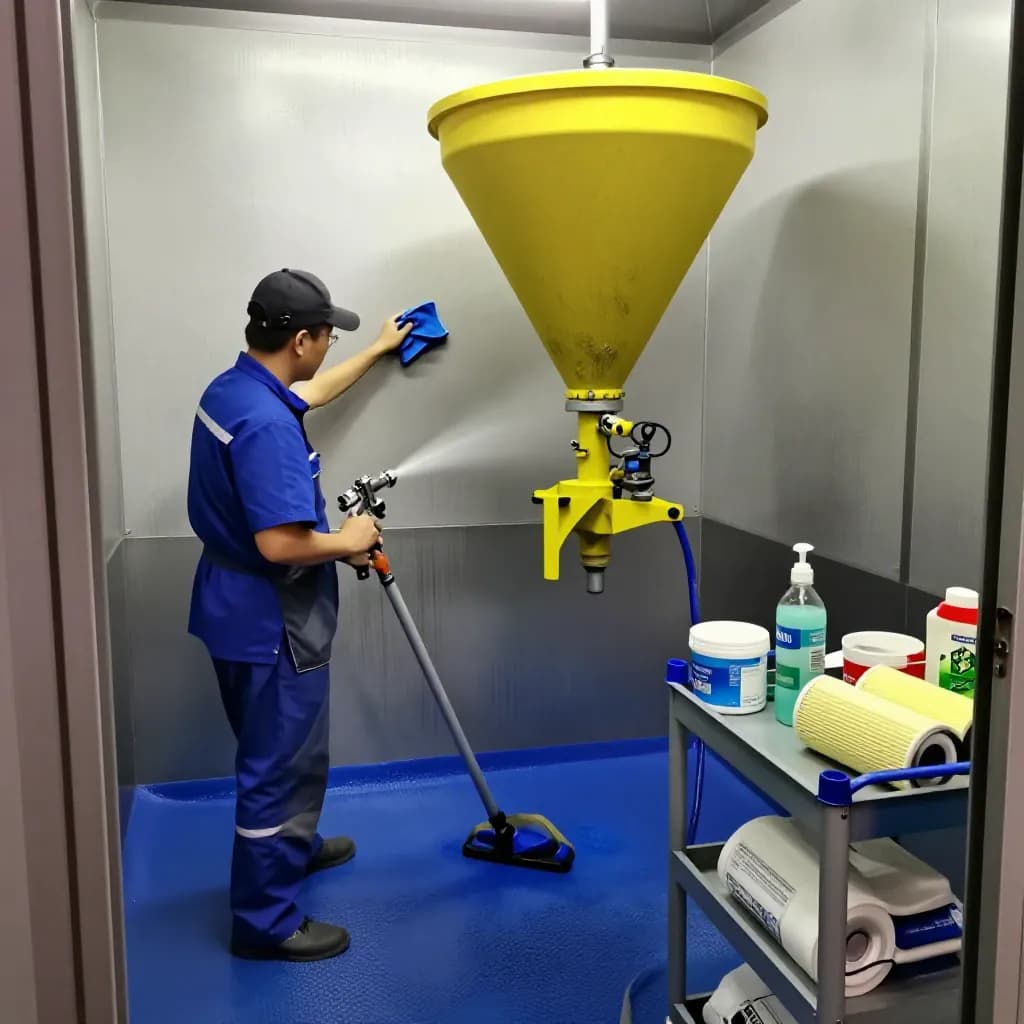
The cost of color changes goes beyond the direct labor time for cleaning. During the changeover, the coating line is not producing finished parts, so throughput is lost. Powder remaining in the system from the previous color is either wasted or must be carefully collected and returned to its original container. The first parts coated after a color change carry a higher risk of contamination defects, requiring closer inspection and potentially higher reject rates.
Ready to Start Your Project?
From one-off customs to 15,000-part production runs — get precise pricing in 24 hours.
On This Page
Why Color Changes Are a Critical Production Challenge
For job shops that coat many different colors in small batches, color changes can consume 20-30% of total production time. Reducing color change time and improving changeover quality are among the highest-impact process improvements available to these operations. Even high-volume operations that run fewer color changes benefit from efficient, systematic changeover procedures.
This guide covers the complete color change process from start to finish, including booth purging, gun and hose cleaning, reclaim system management, and strategies for minimizing changeover time while maintaining contamination-free quality.
Planning and Scheduling Color Changes
Effective color change management starts with production scheduling, not with the cleaning process itself. Thoughtful scheduling can reduce the number of color changes required and sequence them to minimize contamination risk and cleaning effort.
Group orders by color whenever possible. Running all parts of the same color consecutively eliminates color changes between those orders. This seems obvious, but many operations schedule by customer or due date rather than by color, resulting in unnecessary changeovers. A scheduling system that balances delivery requirements with color grouping can significantly reduce total changeover time.
Sequence colors from light to dark when multiple color changes are unavoidable. A small amount of white powder contaminating a black coating is virtually invisible, but a small amount of black powder in a white coating is immediately obvious. By running light colors first and progressing to darker colors, the consequences of residual contamination are minimized. Similarly, run metallics and textures after smooth solid colors, as these specialty powders are more difficult to clean from the system completely.
Schedule the most contamination-sensitive colors — whites, light grays, and bright yellows — at the start of the production day or immediately after a thorough deep cleaning. These colors show contamination most readily and benefit from the cleanest possible system state.
Estimate the changeover time for each color transition and include it in the production schedule. A change from white to black may take 15 minutes, while a change from black to white may take 45 minutes or more due to the higher cleaning standard required. Accurate changeover time estimates prevent schedule overruns and the pressure to rush cleaning that leads to contamination defects.
Booth Purging and Cleaning Procedures
The spray booth is the largest surface area that must be cleaned during a color change. Powder from the previous color settles on booth walls, floor, ceiling, light fixtures, gun mounts, and any other surface inside the booth. All of this powder must be removed before the new color is introduced.
Start by turning off the powder feed and running the booth exhaust system for 2-3 minutes to clear airborne powder from the booth atmosphere. This initial purge removes the bulk of the suspended powder and reduces the amount that settles on surfaces during the cleaning process.
Blow down all booth surfaces with clean, dry compressed air, working from top to bottom so that dislodged powder falls downward and is captured by the booth floor or exhaust system. Pay particular attention to horizontal surfaces, ledges, light fixtures, gun mounts, and any recesses where powder accumulates. Use a flexible air lance to reach behind equipment and into corners that are not accessible with a standard air nozzle.
After the initial blowdown, wipe all booth surfaces with clean, lint-free cloths. Disposable non-woven wipes are preferred over reusable cloths because they eliminate the risk of cross-contamination from previous cleaning cycles. Wipe in one direction — do not scrub back and forth, which can spread contamination rather than removing it.
The booth floor requires special attention. Powder accumulates in floor joints, around drain covers, and in the tracks of any moving equipment. Vacuum the floor with an industrial vacuum equipped with a HEPA filter, then wipe with clean cloths. If the booth has a raised floor or grating, clean both the grating surface and the area beneath it.
After cleaning, perform a visual inspection of all booth surfaces under good lighting. Any visible powder residue must be removed before proceeding. On critical color changes — particularly when changing to white or light colors — some operations run a sacrificial panel through the booth and inspect it for contamination specks before starting production parts.
Gun, Hose, and Feed System Cleaning
The powder delivery system — feed hopper, pump, hoses, and gun — contains the highest concentration of residual powder and requires thorough cleaning to prevent contamination. The cleaning procedure depends on the equipment type, but the principles are the same: remove all powder from every surface that contacts the powder stream.
Start by emptying the feed hopper and returning the remaining powder to its original container. Use a dedicated scoop or vacuum for each color to prevent cross-contamination during powder recovery. Wipe the hopper interior with clean cloths, paying attention to the fluidizing plate, level sensors, and any internal baffles. Blow out the hopper with compressed air to remove powder from crevices and fittings.
Disconnect the powder hoses from the gun and the feed unit. Blow compressed air through each hose from both ends to dislodge powder clinging to the interior walls. For stubborn buildup, use a foam cleaning projectile (pig) pushed through the hose with compressed air. Inspect the hose interior by holding it up to a light source — any visible powder residue requires additional cleaning.
Disassemble the powder gun to the extent recommended by the manufacturer. Remove the nozzle, deflector, electrode assembly, and any internal components that contact the powder stream. Clean each component individually with compressed air and clean cloths. Inspect the electrode and charging components for powder buildup that could affect charging performance. Reassemble the gun with clean components.
The powder pump — whether venturi, dense phase, or peristaltic — must be cleaned according to the manufacturer's procedure. Venturi pumps are typically cleaned by running compressed air through the pump with the powder inlet disconnected. Dense phase pumps may require disassembly of the powder chamber. Follow the manufacturer's cleaning procedure exactly to avoid damaging pump components.
Reclaim System Management During Color Changes
The powder reclaim system — cyclone separators, cartridge filters, and reclaim hoppers — presents the greatest challenge during color changes because these components handle large volumes of overspray powder and are difficult to clean completely. How the reclaim system is managed during color changes has a major impact on changeover time and contamination risk.
The simplest approach is to operate in waste mode during color changes — directing all overspray to waste rather than reclaiming it. This eliminates the need to clean the reclaim system between colors but wastes the overspray powder, which can represent 30-50% of the total powder sprayed. This approach is economical only for small batch sizes where the cost of wasted powder is less than the cost of cleaning the reclaim system.
For operations that reclaim powder, the reclaim system must be cleaned during every color change. Cyclone separators should be blown out with compressed air and wiped clean. Cartridge filters should be pulsed clean with compressed air and inspected for residual powder. If the filters cannot be cleaned adequately, dedicated filter cartridges for each color may be necessary — this adds cost but eliminates filter-related contamination.
Quick-change reclaim systems are designed specifically to minimize color change time. These systems use modular reclaim hoppers and filter modules that can be swapped out as complete units, replacing a dirty module with a clean one in minutes rather than cleaning in place. The dirty modules are cleaned offline while production continues with the new color. Quick-change systems require a higher initial investment but dramatically reduce changeover time for operations with frequent color changes.
Reclaim powder from the previous color should be collected, labeled, and stored properly for future use. Do not mix reclaim powder from different colors or different powder types. Store reclaim powder in sealed containers with clear labels indicating the color, powder type, batch number, and date collected. Reclaim powder can be blended back into virgin powder at ratios of 20-30% for most applications, but it should be sieved to remove any agglomerates or contaminants before reuse.
Contamination Prevention and Quality Verification
Preventing contamination during and after a color change requires attention to details that are easy to overlook in the pressure of production. Establishing and following a standardized changeover checklist ensures that no steps are missed.
Dedicated equipment for each color eliminates the most common contamination sources. Separate feed hoppers, hoses, and gun components for each frequently used color avoid the need to clean these items during changeovers. The investment in duplicate equipment is quickly recovered through reduced changeover time and lower reject rates. At minimum, maintain separate fluidizing hoppers for the most contamination-sensitive colors (whites and light colors).
Personal contamination is an often-overlooked source. Operators' gloves, sleeves, and aprons accumulate powder during spraying. If the same operator performs the color change and then sprays the new color without changing gloves and cleaning their clothing, they can transfer contamination from the previous color. Provide clean gloves for each color change and require operators to brush or blow off their clothing before handling the new color.
Air supply contamination can occur if the compressed air system contains powder residue from the booth exhaust. Ensure that the compressed air intake is located away from the booth exhaust outlet and that the air supply includes adequate filtration. Moisture in the compressed air can also cause powder to clump and stick to surfaces, making cleaning more difficult — maintain the air dryer and drain moisture traps regularly.
Verify the color change quality before starting production parts. Spray a test panel or sacrificial part and inspect it carefully for contamination specks under good lighting. Examine both the coated surface and the cured film — some contamination is only visible after curing when the contrasting color particles melt and spread. If contamination is found, identify the source, clean it, and test again before proceeding to production.
Reducing Color Change Time: Advanced Strategies
Beyond the basic cleaning procedures, several advanced strategies can significantly reduce color change time for operations where changeover frequency is high.
Smooth, non-stick booth surfaces reduce cleaning time because powder does not adhere as tenaciously. Polypropylene and polyethylene booth liners can be wiped clean in a fraction of the time required for bare metal or painted booth surfaces. Some operations use disposable booth liners — plastic sheeting that is removed and replaced during each color change, eliminating the need to clean the booth walls entirely.
Automatic gun cleaning systems purge the gun, hose, and pump with compressed air at the push of a button, reducing the manual cleaning time for the powder delivery system. These systems are standard on many modern automatic coating lines and are available as retrofits for manual operations. Automatic cleaning typically achieves adequate cleanliness in 2-5 minutes compared to 10-15 minutes for manual cleaning.
Color-dedicated spray booths eliminate color changes entirely for high-volume colors. If 60% of production is in one color, a dedicated booth for that color allows it to run continuously while a second booth handles the remaining colors with changeovers. The capital cost of a second booth is justified when the throughput gain from eliminating changeovers on the primary color exceeds the cost of the additional equipment.
Standardize the changeover procedure with a written checklist and time each step. Identify the steps that take the longest and focus improvement efforts on those steps. Often, simple changes — relocating cleaning supplies closer to the booth, pre-staging the next color's powder and equipment, or assigning specific cleaning tasks to specific team members — can reduce changeover time by 20-30% without any capital investment.
Track color change time and contamination reject rates as key performance indicators. Set targets for both metrics and review performance regularly. Operations that measure and manage color change performance consistently achieve shorter changeover times and lower contamination rates than operations that treat color changes as an unavoidable disruption.
Frequently Asked Questions
How long does a powder coating color change take?
A typical color change takes 15-45 minutes depending on the direction of change, equipment type, and cleaning thoroughness required. Light-to-dark changes are faster than dark-to-light. Operations with quick-change reclaim systems and dedicated equipment can achieve changeovers in 10-15 minutes. Manual cleaning of a full reclaim system may take 30-60 minutes.
Should you run colors light to dark or dark to light?
Always sequence from light to dark when possible. A small amount of light powder contaminating a dark coating is virtually invisible, but dark powder in a light coating is immediately obvious. This sequencing minimizes the visual impact of any residual contamination and reduces the cleaning standard required between colors.
Can you reclaim powder during color changes?
During the actual changeover, most operations run in waste mode to avoid contaminating the reclaim system. After the changeover is complete and the new color is running, reclaim can be resumed. Reclaim powder from the previous color should be collected, labeled, and stored separately for future reuse at 20-30% blend ratios with virgin powder.
How do you verify a color change is clean?
Spray a test panel or sacrificial part after cleaning and inspect it carefully for contamination specks under good lighting. Examine both the uncured and cured coating — some contamination is only visible after curing. If specks are found, identify the source, clean it, and test again before starting production parts.
What causes contamination specks after a color change?
Common sources include residual powder in gun components, hoses, feed hoppers, reclaim filters, booth corners, and floor joints. Operator gloves and clothing can also transfer powder. Less obvious sources include compressed air lines, booth lighting fixtures, and conveyor components that pass through the booth. A systematic checklist helps identify and eliminate all sources.
Ready to Start Your Project?
From one-off customs to 15,000-part production runs — get precise pricing in 24 hours.