Curing is the chemical reaction that transforms loose powder particles into a continuous, cross-linked film with the mechanical, chemical, and aesthetic properties specified by the powder manufacturer. Under-cured powder coating looks normal but lacks the hardness, adhesion, chemical resistance, and weathering performance of a properly cured film. Over-cured powder coating may discolor, become brittle, or lose gloss. Both conditions represent coating failures that may not be apparent until the part is in service.
Guides
How to Cure Powder Coating Properly: Oven Setup, Temperature Profiling, and Visual Indicators
Sundial Powder Coating·April 22, 2026·13 min
The curing process involves two distinct phases. First, the powder particles melt and flow together to form a continuous liquid film — this is the melt and flow phase, which occurs as the powder reaches its gel temperature, typically 60-100°C depending on the chemistry. Second, the liquid film undergoes a chemical cross-linking reaction that converts it from a thermoplastic melt into a thermoset solid — this is the cure phase, which requires the film to reach and maintain a specific temperature for a specific time.
Ready to Start Your Project?
From one-off customs to 15,000-part production runs — get precise pricing in 24 hours.
On This Page
Why Proper Curing Is Non-Negotiable for Powder Coating Performance
The cure schedule — the combination of temperature and time required for complete cross-linking — is specified by the powder manufacturer on the technical data sheet. A typical cure schedule might be 200°C for 10 minutes at metal temperature, meaning the metal substrate must reach 200°C and remain at or above that temperature for a full 10 minutes. This is the minimum requirement; the actual oven settings needed to achieve this metal temperature depend on the oven type, part mass, air circulation, and loading density.
This guide covers the practical aspects of achieving proper cure: oven setup, temperature profiling, understanding the difference between air temperature and metal temperature, and using visual indicators to verify cure quality.
Understanding Metal Temperature vs Air Temperature
The single most important concept in powder coating curing is the difference between air temperature and metal temperature. The cure schedule specified by the powder manufacturer refers to metal temperature — the actual temperature of the substrate — not the air temperature displayed on the oven controller. These two temperatures are not the same, and confusing them is the most common cause of under-cured powder coating.
When a cold part enters a hot oven, the air temperature in the oven may be 200°C, but the metal temperature starts at ambient and rises gradually as heat transfers from the oven air to the part. The rate of temperature rise depends on the part mass, thickness, geometry, and the oven's heat transfer characteristics. A thin sheet metal part may reach oven air temperature in 5-8 minutes, while a heavy casting or thick-walled tube may take 20-30 minutes or more.
The cure time clock does not start until the metal reaches the specified cure temperature. If the cure schedule is 200°C for 10 minutes and the part takes 15 minutes to reach 200°C, the total oven time must be at least 25 minutes — 15 minutes of heat-up plus 10 minutes of cure. Setting the oven timer for only 10 minutes would result in a severely under-cured coating because the metal never reached the cure temperature for the required duration.
Different areas of the same part may reach temperature at different rates. Thin flanges heat up faster than thick bosses; edges heat faster than centers of large panels; surfaces facing the heat source heat faster than shielded surfaces. The cure time must be based on the slowest-heating area of the part to ensure complete cure across the entire surface.
Oven Setup and Configuration
Powder coating ovens fall into two main categories: convection ovens that heat parts with circulating hot air, and infrared ovens that heat parts with radiant energy. Convection ovens are the most common type in general powder coating operations because they heat parts uniformly regardless of geometry and are relatively simple to operate and maintain. Infrared ovens offer faster heat-up times and lower energy consumption for flat parts but are less effective on complex three-dimensional geometries.
Convection oven setup starts with verifying uniform air temperature distribution throughout the oven chamber. Temperature variation across the oven should be within ±5°C of the setpoint at the cure temperature. Larger variations indicate problems with air circulation, burner output, or insulation that must be corrected before production. Use a multi-point temperature survey with calibrated thermocouples placed at multiple locations throughout the oven to verify uniformity.
Air circulation is critical for convection oven performance. The oven fans must move sufficient air volume to maintain uniform temperature and transfer heat efficiently to the parts. Blocked or restricted air passages, worn fan belts, and failed fan motors all reduce air circulation and create cold spots in the oven. Check air circulation patterns by observing the movement of lightweight streamers placed at various points in the oven chamber.
Oven loading density affects cure performance. Overloading the oven with too many parts or too much mass reduces the available heat energy per part and extends the time required for parts to reach cure temperature. Establish maximum loading limits based on temperature profiling data and do not exceed them. It is better to run two properly loaded batches than one overloaded batch that produces under-cured parts.
Temperature Profiling: The Definitive Cure Verification
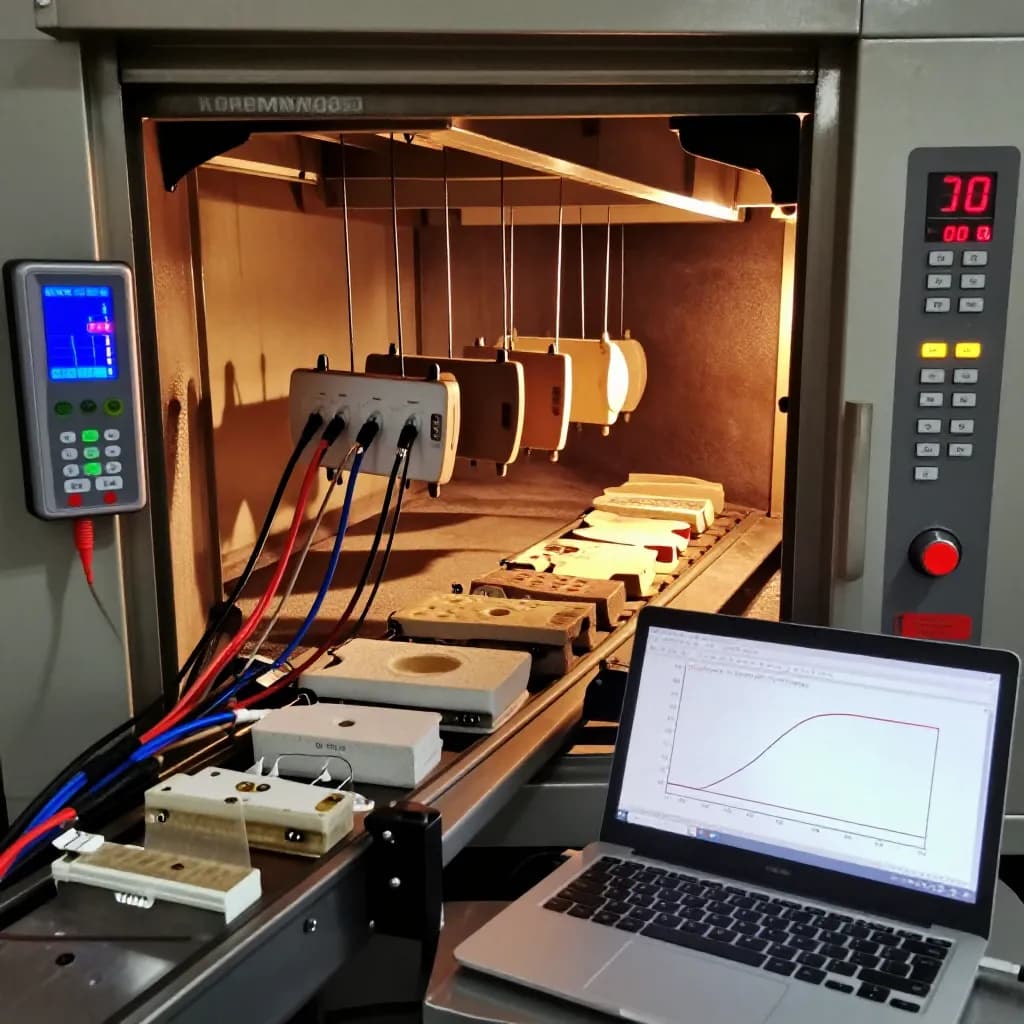
Temperature profiling is the process of measuring the actual metal temperature of parts as they pass through the curing oven, using thermocouples attached directly to the part surface and connected to a data logger that records temperature versus time throughout the cure cycle. This is the only reliable method for verifying that parts are receiving the correct cure schedule.
To perform a temperature profile, attach thermocouples to the part at locations representing the fastest-heating and slowest-heating areas. For a typical part, this means placing thermocouples on thin sections, thick sections, shielded areas, and exposed areas. Use high-temperature adhesive, magnetic mounts, or mechanical clips to secure the thermocouples — the attachment method must maintain good thermal contact with the metal surface throughout the cure cycle.
The data logger travels through the oven with the part, recording temperature data at intervals of 1-5 seconds. After the cycle, download the data and plot the temperature-time curves for each thermocouple location. The profile shows the heat-up rate, the time at which each location reaches the cure temperature, the duration at or above cure temperature, and the peak metal temperature.
Analyze the profile against the powder manufacturer's cure window — the range of temperature-time combinations that produce acceptable cure. Most powder manufacturers provide a cure window chart showing the minimum time required at each temperature. For example, a powder with a nominal cure of 200°C for 10 minutes might also achieve full cure at 190°C for 15 minutes or 210°C for 7 minutes. The profile data for the slowest-heating thermocouple must fall within this cure window.
Profile the oven whenever process conditions change: new part types, different loading patterns, oven maintenance, or seasonal temperature changes. Many quality systems require periodic profiling — quarterly or monthly — even when process conditions have not changed, to verify ongoing cure performance.
Cure Windows and the Time-Temperature Relationship
The cure reaction in thermoset powder coatings follows well-established chemical kinetics: higher temperatures accelerate the reaction, allowing shorter cure times, while lower temperatures slow the reaction, requiring longer times. This relationship is described by the cure window — a chart or table provided by the powder manufacturer showing the acceptable combinations of temperature and time.
A typical polyester powder might have a cure window ranging from 180°C for 20 minutes to 220°C for 5 minutes, with the nominal cure schedule of 200°C for 10 minutes falling in the middle. Operating within this window ensures that the cross-linking reaction reaches at least 95% completion, which is generally accepted as the threshold for full mechanical and chemical properties.
Operating below the cure window — either too low a temperature or too short a time — results in under-cure. Under-cured powder coating may appear normal visually but will have reduced hardness, adhesion, chemical resistance, and weathering performance. Under-cure can be detected by solvent rub testing (MEK rub test), where a cotton swab soaked in methyl ethyl ketone is rubbed against the coating surface. A fully cured coating resists the solvent with minimal softening or color transfer; an under-cured coating softens, smears, or transfers color within 20-30 double rubs.
Operating above the cure window — too high a temperature or too long a time — results in over-cure. Over-cured powder coating may show yellowing or discoloration, particularly in light colors and whites. The film may become brittle and lose flexibility, leading to cracking under impact or bending. Gloss levels may drop below specification. Over-cure is less common than under-cure but can occur when oven temperatures drift high or when parts are left in the oven beyond the intended cycle time.
The cure window concept also applies to multi-coat systems. When applying a second coat over a cured first coat, the total thermal exposure of the first coat includes both cure cycles. Ensure that the cumulative time at temperature does not push the first coat beyond its over-cure limit.
Visual Indicators of Cure Quality
While temperature profiling and solvent rub testing are the definitive methods for verifying cure, experienced powder coaters also use visual indicators to monitor cure quality during production. These visual cues provide real-time feedback that can catch problems before they affect an entire batch.
Gloss level is one of the most sensitive visual indicators of cure. Most powder coatings reach their specified gloss level only when fully cured. Under-cured coatings often appear slightly higher in gloss than the fully cured specification because the cross-linking reaction has not progressed far enough to develop the final surface texture. Over-cured coatings may show reduced gloss due to surface degradation. Comparing production parts against a known good reference panel under consistent lighting conditions can reveal cure variations.
Color consistency is another useful indicator, particularly for light colors and whites. Under-cured white powder may appear slightly chalky or have a different undertone than a fully cured sample. Over-cured whites and light colors show yellowing that is readily apparent when compared to a reference. Dark colors are less sensitive to cure-related color shifts but may show changes in metallic effect or texture.
Surface texture and flow provide additional clues. Powder coating that has not reached sufficient temperature to fully melt and flow will have a rough, grainy texture rather than the smooth, uniform surface of a properly cured film. This is a clear indication of severe under-cure — the powder never reached the melt and flow phase, let alone the cure phase. Conversely, a coating that appears excessively smooth or glossy on a textured powder may indicate over-cure, where extended time at temperature has allowed the texture to flow out.
These visual indicators are supplements to, not substitutes for, proper temperature profiling and testing. Use them as early warning signals during production, but always verify cure quality with objective measurements.
Troubleshooting Common Cure Problems
Inconsistent cure across parts in the same batch usually indicates temperature variation within the oven. Perform a multi-point temperature survey to identify hot and cold spots. Common causes include blocked air circulation paths, failed or unbalanced burners, damaged insulation, and overloaded oven conditions. Parts in cold spots receive less heat and may be under-cured while parts in hot spots are properly cured or over-cured.
Parts that profile correctly but fail solvent rub testing may have contamination issues rather than cure problems. Silicone contamination, residual pretreatment chemicals, or moisture on the surface before coating can interfere with the cross-linking reaction even when the correct temperature and time are achieved. Investigate the surface preparation and pretreatment process if cure failures occur despite correct thermal profiles.
Blistering during cure — bubbles that form in the coating as it melts and flows — is typically caused by outgassing from the substrate rather than a cure problem. Moisture trapped in pores, castings, or weld joints flashes to steam at oven temperatures and pushes through the melting powder film. The solution is to pre-bake parts at cure temperature before coating to drive off trapped moisture and gases. Parts that outgas should be baked until no further bubbling is observed, then cooled and coated.
Color shift between batches of the same powder may indicate cure variation rather than powder variation. Before investigating the powder supply, verify that the cure profile is consistent between batches. A 10°C difference in peak metal temperature or a 2-minute difference in time at temperature can produce visible color differences, particularly in heat-sensitive colors. Standardize the cure profile first, then investigate powder variation if the color shift persists.
Energy Efficiency and Oven Optimization
Curing ovens are the largest energy consumers in a powder coating operation, typically accounting for 60-70% of total energy use. Optimizing oven efficiency reduces operating costs and environmental impact without compromising cure quality.
Insulation condition directly affects energy consumption. Damaged, compressed, or missing insulation allows heat to escape from the oven shell, wasting energy and creating hot spots on the exterior that are also safety hazards. Inspect oven insulation annually and repair or replace damaged sections. Thermal imaging cameras make it easy to identify insulation failures — hot spots on the oven exterior indicate areas where heat is escaping.
Oven door seals and openings are major sources of heat loss. Conveyor openings, access doors, and inspection ports should be sealed as tightly as practical. Air curtains or vestibule sections at conveyor openings reduce heat loss while allowing parts to enter and exit the oven. Keep doors closed when not actively loading or unloading batch ovens.
Optimize the cure schedule to minimize energy use while maintaining full cure. If temperature profiling shows that parts are significantly over-cured — spending much more time at temperature than the minimum required — consider reducing the oven temperature or increasing the line speed. Even a 5°C reduction in oven temperature can produce meaningful energy savings over thousands of operating hours.
Schedule production to minimize the number of oven heat-up and cool-down cycles. Each cycle wastes the energy stored in the oven structure and insulation. Batch operations should be scheduled to run consecutive batches without cooling the oven between loads. Continuous conveyor operations are inherently more energy-efficient than batch operations because the oven maintains temperature continuously during production.
Frequently Asked Questions
What temperature do you cure powder coating at?
Most standard powder coatings cure at 180-200°C metal temperature for 10-20 minutes. The critical distinction is that this refers to the actual metal substrate temperature, not the oven air temperature. The oven must be set higher than the cure temperature to account for heat-up time, and total oven time must include both heat-up and cure duration.
How do you know if powder coating is fully cured?
The definitive test is the MEK solvent rub test — rub a cotton swab soaked in methyl ethyl ketone against the coating. Fully cured coating resists the solvent with minimal softening. Temperature profiling with thermocouples attached to the part provides objective verification that the cure schedule was achieved. Visual indicators like gloss and color consistency provide supplementary feedback.
What happens if powder coating is under-cured?
Under-cured powder coating may look normal but has reduced hardness, adhesion, chemical resistance, and weathering performance. It will soften and transfer color during a solvent rub test. Under-cured parts should be returned to the oven for additional cure time, though this may affect color and gloss on sensitive finishes.
What is the difference between air temperature and metal temperature?
Air temperature is what the oven controller displays. Metal temperature is the actual temperature of the part substrate, which lags behind air temperature during heat-up. A thin part may reach oven air temperature in 5-8 minutes, while a heavy part may take 20-30 minutes. The cure schedule always refers to metal temperature, not air temperature.
How often should you profile a powder coating oven?
Profile whenever process conditions change — new part types, different loading patterns, oven maintenance, or seasonal changes. Many quality systems require periodic profiling quarterly or monthly even without process changes. Always profile after oven repairs, burner adjustments, or fan maintenance to verify that cure performance has not been affected.
Ready to Start Your Project?
From one-off customs to 15,000-part production runs — get precise pricing in 24 hours.