Knowing how much powder coating is needed to coat a given quantity of parts is essential for purchasing, production planning, cost estimation, and waste management. Under-ordering powder causes production delays when material runs out mid-batch. Over-ordering ties up capital in excess inventory and risks powder degradation during extended storage. Inaccurate coverage estimates lead to incorrect job costing, which erodes profitability on under-estimated jobs and loses competitive bids on over-estimated ones.
Guides
How to Calculate Powder Coating Coverage: Specific Gravity, Transfer Efficiency, and Batch Estimation
Sundial Powder Coating·April 22, 2026·13 min
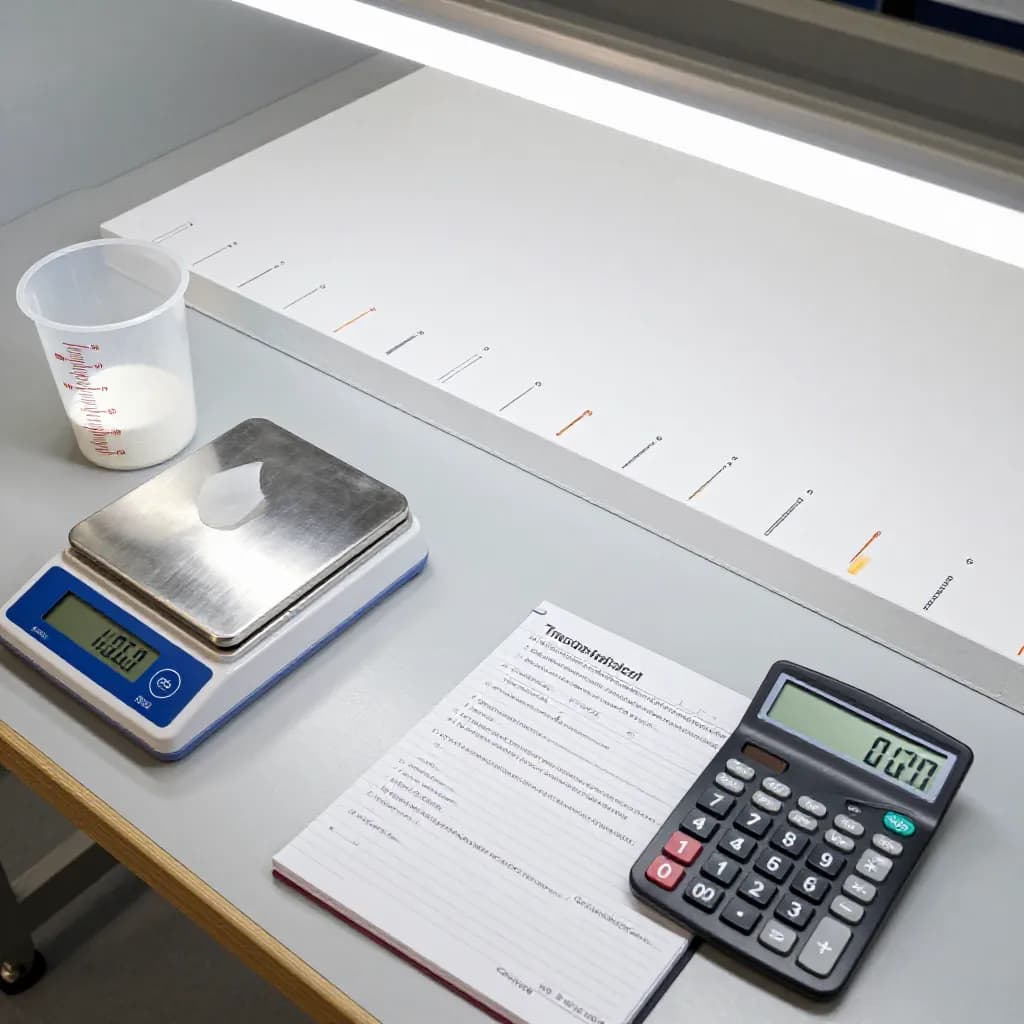
Coverage calculation in powder coating is more complex than simply dividing the total surface area by a coverage rate. The actual powder consumption depends on the theoretical coverage rate of the specific powder (determined by its specific gravity), the target film thickness, the transfer efficiency of the application system, the complexity of the part geometry, and the waste generated by color changes, startup and shutdown, and quality rejects.
Ready to Start Your Project?
From one-off customs to 15,000-part production runs — get precise pricing in 24 hours.
On This Page
Why Accurate Coverage Calculation Matters
Each of these factors can vary significantly between different powders, parts, and operations. A high-density powder covers less area per kilogram than a low-density powder at the same film thickness. A complex part with deep recesses consumes more powder per square meter than a flat panel because of the lower transfer efficiency in Faraday areas. An operation with frequent color changes wastes more powder in changeover cleaning than an operation running a single color.
This guide provides the formulas, factors, and practical methods for calculating powder coating coverage accurately, from the basic theoretical calculation through the real-world adjustments that account for actual production conditions.
Theoretical Coverage: The Starting Point
Theoretical coverage is the area that one kilogram of powder would cover at a given film thickness if 100% of the powder ended up on the part with no waste. It is the starting point for all coverage calculations and depends on only two variables: the specific gravity of the powder and the target film thickness.
The formula for theoretical coverage is:
Theoretical coverage (m²/kg) = 1000 / (specific gravity × film thickness in microns)
For example, a powder with a specific gravity of 1.5 applied at 70 microns film thickness has a theoretical coverage of:
1000 / (1.5 × 70) = 9.52 m²/kg
This means that one kilogram of this powder, if applied with zero waste, would cover 9.52 square meters at 70 microns thickness.
Specific gravity varies by powder type and color. Standard polyester powders typically have specific gravities of 1.3-1.6. Epoxy powders range from 1.4-1.7. Metallic and heavily pigmented powders can have specific gravities of 1.8 or higher due to the dense metallic pigments. White powders containing titanium dioxide (specific gravity 4.2) tend to have higher overall specific gravity than organic-pigmented colors. The specific gravity is listed on the powder manufacturer's technical data sheet.
Film thickness is specified by the coating specification and typically ranges from 60-80 microns for standard applications to 100-120 microns for heavy-duty industrial applications. Use the midpoint of the specified range for coverage calculations — if the specification calls for 60-80 microns, calculate at 70 microns.
Theoretical coverage provides the baseline, but actual powder consumption is always higher because no application process achieves 100% transfer efficiency. The real-world factors that increase consumption above the theoretical rate are addressed in the following sections.
Transfer Efficiency: The Biggest Variable
Transfer efficiency is the percentage of the powder sprayed that actually ends up on the part as cured coating. The remainder — overspray — either enters the reclaim system for reuse or is lost as waste. Transfer efficiency is the single largest factor affecting actual powder consumption and varies widely depending on the application method, part geometry, and operator skill.
First-pass transfer efficiency — the percentage of powder that adheres to the part on the first pass through the spray zone, before any reclaim — typically ranges from 40-70% for electrostatic spray application. Simple flat parts with good grounding achieve the higher end of this range. Complex parts with Faraday areas, poor grounding, or difficult geometries achieve the lower end.
With powder reclaim — collecting overspray and feeding it back into the application system — the effective transfer efficiency increases significantly. A well-designed reclaim system can recover 95-98% of the overspray, bringing the overall system transfer efficiency to 90-95% for operations running a single color. The remaining 5-10% is lost as waste in the reclaim system filters, during color changes, and as powder that degrades during recirculation.
Without reclaim — operating in waste mode, where all overspray is discarded — the transfer efficiency equals the first-pass efficiency, typically 40-70%. This is common during color changes, when running very small batches where reclaim setup is not justified, or when the powder type is not suitable for reclaim (some metallic and specialty powders degrade during recirculation).
For coverage calculations, use the following transfer efficiency estimates as starting points: 60% for complex parts without reclaim, 50% for very complex or Faraday-heavy parts without reclaim, 70% for simple flat parts without reclaim, 90% for simple parts with reclaim, and 85% for complex parts with reclaim. Refine these estimates based on actual consumption data from your operation as it becomes available.
The Complete Coverage Formula
Combining theoretical coverage with transfer efficiency gives the practical coverage rate — the actual area covered per kilogram of powder consumed under real production conditions.
Practical coverage (m²/kg) = Theoretical coverage × Transfer efficiency
Using the previous example of a powder with specific gravity 1.5 at 70 microns, with a transfer efficiency of 60% (complex parts, no reclaim):
Practical coverage = 9.52 × 0.60 = 5.71 m²/kg
To calculate the powder required for a specific job, divide the total surface area by the practical coverage rate:
Powder required (kg) = Total surface area (m²) / Practical coverage (m²/kg)
For example, to coat 100 parts with a total surface area of 200 m²:
Powder required = 200 / 5.71 = 35.0 kg
This is the net powder consumption for the coating operation itself. Additional powder must be added for waste factors that are not captured in the transfer efficiency calculation.
To convert the formula for those working in imperial units: Theoretical coverage in square feet per pound = 1604 / (specific gravity × film thickness in mils). The same transfer efficiency percentages apply.
For quick estimation without a calculator, a useful rule of thumb is that standard powder coatings (specific gravity approximately 1.5) at 70 microns with 60% transfer efficiency require approximately 175 grams per square meter of surface area. This rule of thumb is accurate enough for rough estimates and quick quotations, but should be replaced with the full calculation for precise material ordering.
Waste Factors: Accounting for Real-World Losses
Beyond the transfer efficiency losses during application, several additional waste factors increase the total powder consumption above the calculated practical coverage amount. These waste factors must be included in the total material estimate to avoid under-ordering.
Color change waste is the powder lost during booth and equipment cleaning between colors. The amount depends on the cleaning thoroughness, the equipment design, and the frequency of color changes. A typical color change wastes 0.5-2.0 kg of powder from the gun, hoses, feed hopper, and reclaim system. For operations with frequent color changes, this waste can be significant — 10 color changes per day at 1 kg per change is 10 kg of waste per day.
Startup and shutdown waste occurs at the beginning and end of each production run as the gun settings are adjusted and the first and last parts may not meet quality standards. Allow 0.5-1.0 kg per startup for gun purging and setting adjustment.
Quality reject waste is the powder consumed on parts that fail inspection and must be stripped and recoated or scrapped. If the reject rate is 5%, add 5% to the powder consumption estimate. Track reject rates by powder color and part type to refine this estimate.
Powder degradation waste occurs when reclaimed powder degrades through repeated recirculation — particle size changes, contamination accumulates, and charging properties deteriorate. Periodically, degraded reclaim powder must be discarded and replaced with virgin powder. The rate of degradation depends on the powder type and the reclaim system design, but allowing 2-5% waste for reclaim degradation is reasonable.
A practical total waste factor that accounts for all of these losses is typically 10-20% above the calculated practical coverage amount. For a new operation without historical data, use 15% as a starting estimate and refine based on actual consumption tracking.
Calculating Surface Area for Common Part Geometries
Accurate coverage calculation requires accurate surface area measurement. For simple geometric shapes, surface area can be calculated from dimensions using standard formulas. For complex parts, other methods are needed.
Flat panels: Surface area = length × width × 2 (for both sides) + perimeter × thickness (for edges). For panels coated on one side only, omit the factor of 2.
Cylindrical tubes: Surface area = π × diameter × length (for the outer surface). Add π × diameter × length for the inner surface if both sides are coated. Add 2 × π × (outer radius² - inner radius²) for the end faces if they are coated.
Box sections: Calculate the area of each face (top, bottom, front, back, left, right) and sum them. Include interior surfaces if they will be coated.
Angle and channel sections: Calculate the area of each flat surface and sum them. Include both sides of each flange and the web.
For complex fabricated parts that do not reduce to simple geometric shapes, several approaches can be used. CAD software can calculate the surface area of 3D models directly — this is the most accurate method if a CAD model is available. Weight-based estimation uses the relationship between part weight, material density, and average material thickness to estimate surface area: Surface area ≈ Weight / (density × average thickness). This method is approximate but useful for quick estimates.
For production operations coating the same parts repeatedly, measure the actual powder consumption on a known quantity of parts and calculate the actual coverage rate. This empirical approach accounts for all real-world factors — transfer efficiency, waste, and surface area — in a single measurement and is the most accurate method for ongoing production planning.
Batch Estimation and Material Ordering
Putting it all together, the complete batch estimation process follows these steps:
Step 1: Calculate the total surface area of all parts in the batch. Multiply the surface area per part by the number of parts. If the batch contains different part types, calculate each type separately and sum the totals.
Step 2: Determine the theoretical coverage rate for the specific powder being used. Look up the specific gravity on the technical data sheet and calculate using the formula: 1000 / (specific gravity × target film thickness in microns).
Step 3: Apply the transfer efficiency factor based on the part complexity and whether reclaim will be used. Multiply the theoretical coverage by the transfer efficiency to get the practical coverage rate.
Step 4: Calculate the net powder requirement by dividing the total surface area by the practical coverage rate.
Step 5: Add the waste factor — typically 10-20% — to account for color changes, startup/shutdown, rejects, and reclaim degradation.
Step 6: Add a safety margin of 5-10% to ensure you do not run short during production. Running out of powder mid-batch causes delays and may result in color variation if a different powder batch must be used to complete the job.
Example: 500 parts, each with 0.8 m² surface area (total 400 m²), powder specific gravity 1.4, target film thickness 70 microns, complex parts with reclaim (85% transfer efficiency), 15% waste factor, 10% safety margin.
Theoretical coverage = 1000 / (1.4 × 70) = 10.20 m²/kg Practical coverage = 10.20 × 0.85 = 8.67 m²/kg Net powder = 400 / 8.67 = 46.1 kg With waste factor = 46.1 × 1.15 = 53.0 kg With safety margin = 53.0 × 1.10 = 58.3 kg
Order 60 kg (rounding up to the nearest standard package size).
Track actual consumption against estimates for every batch. Over time, this comparison data allows you to refine your transfer efficiency and waste factor estimates for specific part types and powder colors, improving the accuracy of future estimates.
Tracking Consumption and Improving Efficiency
Accurate coverage calculation is not a one-time exercise — it is an ongoing process of estimation, measurement, comparison, and refinement. Tracking actual powder consumption against estimates provides the data needed to improve both the accuracy of future estimates and the efficiency of the coating operation itself.
Measure actual consumption for every batch by weighing the powder before and after the coating run. The difference — minus any powder returned to inventory — is the actual consumption. Divide by the total surface area coated to get the actual coverage rate in m²/kg. Compare this to the estimated coverage rate to identify discrepancies.
If actual consumption consistently exceeds estimates, investigate the cause. Common reasons include lower-than-assumed transfer efficiency (check gun settings, grounding, and operator technique), higher-than-assumed waste (check color change procedures, reject rates, and reclaim system performance), or inaccurate surface area calculations (verify with actual measurements or CAD data).
If actual consumption is consistently below estimates, the estimates are conservative — which is better than being short, but it means you are over-ordering powder and tying up capital in excess inventory. Adjust the transfer efficiency and waste factors in your calculations to match actual performance.
Transfer efficiency improvement is the most impactful way to reduce powder consumption. Even a 5% improvement in transfer efficiency — from 60% to 65%, for example — reduces powder consumption by approximately 8%. Strategies for improving transfer efficiency include optimizing gun settings (voltage, flow rate, and air pressure), improving part grounding, adjusting part orientation and spacing on the rack, and training operators in efficient application technique.
Reclaim system optimization also reduces consumption. Ensure the reclaim system is capturing the maximum amount of overspray, that the reclaimed powder is being blended back into the feed at the optimal ratio, and that the reclaim powder quality is being maintained through regular sieving and monitoring. A well-managed reclaim system can reduce net powder consumption by 30-40% compared to operating without reclaim.
Frequently Asked Questions
How do you calculate powder coating coverage per kilogram?
Theoretical coverage (m²/kg) = 1000 / (specific gravity × film thickness in microns). For example, a powder with specific gravity 1.5 at 70 microns covers 9.52 m²/kg theoretically. Multiply by transfer efficiency (typically 50-90%) for practical coverage. A standard powder at 60% efficiency covers approximately 5.7 m²/kg.
What is transfer efficiency in powder coating?
Transfer efficiency is the percentage of sprayed powder that ends up on the part as cured coating. First-pass efficiency is typically 40-70% depending on part complexity. With a reclaim system recovering overspray, overall efficiency reaches 85-95%. Transfer efficiency is the biggest variable in powder consumption calculations.
How much powder coating do you need per square meter?
As a rule of thumb, standard powder coatings (specific gravity ~1.5) at 70 microns with 60% transfer efficiency require approximately 175 grams per square meter. Actual consumption varies with powder density, film thickness, transfer efficiency, and waste factors. Calculate precisely using the specific gravity and transfer efficiency for your specific situation.
What waste factor should you add to powder coating estimates?
Add 10-20% above the calculated practical coverage to account for color change waste, startup/shutdown losses, quality rejects, and reclaim degradation. Use 15% as a starting estimate for new operations. Add an additional 5-10% safety margin to avoid running short. Refine these factors based on actual consumption tracking.
How does specific gravity affect powder coating coverage?
Higher specific gravity means denser powder that covers less area per kilogram at the same film thickness. A powder with specific gravity 1.8 covers 30% less area per kilogram than a powder with specific gravity 1.3 at the same thickness. Always use the actual specific gravity from the powder's technical data sheet, not a generic estimate.
Ready to Start Your Project?
From one-off customs to 15,000-part production runs — get precise pricing in 24 hours.