The story of powder coating begins in the aftermath of World War II, in a period of intense industrial innovation across Europe. Dr. Erwin Gemmer, a German scientist working on methods to apply thermoplastic resins to metal substrates, filed the first patent for a powder coating process in 1945. His method involved applying finely ground polymer powder to heated metal parts, where the powder would melt and fuse into a continuous film upon contact with the hot surface.
Reference
The History of Powder Coating Technology: From 1940s Origins to Modern Innovation
Sundial Powder Coating·April 23, 2026·12 min
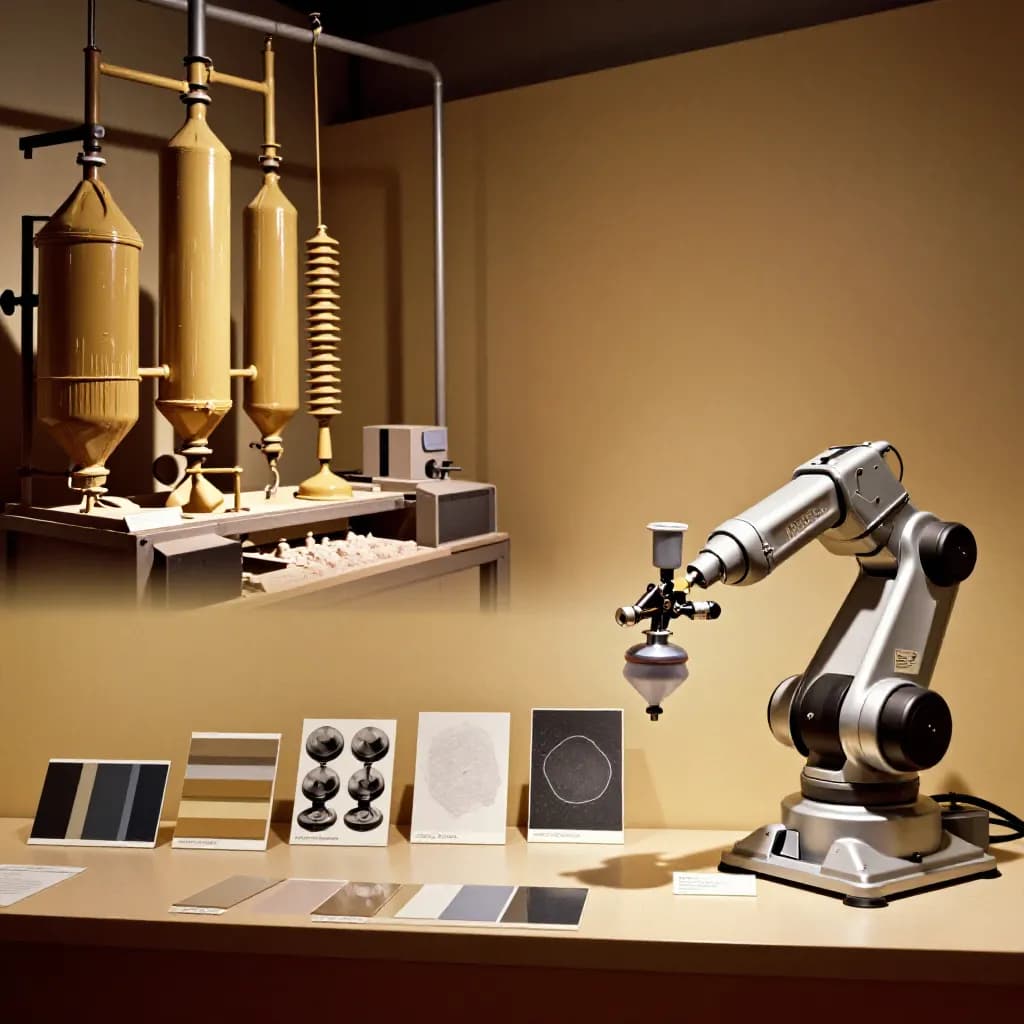
Gemmer's original process was relatively crude by modern standards. The powder particles were large and irregular, the application methods were imprecise, and the resulting coatings were thick and somewhat uneven. However, the fundamental insight — that dry polymer powder could replace liquid paint as a protective and decorative coating — was revolutionary. It eliminated the need for solvents entirely, addressing both the practical challenges of solvent handling and the environmental concerns that would become increasingly important in later decades.
Ready to Start Your Project?
From one-off customs to 15,000-part production runs — get precise pricing in 24 hours.
On This Page
The Origins of Powder Coating: 1940s Germany
The initial applications were limited to functional coatings where appearance was secondary to protection. Electrical insulation, pipe coatings, and industrial equipment were among the first commercial uses. The technology attracted attention from manufacturers who recognized the potential for reduced waste, simplified application processes, and improved worker safety compared to solvent-based liquid paints.
Gemmer's work laid the intellectual foundation for everything that followed in powder coating technology. While the specific methods he patented would be superseded within two decades, his core concept — applying dry powder to a substrate and fusing it through heat — remains the fundamental principle underlying all modern powder coating processes.
The Fluidized Bed Process: 1950s Breakthrough
The first major advancement beyond Gemmer's original concept came in the 1950s with the development of the fluidized bed coating process. This technique, pioneered in Germany and refined by researchers across Europe, involved suspending powder coating material in an upward-flowing stream of air within a tank or container. The air flow created a fluid-like bed of powder particles that behaved almost like a liquid.
In the fluidized bed process, metal parts were preheated to temperatures above the melting point of the powder — typically between 200°C and 400°C depending on the polymer — and then dipped into the fluidized powder bed. The hot metal surface caused the powder particles to melt on contact, building up a coating layer whose thickness was controlled by the temperature of the part and the duration of immersion. Thicker coatings could be achieved by increasing either variable.
This process represented a significant improvement over earlier methods because it provided more uniform coating coverage and better control over film thickness. The fluidized bed naturally distributed powder particles evenly around the immersed part, reducing the inconsistencies that plagued manual powder application methods. It was particularly well-suited to coating small parts, wire goods, and components that required thick protective coatings.
However, the fluidized bed process had inherent limitations. It required preheating parts to high temperatures, which consumed significant energy and limited the range of substrates that could be coated. The resulting coatings were typically 150-500 microns thick — far thicker than necessary for many decorative applications. And the process was difficult to apply to large or complex-shaped parts that could not be easily dipped into a powder bed. These limitations would drive the search for alternative application methods throughout the 1960s.
Electrostatic Spray: The 1960s Revolution
The development of electrostatic spray application in the early 1960s transformed powder coating from a niche industrial process into a versatile finishing technology capable of competing directly with liquid paint. The breakthrough came from Sames, a French company that adapted electrostatic principles already used in liquid paint spraying to the application of dry powder particles.
The electrostatic spray process works by charging powder particles as they pass through or near a high-voltage electrode at the tip of a spray gun. The charged particles are propelled toward a grounded workpiece by a combination of air flow and electrostatic attraction. The electrical charge causes the particles to adhere to the metal surface in a uniform layer, even wrapping around edges and into recesses to some degree. The coated part is then transferred to a curing oven where the powder melts, flows, and crosslinks into a continuous film.
This innovation solved several problems simultaneously. Parts no longer needed to be preheated, dramatically reducing energy consumption and expanding the range of substrates that could be coated. Film thickness could be precisely controlled in the 25-150 micron range, making powder coating suitable for decorative as well as functional applications. And the process could be applied to parts of virtually any size and shape, from small fasteners to large architectural panels.
The electrostatic spray process also introduced the possibility of powder reclamation. Overspray powder that did not adhere to the workpiece could be collected, sieved, and reused, achieving material utilization rates of 95-98%. This efficiency advantage over liquid paint — where overspray is typically lost as waste — became one of powder coating's most compelling economic and environmental arguments.
Thermoset Chemistry: 1970s and 1980s Advances
While the early decades of powder coating relied primarily on thermoplastic polymers — materials that melt and resolidify without chemical change — the 1970s and 1980s saw the rise of thermoset powder coatings that would come to dominate the industry. Thermoset powders undergo irreversible chemical crosslinking reactions during the curing process, creating a three-dimensional polymer network that is harder, more chemically resistant, and more durable than thermoplastic alternatives.
Epoxy powder coatings were among the first thermoset systems to achieve widespread commercial success. Developed in the late 1960s and refined throughout the 1970s, epoxy powders offered excellent adhesion, chemical resistance, and mechanical properties. They became the standard for functional protective coatings in industries ranging from pipeline protection to electrical insulation. However, epoxy coatings had a significant weakness: poor UV resistance that caused rapid chalking and color change when exposed to sunlight.
The introduction of polyester and polyester-epoxy hybrid powder coatings in the late 1970s and early 1980s addressed this limitation. Polyester powders, crosslinked with either TGIC (triglycidylisocyanurate) or HAA (hydroxyalkylamide) hardeners, offered dramatically improved weathering resistance while maintaining good mechanical properties. These formulations opened the door to exterior architectural applications, automotive components, and outdoor furniture — markets that had been inaccessible to epoxy-only systems.
Polyurethane and acrylic powder coatings followed, each offering specific performance advantages for particular applications. Polyurethane powders provided exceptional smoothness and chemical resistance, while acrylic systems delivered outstanding clarity and weathering performance for automotive clear coats. By the end of the 1980s, the powder coating industry had a comprehensive portfolio of resin chemistries capable of addressing virtually any performance requirement.
Automation and Quality Systems: 1990s Maturation
The 1990s marked the maturation of powder coating from an emerging technology into a mainstream industrial finishing process. This decade saw dramatic improvements in application equipment, curing technology, quality control systems, and industry standards that collectively raised the bar for coating performance and consistency.
Automatic spray systems with reciprocating or robotic gun movers replaced manual spraying in high-volume production environments. These systems used programmable gun positions, powder flow rates, and electrostatic settings to achieve consistent coating thickness across complex part geometries. Automatic color change systems reduced the time required to switch between powder colors from hours to minutes, making powder coating economically viable for short production runs and just-in-time manufacturing.
Infrared and combination IR/convection curing ovens were introduced alongside traditional convection ovens, offering faster cure times and reduced energy consumption. These advanced curing systems were particularly beneficial for heat-sensitive substrates and for production lines where floor space was limited. Near-infrared technology could cure powder coatings in seconds rather than minutes, enabling inline coating of continuous substrates such as coil and extrusion.
Quality certification systems gained widespread adoption during this period. Qualicoat, established in 1986, expanded its membership and tightened its specifications throughout the 1990s. GSB International and AAMA specifications similarly evolved to reflect advancing technology and rising performance expectations. These quality marks gave architects, engineers, and procurement professionals confidence that powder-coated products would meet defined performance standards, accelerating adoption in demanding applications such as architectural facades and automotive components.
The 1990s also saw the emergence of environmental regulations that favored powder coating over liquid paint. The US Clean Air Act amendments of 1990 and equivalent European directives imposed increasingly strict limits on VOC emissions from industrial coating operations, creating a powerful regulatory incentive for manufacturers to convert from liquid to powder.
The Digital Age: 2000s to 2010s Innovation
The first two decades of the twenty-first century brought digital technology, advanced materials science, and sustainability imperatives together to drive a new wave of powder coating innovation. Digital color matching systems, computerized process control, and data-driven quality management transformed the precision and repeatability of powder coating operations.
Low-temperature cure powder coatings emerged as a major development area, with formulations capable of curing at 140-160°C compared to the traditional 180-200°C range. These lower cure temperatures expanded the range of substrates that could be powder coated to include medium-density fiberboard (MDF), certain plastics, and heat-sensitive assemblies. The energy savings from reduced oven temperatures also improved the environmental and economic profile of powder coating operations.
Ultra-thin film powder coatings, capable of achieving smooth, uniform films at 30-50 microns, addressed one of the historical limitations of powder coating compared to liquid paint. These thin-film formulations, enabled by advances in powder particle size reduction and electrostatic application technology, made powder coating competitive in applications such as automotive body panels and consumer electronics housings where film smoothness and thinness were critical.
Sublimation transfer technology matured during this period, enabling photorealistic wood-grain, stone, and decorative patterns to be applied to powder-coated surfaces. This technology found particular success in architectural applications, where it allowed aluminum profiles to replicate the appearance of natural materials while retaining the durability and fire performance advantages of powder-coated metal.
Functional powder coatings with antimicrobial, anti-fingerprint, self-cleaning, and thermal-barrier properties were developed, expanding powder coating beyond its traditional role as a protective and decorative finish into the realm of performance-enhancing surface engineering.
Key Milestones and Turning Points
Looking back across eight decades of powder coating development, several milestones stand out as pivotal moments that shaped the trajectory of the technology. The Gemmer patent of 1945 established the foundational concept. The fluidized bed process of the 1950s proved commercial viability. Electrostatic spray application in the 1960s unlocked mass-market potential. And the thermoset chemistry revolution of the 1970s-1980s delivered the performance properties needed to compete with liquid paint in demanding applications.
The establishment of quality certification systems — Qualicoat in 1986, GSB International, and the AAMA specification framework — created the trust infrastructure that enabled powder coating to penetrate the architectural and automotive markets. Without independently verified performance standards, specifiers would have been reluctant to adopt a relatively new technology for high-value, long-life applications.
Environmental regulation proved to be one of the most powerful drivers of powder coating adoption. Each tightening of VOC emission limits made liquid paint more expensive and operationally complex, while powder coating's zero-VOC profile became an increasingly valuable competitive advantage. The Montreal Protocol, Clean Air Act, and European Solvents Directive all contributed to accelerating the shift from liquid to powder.
The global financial crisis of 2008-2009 paradoxically accelerated powder coating adoption in some sectors, as manufacturers sought to reduce material waste, energy consumption, and environmental compliance costs. Powder coating's superior material efficiency and simpler waste management requirements made it an attractive option for companies looking to reduce operating costs without sacrificing coating quality.
By 2020, the global powder coating market had grown to represent approximately 15% of all industrial coatings by volume, with significantly higher shares in specific segments such as architectural aluminum finishing, where powder coating accounts for over 90% of the market in many regions.
The Future of Powder Coating Technology
The next chapter of powder coating history is being written by converging trends in sustainability, digitalization, and advanced materials science. Several emerging technologies and market forces are likely to shape the industry's trajectory over the coming decades.
Bio-based and recycled-content powder coatings are under active development by major manufacturers and academic research groups. These formulations aim to replace petroleum-derived raw materials with renewable alternatives — plant-based polyesters, bio-sourced epoxies, and recycled polymer feedstocks — without compromising coating performance. As circular economy principles gain traction across manufacturing, the demand for sustainable coating materials will intensify.
UV-curable powder coatings represent another frontier, offering the possibility of near-instant curing at ambient or low temperatures using ultraviolet light rather than thermal energy. This technology could dramatically reduce energy consumption, enable powder coating of highly heat-sensitive substrates including plastics and composites, and increase production line speeds. While UV-cure powder technology has been under development for decades, recent advances in photoinitiator chemistry and UV lamp technology are bringing it closer to broad commercial viability.
Digital twin technology and artificial intelligence are beginning to transform powder coating process control. By creating virtual models of coating lines and using machine learning algorithms to optimize spray parameters, cure schedules, and quality inspection in real time, manufacturers can achieve unprecedented levels of consistency and efficiency. Predictive maintenance systems that anticipate equipment failures before they occur are reducing downtime and improving overall equipment effectiveness.
The integration of powder coating with additive manufacturing, advanced robotics, and Industry 4.0 principles points toward a future where coating operations are fully automated, data-driven, and seamlessly integrated into digital manufacturing ecosystems. From Gemmer's first patent to the smart factories of tomorrow, the evolution of powder coating technology reflects the broader arc of industrial innovation — a continuous journey from manual craft to precision engineering.
Frequently Asked Questions
Who invented powder coating?
Dr. Erwin Gemmer, a German scientist, filed the first patent for a powder coating process in 1945. His method involved applying finely ground polymer powder to heated metal parts, where the powder melted and fused into a continuous protective film. While his specific methods were later superseded, the core concept remains the foundation of all modern powder coating.
When did electrostatic powder coating begin?
Electrostatic spray application of powder coatings was developed in the early 1960s by Sames, a French company. This breakthrough allowed charged powder particles to be sprayed onto grounded metal parts without preheating, dramatically expanding the range of applications and making powder coating competitive with liquid paint for decorative finishes.
What was the fluidized bed coating process?
The fluidized bed process, developed in the 1950s, involved suspending powder in an upward-flowing air stream to create a fluid-like bed. Preheated metal parts were dipped into this bed, causing powder to melt on contact and form a coating. While effective for thick functional coatings, it was limited by the need for preheating and produced coatings too thick for many decorative applications.
How has powder coating technology changed since the 1990s?
Since the 1990s, powder coating has seen advances in automation, low-temperature cure formulations (140-160°C vs traditional 180-200°C), ultra-thin film technology (30-50 microns), sublimation transfer for decorative patterns, and digital process control. Functional coatings with antimicrobial and self-cleaning properties have also emerged.
What percentage of industrial coatings are powder coatings today?
Powder coatings represent approximately 15% of all industrial coatings by volume globally. However, in specific segments the share is much higher — powder coating accounts for over 90% of architectural aluminum finishing in many regions, reflecting its dominance in applications where durability and environmental performance are priorities.
Ready to Start Your Project?
From one-off customs to 15,000-part production runs — get precise pricing in 24 hours.