Liquid paint introduces fire risk at multiple stages of its lifecycle. During storage and handling, solvent-based liquid paints are classified as flammable materials requiring fire-rated storage facilities, spill containment, and separation from ignition sources. The solvents used in architectural liquid coatings — including xylene, toluene, methyl ethyl ketone, and various glycol ethers — have flash points well below ambient temperatures in warm climates, creating a persistent ignition hazard.
Architecture
Fire Safety: Why Powder Coating Is Safer Than Liquid Paint for Buildings
Sundial Powder Coating·April 20, 2026·8 min
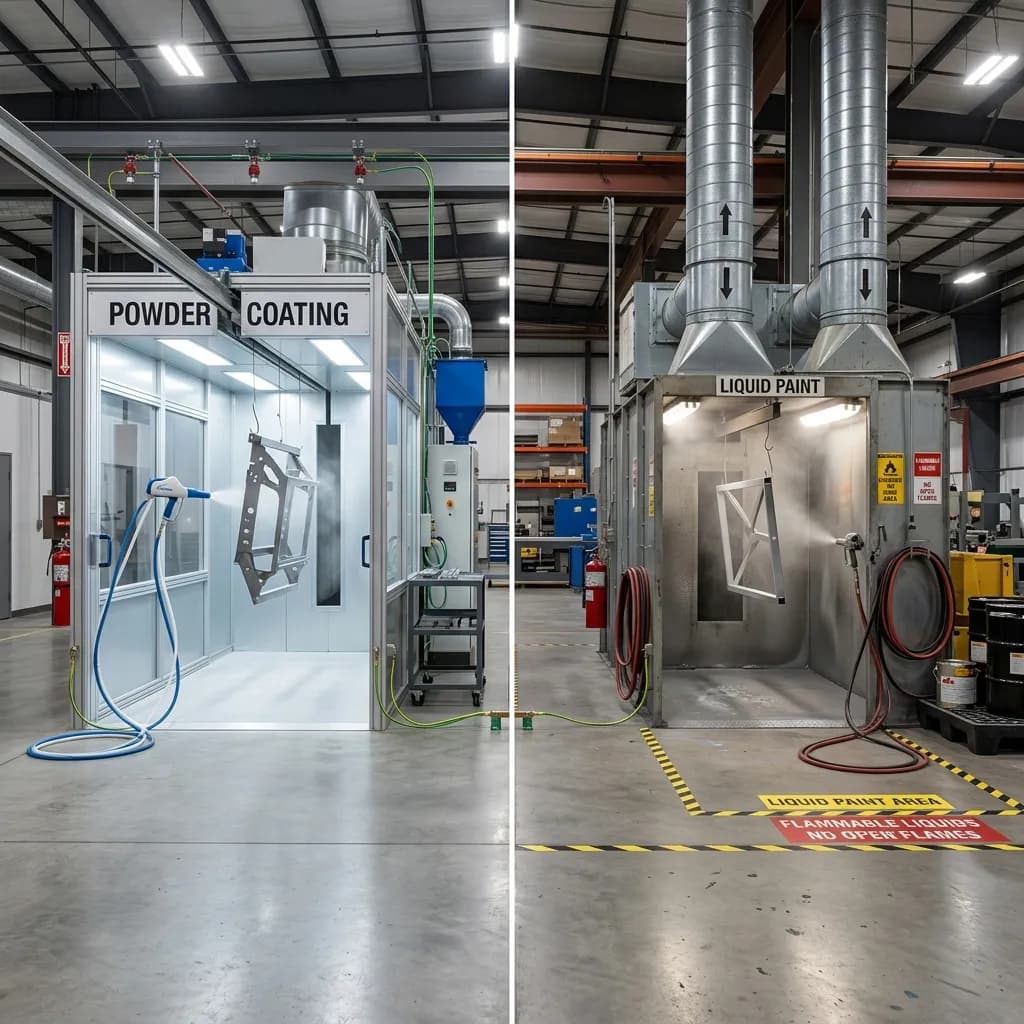
During application, liquid paint generates flammable vapor concentrations that can reach explosive levels in enclosed or poorly ventilated spray environments. Paint spray booths for liquid application must be equipped with explosion-proof electrical systems, continuous forced ventilation, fire suppression systems, and vapor monitoring equipment. Despite these precautions, paint booth fires and explosions remain a recognized industrial hazard.
Ready to Start Your Project?
From one-off customs to 15,000-part production runs — get precise pricing in 24 hours.
On This Page
The Fire Risk of Liquid Paint on Buildings
Even after application and curing, liquid paint can contribute to fire risk on the finished building. Thick accumulations of liquid paint on structural elements, combined with combustible substrates or insulation materials, can add to the fuel load in a fire scenario. The organic solvents retained in improperly cured coatings can also contribute to fire spread and toxic smoke generation.
How Powder Coating Eliminates Fire Risk
Powder coating fundamentally eliminates the fire risks associated with liquid paint. Because powder coatings contain no solvents, there are no flammable vapors during storage, handling, or application. Powder coating storage areas do not require fire-rated construction, and application booths do not need explosion-proof equipment or solvent vapor monitoring systems.
The powder coating application process uses electrostatic charging to deposit dry powder particles onto grounded metal substrates. While airborne powder concentrations must be managed to prevent dust accumulation, the ignition energy required for powder dust is substantially higher than for solvent vapors, and standard dust extraction and housekeeping practices effectively manage this risk. The overall fire risk profile of a powder coating facility is dramatically lower than that of a liquid paint operation.
On the finished building, powder-coated aluminum contributes virtually no fuel load. The cured powder film is a thin, fully cross-linked thermoset polymer that does not release flammable vapors when exposed to heat. Combined with the inherent non-combustibility of the aluminum substrate, this creates a facade system with the highest possible fire safety credentials.
Fire Classification: A1/A2 Euroclass vs Variable Liquid Ratings
The European fire classification system, defined by EN 13501-1, provides a clear framework for comparing the fire performance of building materials. Powder-coated aluminum consistently achieves A1 or A2 Euroclass ratings — the two highest classifications, indicating non-combustible or limited combustibility materials. This classification is achieved because the aluminum substrate is inherently non-combustible and the thin powder coating film contributes negligible additional fuel.
Liquid paint systems achieve variable fire classifications depending on the paint formulation, film thickness, substrate material, and overall system composition. While liquid-painted aluminum may achieve acceptable fire ratings, liquid-painted composite panels, timber cladding, and other combustible substrates may fall into lower Euroclass categories — C, D, or even E — indicating significant combustibility.
The distinction matters enormously for regulatory compliance. Building regulations in most jurisdictions now require non-combustible or limited combustibility materials for facades above certain heights, typically 11-18 meters depending on the country. Specifying powder-coated aluminum provides an unambiguous route to compliance with these requirements, while liquid-painted systems on some substrates may require additional fire testing, engineering assessments, or compensatory fire safety measures.
Post-Grenfell Regulations and Facade Safety
The Grenfell Tower fire in London in June 2017, which claimed 72 lives, triggered a fundamental reassessment of facade fire safety regulations worldwide. Investigations revealed that combustible cladding materials and inadequate fire testing contributed to the rapid fire spread that engulfed the building. The resulting regulatory reforms have had profound implications for facade material and coating specification.
In the United Kingdom, the Building Safety Act 2022 and updated Approved Document B now impose strict requirements on facade materials for buildings above 18 meters. Combustible materials are effectively banned from the external walls of high-rise residential buildings, and all facade systems must demonstrate compliance through large-scale fire testing to BS 8414 or achieve A1/A2 Euroclass classification.
Similar regulatory tightening has occurred across Europe, the Middle East, and Australasia. The common thread is a move toward non-combustible facade systems with independently verified fire performance. Powder-coated aluminum meets these requirements inherently, without the need for system-specific fire testing or reliance on particular combinations of materials. This regulatory alignment has further strengthened the position of powder coating as the preferred facade finishing technology.
Insurance and Liability Implications
The fire performance of facade materials has become a significant factor in building insurance underwriting. Following Grenfell and other high-profile facade fires, insurers have increased scrutiny of cladding and coating systems, with some refusing to provide cover or imposing substantial premium increases for buildings with combustible facade materials.
Buildings with powder-coated aluminum facades benefit from straightforward insurance assessments. The A1/A2 non-combustible classification provides clear evidence of low fire risk, simplifying the underwriting process and supporting competitive premium rates. Building owners and developers who specify powder-coated aluminum can demonstrate due diligence in fire safety, reducing their exposure to liability claims.
Liquid-painted facades on combustible substrates face a more challenging insurance landscape. Insurers may require detailed fire engineering reports, remediation plans, or interim fire safety measures before providing cover. In extreme cases, buildings with non-compliant cladding systems have been rendered effectively uninsurable, with devastating consequences for property values and building occupants.
Specifying Fire-Safe Coating Systems
Architects and specifiers can ensure fire-safe facade coatings by following a clear specification approach. First, specify aluminum or other non-combustible substrates for all facade elements. Second, require powder coating as the finishing system, with certification to Qualicoat, GSB, or AAMA standards. Third, require documentary evidence of Euroclass A1 or A2 fire classification for the complete coated system.
Avoid specification language that leaves the coating method open to interpretation. Generic references to painted aluminum or coated aluminum may allow liquid paint to be substituted, potentially compromising fire performance. Instead, explicitly specify powder-coated aluminum and require that the coating applicator holds current quality certification.
For projects where fire safety is a primary concern — high-rise residential buildings, hospitals, schools, and public assembly buildings — consider requiring the coating applicator to provide a fire safety declaration confirming the Euroclass rating of the finished product. This documentation provides an auditable record of fire safety compliance that protects the specifier, the building owner, and the building occupants throughout the life of the building.
Frequently Asked Questions
What Euroclass fire rating does powder-coated aluminum achieve?
Powder-coated aluminum achieves A1 or A2 Euroclass fire ratings under EN 13501-1, classifying it as non-combustible or limited combustibility. This is the highest fire classification available and meets the requirements of post-Grenfell building regulations for facades above 18 meters in most jurisdictions.
Is liquid paint a fire hazard during application?
Yes. Solvent-based liquid paints generate flammable vapors during application that can reach explosive concentrations in spray booths. This requires explosion-proof electrical equipment, continuous ventilation, fire suppression systems, and vapor monitoring. Powder coating eliminates these hazards entirely because it contains no solvents.
How did the Grenfell Tower fire change coating specifications?
The Grenfell fire led to regulatory reforms requiring non-combustible facade materials on high-rise buildings. The UK Building Safety Act 2022 and similar regulations worldwide now effectively mandate A1 or A2 Euroclass materials for facades above certain heights. Powder-coated aluminum meets these requirements inherently, strengthening its position as the preferred facade finish.
Does facade coating type affect building insurance?
Yes. Insurers now scrutinize facade materials closely, with combustible cladding and coating systems potentially leading to higher premiums, coverage restrictions, or refusal to insure. Powder-coated aluminum with A1/A2 Euroclass classification simplifies insurance assessments and supports competitive premium rates due to its proven non-combustible performance.
Ready to Start Your Project?
From one-off customs to 15,000-part production runs — get precise pricing in 24 hours.