Epoxy powder coatings are based on solid bisphenol-A epoxy resins — thermosetting polymers containing reactive oxirane (epoxide) groups that crosslink with various hardeners to form dense, highly adhesive, chemically resistant films. The most widely used epoxy resins in powder coatings are Type 1 (equivalent weight 450-550), Type 2 (equivalent weight 600-700), and Type 4 (equivalent weight 875-1000) solid epoxies, with the type number indicating increasing molecular weight and decreasing epoxide functionality.
Technical
Epoxy Powder Coatings as Primer Systems: FBE, Rebar, and Functional Applications
Sundial Powder Coating·April 22, 2026·14 min
The crosslinking chemistry of epoxy powder coatings is versatile, with multiple hardener options available to tailor cure behavior and final film properties. Dicyandiamide (DICY) is the most common hardener for general-purpose epoxy powder coatings, providing good chemical resistance and mechanical properties with cure temperatures of 180-200°C. Phenolic hardeners produce coatings with superior chemical and solvent resistance, making them preferred for aggressive chemical exposure environments. Anhydride hardeners offer excellent electrical insulation properties for electronics applications.
Ready to Start Your Project?
From one-off customs to 15,000-part production runs — get precise pricing in 24 hours.
On This Page
Epoxy Resin Chemistry in Powder Coatings
The adhesion of epoxy coatings to metal substrates is exceptional — among the best of any organic coating chemistry. This strong adhesion results from the polar nature of the epoxy resin, which forms hydrogen bonds and polar interactions with metal oxide surfaces, and from the hydroxyl groups generated during the epoxy-hardener reaction, which can form covalent bonds with metal substrates under appropriate conditions. This inherent adhesion advantage makes epoxy the preferred chemistry for primer applications where the coating-substrate bond is the critical performance factor.
However, epoxy coatings have a significant limitation: poor UV resistance. The bisphenol-A backbone absorbs UV radiation, leading to chain scission, chalking, and yellowing on exterior exposure. This UV sensitivity limits epoxy powder coatings to interior applications, primer layers protected by UV-resistant topcoats, or buried/immersed applications where UV exposure does not occur.
Epoxy as Architectural and Industrial Primer
In multi-coat architectural and industrial coating systems, epoxy powder coatings serve as the primer layer — the foundation that provides adhesion to the substrate, corrosion protection, and a bonding surface for the topcoat. This primer function leverages the two greatest strengths of epoxy chemistry: exceptional substrate adhesion and outstanding corrosion resistance, while the UV-resistant topcoat (typically polyester or fluoropolymer) protects the epoxy primer from photodegradation.
Architectural primer-topcoat systems are specified for demanding environments where single-coat polyester systems may not provide adequate corrosion protection. Coastal and marine environments, industrial zones with chemical pollutant exposure, and tropical climates with high humidity and temperature cycling all benefit from the additional corrosion barrier provided by an epoxy primer. Qualicoat Seaside certification, which qualifies coating systems for use within 1 km of the coastline, typically requires a primer-topcoat system with an epoxy or epoxy-polyester primer.
The primer film thickness in architectural systems is typically 20-40 microns, applied over a chromate-free pretreatment (chrome-free conversion coating or anodic oxidation). The topcoat is then applied at 40-80 microns over the cured or partially cured primer. Total system film thickness of 80-120 microns provides a robust multi-layer barrier against environmental degradation.
Industrial primer applications extend beyond architecture to include agricultural equipment, construction machinery, automotive components, and general industrial fabrication. In these applications, the epoxy primer provides corrosion protection and adhesion on steel substrates that may be blast-cleaned, phosphated, or mechanically prepared. The primer must tolerate the surface preparation variability inherent in industrial coating operations while still delivering reliable adhesion and corrosion performance.
Zinc-rich epoxy primers represent a specialized subcategory that combines the barrier protection of epoxy with the cathodic (sacrificial) protection of metallic zinc. These primers contain 70-85% zinc dust by weight in the dry film and provide galvanic corrosion protection similar to hot-dip galvanizing, with the additional benefits of controlled film thickness and compatibility with topcoat systems.
Fusion Bonded Epoxy for Pipeline Protection
Fusion bonded epoxy (FBE) is the dominant coating technology for corrosion protection of buried steel pipelines used in oil and gas transmission, water distribution, and industrial process piping. FBE coatings are single-layer epoxy powder coatings applied at 300-500 microns to preheated steel pipe, forming a dense, impermeable barrier that protects the steel from soil corrosion, groundwater, and cathodic disbondment.
The FBE application process is highly specialized. Steel pipe is first cleaned by abrasive blasting to near-white metal (SSPC-SP10/NACE No. 2) to achieve a surface profile of 50-100 microns. The cleaned pipe is then heated to 220-245°C using induction coils, and the FBE powder is applied by electrostatic spray or fluidized bed dipping. The powder melts on contact with the hot pipe surface, flows to form a continuous film, and cures rapidly due to the high substrate temperature. The entire application process — from blasting to cured coating — takes only minutes per pipe joint.
FBE formulations for pipeline use are specifically designed for the unique requirements of buried service. They must provide excellent wet adhesion — maintaining bond strength to the steel substrate even after prolonged immersion in water or exposure to soil moisture. Cathodic disbondment resistance is critical because pipelines are protected by cathodic protection (CP) systems that impose negative electrical potential on the steel, and the coating must resist the alkaline environment generated at the coating-steel interface by CP current.
The performance requirements for pipeline FBE are defined by standards including CSA Z245.20 (Canadian Standards Association), AWWA C213 (American Water Works Association), and ISO 21809-2 (International Organization for Standardization). These standards specify minimum requirements for adhesion, flexibility, cathodic disbondment resistance, hot water soak resistance, chemical resistance, and impact resistance, along with detailed application and quality control procedures.
Rebar Coating: Epoxy Protection for Reinforced Concrete
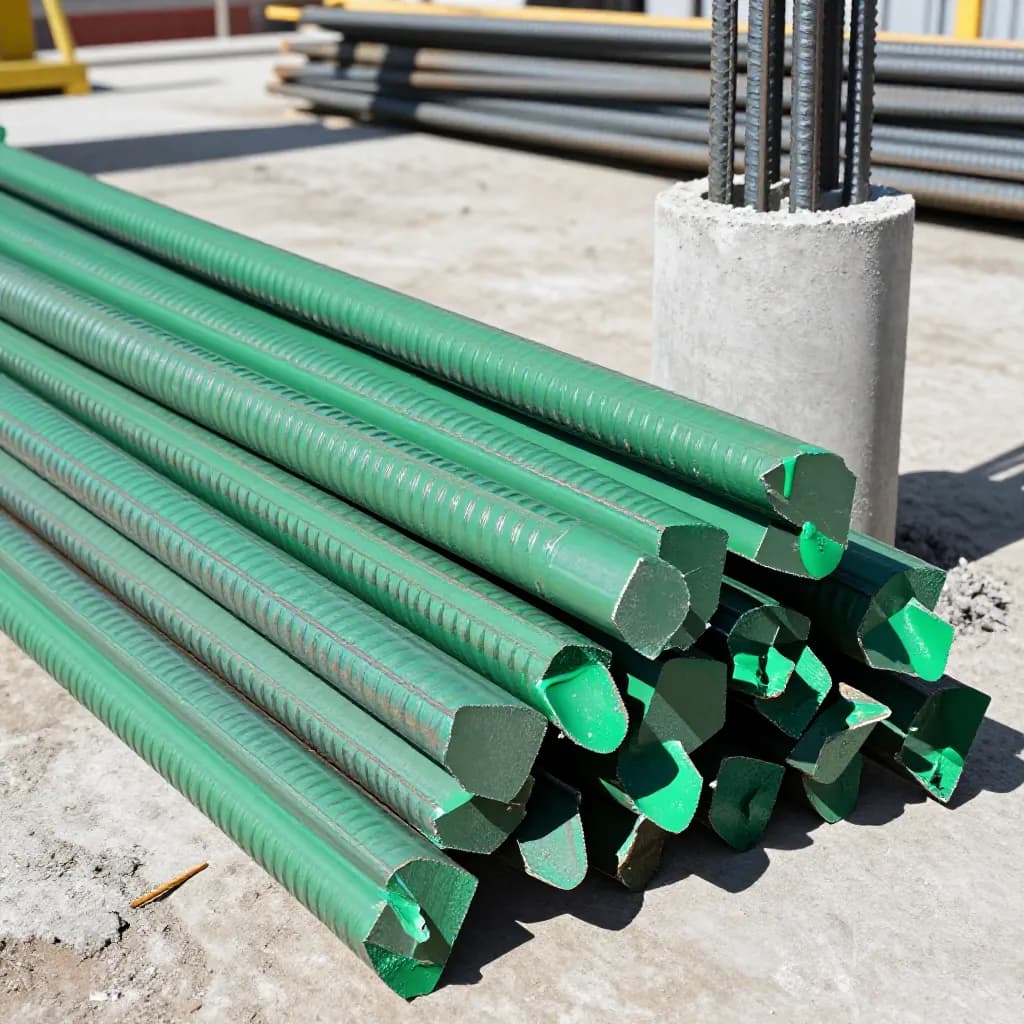
Epoxy-coated reinforcing steel (ECR), commonly known as epoxy-coated rebar, is a major application of epoxy powder coatings in the construction industry. The epoxy coating provides a barrier between the steel reinforcement and the alkaline concrete environment, preventing the chloride-induced corrosion that is the primary cause of reinforced concrete deterioration in bridges, parking structures, marine structures, and buildings exposed to deicing salts.
The rebar coating process uses specialized high-speed application lines capable of coating continuous lengths of reinforcing bar at speeds of 10-30 meters per minute. The steel bar is first cleaned by abrasive blasting, heated to 220-240°C by induction, and then passed through an electrostatic powder spray zone where the epoxy powder is applied to achieve a film thickness of 175-300 microns (7-12 mils). The coated bar passes through a water quench to cool rapidly, and the cured coating is inspected for film thickness, continuity, adhesion, and holiday (pinhole) detection.
The performance requirements for rebar coating are defined by ASTM A775 (Standard Specification for Epoxy-Coated Steel Reinforcing Bars) and ASTM A934 (Standard Specification for Epoxy-Coated Prefabricated Steel Reinforcing Bars). These standards specify minimum requirements for coating thickness, adhesion (cathodic disbondment and direct pull-off), flexibility (bend test around a mandrel), continuity (holiday detection at specified voltage), and chemical resistance.
The effectiveness of epoxy-coated rebar in preventing corrosion has been the subject of extensive research and some controversy. Field studies of bridges and structures built with ECR have shown mixed results, with some structures performing excellently after 30+ years while others have experienced premature coating deterioration and corrosion. The performance variability has been attributed to coating damage during handling and installation, inadequate holiday detection, and the inherent limitation of barrier-only protection without cathodic protection capability. These findings have led to improved coating specifications, better handling practices, and the development of enhanced ECR products with improved damage tolerance.
Chemical Resistance Applications
Epoxy powder coatings are the chemistry of choice for applications requiring resistance to aggressive chemical environments. The dense, highly crosslinked epoxy network provides an effective barrier against a wide range of chemicals, including acids, alkalis, solvents, fuels, and process chemicals. This chemical resistance, combined with excellent adhesion and mechanical properties, makes epoxy powder coatings the standard for internal linings of tanks, vessels, pipes, and valves in chemical processing, water treatment, and food and beverage industries.
For chemical tank linings, epoxy powder coatings are applied at film thicknesses of 200-500 microns, often in multiple coats, to provide a continuous, pinhole-free barrier between the steel substrate and the contained chemical. Novolac epoxy formulations — based on epoxy novolac resins with higher crosslink density than standard bisphenol-A epoxies — provide enhanced resistance to solvents and elevated-temperature chemical exposure. Phenolic-cured epoxy systems offer the best resistance to strong acids and are used for linings exposed to sulfuric acid, hydrochloric acid, and other aggressive mineral acids.
Water and wastewater treatment infrastructure relies heavily on epoxy powder coatings for corrosion protection of steel pipes, fittings, valves, and structural components. The coatings must resist the corrosive effects of treated and untreated water, chlorine and chloramine disinfectants, and the biological activity present in wastewater systems. NSF/ANSI 61 certification is required for coatings in contact with potable water, ensuring that the coating does not leach harmful substances into the water supply.
Food and beverage processing equipment presents additional requirements beyond chemical resistance. Coatings must comply with FDA 21 CFR 175.300 for food contact applications, must be cleanable and resistant to the aggressive cleaning and sanitizing chemicals used in food processing (caustic soda, peracetic acid, quaternary ammonium compounds), and must not harbor bacteria or support biofilm formation. Epoxy powder coatings formulated for food contact applications meet these requirements while providing the mechanical durability needed for processing equipment subject to impact, abrasion, and thermal cycling.
Epoxy-Polyester Hybrid Systems as Functional Primers
Epoxy-polyester hybrid powder coatings — blends of epoxy and polyester resins that crosslink with each other during cure — occupy a middle ground between pure epoxy and pure polyester systems. While hybrids are most commonly used as single-coat interior finishes, they also serve as functional primers in specific applications where the full chemical resistance of pure epoxy is not required but better corrosion protection than polyester alone is needed.
The typical hybrid ratio is 50:50 or 60:40 epoxy to polyester by weight, though ratios can be adjusted to shift the property balance. Higher epoxy content improves adhesion, corrosion resistance, and chemical resistance, while higher polyester content improves UV resistance, overbake tolerance, and exterior durability. For primer applications, epoxy-rich formulations (60:40 or 70:30 epoxy:polyester) are preferred to maximize the corrosion protection contribution of the epoxy component.
Hybrid primers offer practical advantages over pure epoxy primers in some production environments. They are more tolerant of overbaking — a common occurrence when primer-coated parts are held at elevated temperature while awaiting topcoat application. Pure epoxy primers can become excessively crosslinked and brittle when overbaked, potentially compromising intercoat adhesion with the topcoat. Hybrid primers maintain better flexibility and surface reactivity over a wider cure window, providing more forgiving production scheduling.
The intercoat adhesion between a hybrid primer and a polyester topcoat is generally excellent, particularly when the primer is cured to a state that leaves some residual surface reactivity for chemical bonding with the topcoat. This partial cure approach — sometimes called a B-stage cure — creates a primer surface with unreacted functional groups that can participate in crosslinking reactions with the topcoat during the second cure cycle, forming a chemical bond at the primer-topcoat interface that is stronger than the mechanical adhesion achieved with a fully cured primer.
For applications requiring maximum corrosion protection, pure epoxy primers remain the preferred choice. But for general industrial applications where good corrosion protection, production flexibility, and reliable intercoat adhesion are the priorities, hybrid primers offer an effective and practical solution.
Application Methods and Quality Control for Epoxy Primers
The application of epoxy powder coating primers requires attention to several process parameters that differ from standard single-coat powder coating operations. Film thickness control is critical — too thin a primer provides inadequate corrosion protection, while too thick a primer can cause intercoat adhesion problems with the topcoat and may crack under thermal stress. Target primer film thickness is typically 20-40 microns for architectural systems and 50-100 microns for industrial systems, with tighter tolerances than single-coat applications.
Electrostatic spray application of thin primer films requires careful optimization of powder output, air flow, electrostatic voltage, and gun-to-part distance. Lower powder output rates and reduced electrostatic voltage compared to topcoat application help achieve uniform thin films without excessive edge buildup or back-ionization effects. Corona charging is most common for primer application, though tribo charging can provide advantages for complex geometries where Faraday cage effects limit corona penetration.
Cure control for primers in two-coat systems requires a decision between full cure and partial cure (B-stage) approaches. Full cure provides maximum primer film properties but relies on mechanical adhesion (surface roughness and profile) for topcoat bonding. Partial cure leaves residual reactive groups for chemical bonding with the topcoat but requires precise oven control to achieve consistent partial cure without undercure or overcure. The choice between these approaches depends on the specific primer and topcoat chemistries, production line configuration, and quality requirements.
Quality control testing for epoxy primers includes film thickness measurement (magnetic or eddy current gauges), adhesion testing (cross-cut tape pull per ASTM D3359), cure verification (solvent rub or DSC), and corrosion resistance testing (salt spray per ASTM B117, typically 500-2000 hours depending on specification). For pipeline FBE and rebar coatings, additional tests include cathodic disbondment, hot water adhesion, flexibility, and holiday detection using high-voltage spark testing to identify pinholes and discontinuities in the coating film.
Frequently Asked Questions
Why can't epoxy powder coatings be used as exterior topcoats?
Epoxy resins contain bisphenol-A backbone structures that absorb UV radiation, causing chain scission, chalking, and yellowing on exterior exposure. This UV sensitivity limits epoxy to interior applications, primer layers protected by UV-resistant topcoats, or buried/immersed applications where UV exposure does not occur.
What is fusion bonded epoxy (FBE) used for?
FBE is the dominant coating for corrosion protection of buried steel pipelines in oil and gas, water distribution, and industrial piping. It is applied at 300-500 microns to preheated pipe (220-245°C), forming a dense barrier that protects against soil corrosion, groundwater, and cathodic disbondment.
How thick should an epoxy primer be in a two-coat system?
Epoxy primer film thickness is typically 20-40 microns for architectural systems and 50-100 microns for industrial systems. Too thin provides inadequate corrosion protection, while too thick can cause intercoat adhesion problems and may crack under thermal stress.
Is epoxy-coated rebar effective at preventing corrosion?
Epoxy-coated rebar provides effective corrosion protection when properly applied, handled, and installed. Field performance has been mixed — some structures perform excellently after 30+ years while others show premature deterioration. Performance depends on coating quality, damage during handling, and installation practices. Improved specifications and handling procedures have addressed many early issues.
Can epoxy powder coatings be used for food contact applications?
Yes. Epoxy powder coatings formulated for food contact comply with FDA 21 CFR 175.300 and provide the chemical resistance needed for food processing equipment. They resist aggressive cleaning chemicals (caustic soda, peracetic acid), do not harbor bacteria, and withstand the mechanical demands of processing environments.
Ready to Start Your Project?
From one-off customs to 15,000-part production runs — get precise pricing in 24 hours.