Powder coating significantly affects welding quality and should be removed from weld zones before any welding operation. Attempting to weld through powder coating introduces multiple problems including porosity in the weld, toxic fume generation, poor weld penetration, contaminated weld pools, and weakened joint strength. The organic coating material decomposes in the welding arc, releasing gases that become trapped in the molten weld metal and creating defects that compromise structural integrity.
Technical
Does Powder Coating Affect Welding? Weld-Through Issues and Best Practices
Sundial Powder Coating·April 22, 2026·11 min
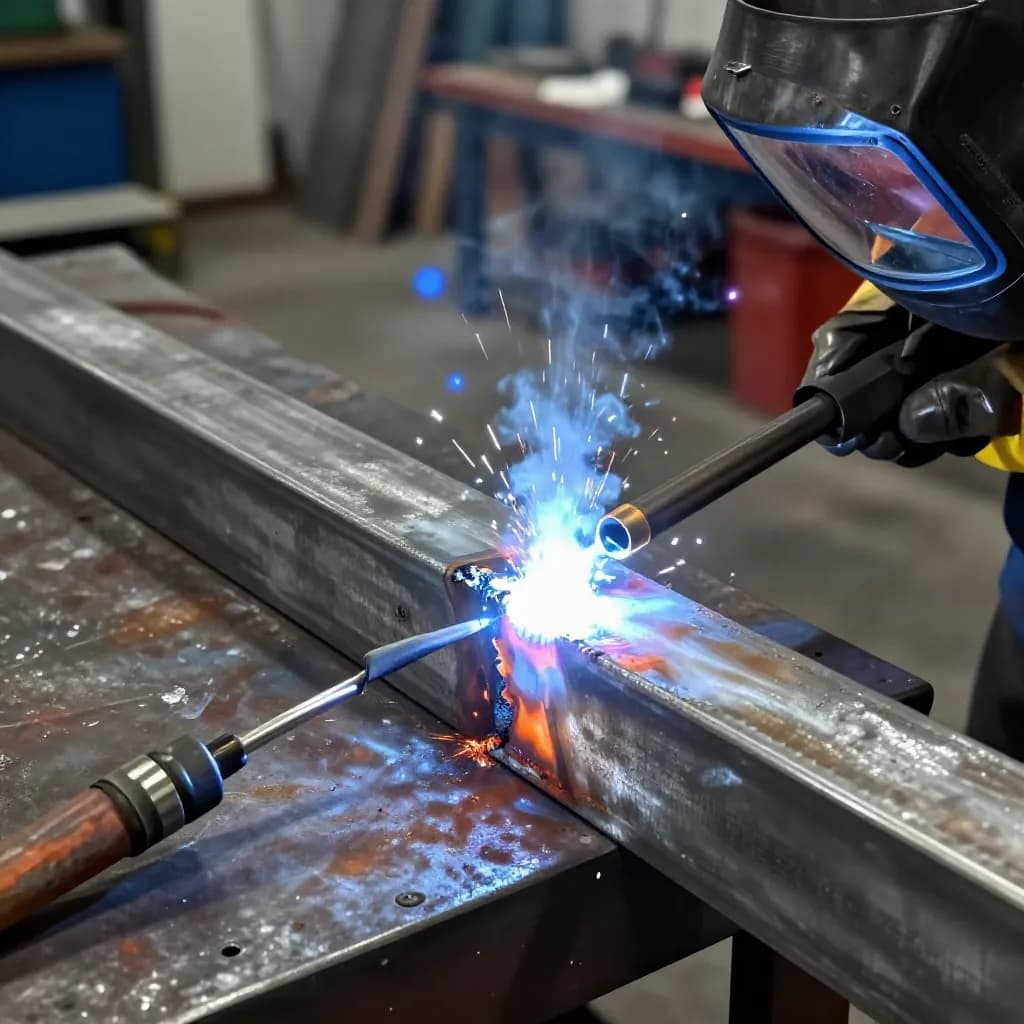
The standard best practice in metal fabrication is to complete all welding operations before powder coating, allowing the entire welded assembly to be pretreated and coated as a unit. This sequence produces the best results for both weld quality and coating performance. However, there are situations where welding must be performed on previously coated parts — field assembly, repair work, and modifications to existing structures being common examples.
Ready to Start Your Project?
From one-off customs to 15,000-part production runs — get precise pricing in 24 hours.
On This Page
Powder Coating Must Be Removed Before Welding for Quality Results
When welding on powder-coated parts is unavoidable, the coating must be removed from the weld zone and surrounding area before welding begins. After welding, the weld area requires cleaning, preparation, and touch-up coating to restore corrosion protection and appearance.
This article examines the specific problems caused by welding through powder coating, the methods for removing coating before welding, and the procedures for restoring coating protection after welding is complete.
What Happens When You Weld Through Powder Coating
Welding through powder coating creates a cascade of quality problems that affect both the weld and the surrounding coating. Understanding these problems explains why coating removal before welding is not optional for structural or quality-critical applications.
Porosity is the most common weld defect caused by welding through organic coatings. As the welding arc decomposes the powder coating, the organic resin and additives release gases including carbon dioxide, carbon monoxide, water vapor, and various hydrocarbon compounds. These gases become trapped in the rapidly solidifying weld pool, creating spherical voids (porosity) within the weld metal. Porosity reduces the effective cross-sectional area of the weld and acts as stress concentration points, significantly reducing joint strength and fatigue life.
Weld contamination occurs when decomposition products from the coating mix with the molten weld metal. Carbon from the organic coating can increase the carbon content of the weld, affecting its metallurgical properties and potentially causing hardening and cracking in the heat-affected zone. Pigment residues containing metallic compounds can also contaminate the weld, altering its composition and properties.
Poor weld penetration results from the insulating effect of the coating, which can interfere with arc initiation and stability. The coating layer between the parts being joined prevents intimate metal-to-metal contact at the joint interface, and the gases released during coating decomposition can disrupt the welding arc, causing inconsistent penetration and fusion.
Toxic fume generation is a serious health and safety concern. The thermal decomposition of powder coating resins produces fumes that may contain hazardous substances depending on the coating formulation. Epoxy coatings can release bisphenol A compounds, while some pigments may release metal fumes. Welding through coatings without adequate ventilation and respiratory protection exposes workers to these hazardous fumes.
Coating damage extends well beyond the weld zone. The heat from welding degrades the powder coating for a significant distance around the weld, causing discoloration, blistering, and loss of adhesion in the heat-affected zone. This damaged coating must be removed and replaced to restore protection.
Methods for Removing Coating Before Welding
Several methods are available for removing powder coating from weld zones, each with advantages and limitations depending on the situation. The choice of removal method depends on the part size, accessibility, coating thickness, and the precision required.
Mechanical grinding using abrasive discs or flap wheels is the most common field method for coating removal. Angle grinders with 40 to 80 grit abrasive discs quickly remove powder coating and expose clean metal for welding. The grinding should extend at least 25 millimeters beyond the weld zone on all sides to ensure that coating decomposition products do not reach the weld pool. Care must be taken to avoid excessive metal removal, particularly on thin-gauge materials.
Abrasive blasting provides thorough coating removal over larger areas and is preferred when multiple weld zones must be prepared or when the entire part requires stripping. Grit blasting with aluminum oxide or steel grit removes the coating and simultaneously creates a surface profile suitable for subsequent recoating. Blasting is more uniform than grinding but requires equipment and containment that may not be available in field situations.
Chemical stripping using paint removers can dissolve powder coating without mechanical damage to the substrate. This method is useful for delicate parts or situations where mechanical removal could damage the base metal. However, chemical strippers require adequate ventilation, proper disposal of waste, and thorough rinsing to remove all chemical residues before welding.
Thermal removal by heating the coating above its decomposition temperature with a torch or heat gun can soften and char the coating for easier removal. This method is quick but produces fumes and leaves carbonaceous residue that must be cleaned from the surface before welding. It is generally used as a preliminary step followed by mechanical cleaning.
For production applications where welding of pre-coated parts is planned, masking the weld zones before coating is the most efficient approach. This eliminates the need for post-coating removal and ensures clean metal is available for welding without additional preparation.
The Ideal Fabrication Sequence
The optimal fabrication sequence for powder-coated welded assemblies places all welding operations before the coating process. This sequence eliminates the problems associated with welding through coating and produces the best results for both weld quality and coating performance.
The recommended sequence is: cut and form individual components, complete all welding and fabrication operations, perform post-weld cleaning including removal of weld spatter and slag, grind welds smooth where required, pretreat the entire assembly, and apply powder coating to the finished assembly. This sequence ensures that welds are made on clean, uncoated metal and that the entire assembly, including weld zones, receives uniform pretreatment and coating.
Post-weld cleaning is a critical step that is sometimes overlooked. Weld spatter, slag, flux residues, and heat tint (discoloration) on the metal surface around welds can interfere with pretreatment and coating adhesion. Thorough cleaning by grinding, wire brushing, or blasting ensures that the weld zones receive the same quality of pretreatment and coating as the rest of the assembly.
Weld design also affects coating quality. Smooth, continuous welds with minimal spatter provide the best surface for coating. Skip welds, tack welds, and welds with excessive reinforcement create surface irregularities that are difficult to coat uniformly. Specifying weld quality requirements that consider the subsequent coating process helps ensure good coating results.
For large assemblies that cannot be processed through a standard coating line, modular fabrication approaches can be used. Individual modules are welded, pretreated, and coated separately, then assembled using mechanical fasteners rather than welding. This approach maintains the weld-before-coat sequence while accommodating size limitations of the coating facility.
Post-Weld Touch-Up and Repair Coating
When welding on previously coated parts is unavoidable, restoring coating protection to the weld zone and heat-affected area is essential for long-term corrosion protection and appearance. The touch-up process must address both the bare metal at the weld and the damaged coating in the surrounding heat-affected zone.
The first step is thorough cleaning of the weld area. Remove all weld spatter, slag, and flux residues by grinding or wire brushing. Clean the area with solvent to remove any oils or contaminants introduced during the welding process. The goal is a clean, bare metal surface at the weld and a clean, sound coating surface in the surrounding area.
The heat-affected zone where the existing coating has been damaged by welding heat must be assessed. Coating that has discolored but remains well-adhered can often be left in place and overcoated. Coating that has blistered, cracked, or lost adhesion must be removed back to sound coating or bare metal. Feather the edges of the remaining sound coating to create a smooth transition for the repair coating.
For field touch-up, liquid repair coatings are the practical choice because they do not require oven curing. Two-component epoxy or polyurethane liquid paints provide good adhesion and protection when applied over properly prepared surfaces. Color matching to the original powder coating can be challenging, and some visible difference between the touch-up area and the original coating is usually unavoidable.
For shop repairs where oven access is available, powder coating touch-up provides the best match to the original coating. The repair area is prepared, powder is applied by spray gun, and the part is returned to the oven for curing. This approach produces the most seamless repair but requires the part to be transported back to the coating facility.
Spray-can touch-up paints matched to common powder coating colors are available for minor repairs and are the most convenient option for field use. While they do not match the durability of the original powder coating, they provide adequate protection for small areas and are easily applied without specialized equipment.
Special Considerations for Different Welding Processes
Different welding processes interact with powder coating in different ways, and understanding these differences helps select the most appropriate welding method when working near or on coated surfaces.
MIG welding (GMAW) is the most commonly used process for fabrication of powder-coated assemblies. It produces relatively high heat input and a large heat-affected zone, meaning coating damage extends further from the weld than with lower-heat processes. The shielding gas can blow decomposition products from the coating into the weld pool if the coating is not adequately removed from the weld zone.
TIG welding (GTAW) offers more precise heat control and a smaller heat-affected zone, making it preferable when minimizing coating damage is important. The lower heat input reduces the extent of coating degradation around the weld. However, TIG welding is slower than MIG welding and may not be practical for large-volume production.
Spot welding (resistance welding) is commonly used for joining pre-coated sheet metal in manufacturing. The coating at the spot weld location is displaced by the electrode pressure and heat, creating a metal-to-metal bond at the weld nugget. While spot welding through coating is feasible, it requires higher welding currents and longer weld times than bare metal, and electrode life is reduced by coating contamination. Weld quality monitoring is essential to ensure adequate nugget formation through the coating.
Laser welding offers the most precise heat input and smallest heat-affected zone of any fusion welding process. The highly focused energy beam can vaporize coating in the immediate weld zone while minimizing damage to surrounding coating. Laser welding is increasingly used in automotive and appliance manufacturing for joining pre-coated components.
Mechanical fastening — bolting, riveting, and clinching — avoids the welding-coating conflict entirely and is the preferred joining method for pre-coated components in many applications. These methods create no heat-affected zone and require only localized masking at fastener contact points.
Planning for Weldments: Design and Specification Best Practices
Effective planning for powder-coated welded assemblies begins at the design stage and involves coordination between the design engineer, fabricator, and coating applicator. The following best practices help ensure that both weld quality and coating quality meet requirements.
Design the assembly to complete all welding before coating whenever possible. This is the single most important design decision for powder-coated weldments. If the assembly is too large for the coating facility, consider designing it as bolted sub-assemblies that can be individually coated.
When field welding of coated assemblies is anticipated, design the joints to facilitate coating removal and touch-up. Provide adequate access for grinding tools, specify weld joint designs that are easy to clean and recoat, and avoid joints in locations that are difficult to reach for touch-up coating.
Specify weld quality requirements that consider the coating process. Smooth, flush welds with minimal spatter coat better than rough, reinforced welds with heavy spatter. Specify grinding of weld reinforcement where a smooth coated appearance is required.
Include coating touch-up requirements in the welding specification for field-welded joints. Define the required surface preparation, touch-up coating material, minimum film thickness, and inspection criteria for repaired areas. This ensures that touch-up is performed consistently and to an adequate standard.
For assemblies that will be modified or repaired in service, consider specifying a coating system that facilitates touch-up. Some powder coating colors and finishes are easier to touch up than others — textured finishes hide touch-up boundaries better than high-gloss smooth finishes, and common colors are more readily available in touch-up formats.
Communicate the complete fabrication and coating sequence to all parties involved. The fabricator needs to know which surfaces will be coated and which will be masked. The coating applicator needs to know where welds are located and what surface preparation has been performed. Clear communication prevents errors and ensures that the finished assembly meets both structural and coating requirements.
Frequently Asked Questions
Can you weld through powder coating?
Technically possible but strongly discouraged. Welding through powder coating causes porosity, weld contamination, poor penetration, toxic fumes, and weakened joints. The coating must be removed from the weld zone — at least 25mm beyond the joint — before welding for quality results.
Should you weld before or after powder coating?
Always weld before powder coating when possible. This produces the best weld quality and allows the entire assembly to receive uniform pretreatment and coating. The ideal sequence is: fabricate, weld, clean, pretreat, then powder coat the complete assembly.
How do you repair powder coating after welding?
Clean the weld area thoroughly, remove damaged coating back to sound material, feather the edges, and apply touch-up coating. Field repairs typically use two-component liquid epoxy or polyurethane paint. For the best match, return the part to a coating facility for powder coating touch-up with oven cure.
How far should you remove coating from a weld zone?
Remove coating at least 25mm (1 inch) beyond the weld zone on all sides. This prevents coating decomposition products from contaminating the weld pool and provides clean metal for proper arc initiation and shielding gas coverage.
Does welding damage surrounding powder coating?
Yes. Welding heat degrades powder coating for a significant distance around the weld, causing discoloration, blistering, and adhesion loss in the heat-affected zone. This damaged coating must be removed and replaced with touch-up coating to restore protection.
Ready to Start Your Project?
From one-off customs to 15,000-part production runs — get precise pricing in 24 hours.