Surface preparation is the single most important factor in powder coating adhesion and durability, and sandblasting — more accurately called abrasive blasting or media blasting — is the gold standard for preparing metal surfaces. Blasting removes rust, old paint, mill scale, oxidation, and surface contaminants while simultaneously creating a surface profile that gives the powder coating something to grip. Without proper surface preparation, even the best powder applied with perfect technique will eventually fail.
DIY
DIY Powder Coating Sandblasting Setup: Cabinets, Media, and Compressors
Sundial Powder Coating·April 22, 2026·12 min
Chemical stripping and hand sanding can work for small, simple parts, but they cannot match the speed, thoroughness, or surface profile that blasting provides. A blasted surface has a uniform anchor pattern of microscopic peaks and valleys that dramatically increases the mechanical bond between the metal and the powder coating. This is why professional powder coaters blast virtually every part before coating — it is not optional, it is foundational.
Ready to Start Your Project?
From one-off customs to 15,000-part production runs — get precise pricing in 24 hours.
On This Page
Why Sandblasting Is Essential for Powder Coating Success
For the DIY coater, setting up a blasting capability is a significant but worthwhile investment. The equipment ranges from simple siphon-feed blast guns to enclosed blast cabinets to pressure-pot systems, each with different capabilities and requirements. Your choice depends on the size and volume of parts you plan to coat, your available space, your compressor capacity, and your budget.
This guide walks you through the key decisions: cabinet versus pressure blasting, media selection for different substrates, compressor sizing to keep up with your blasting demands, and dust collection to keep your workspace livable. Getting these decisions right from the start will save you frustration and money down the road.
Blast Cabinet vs Pressure Blaster: Choosing Your System
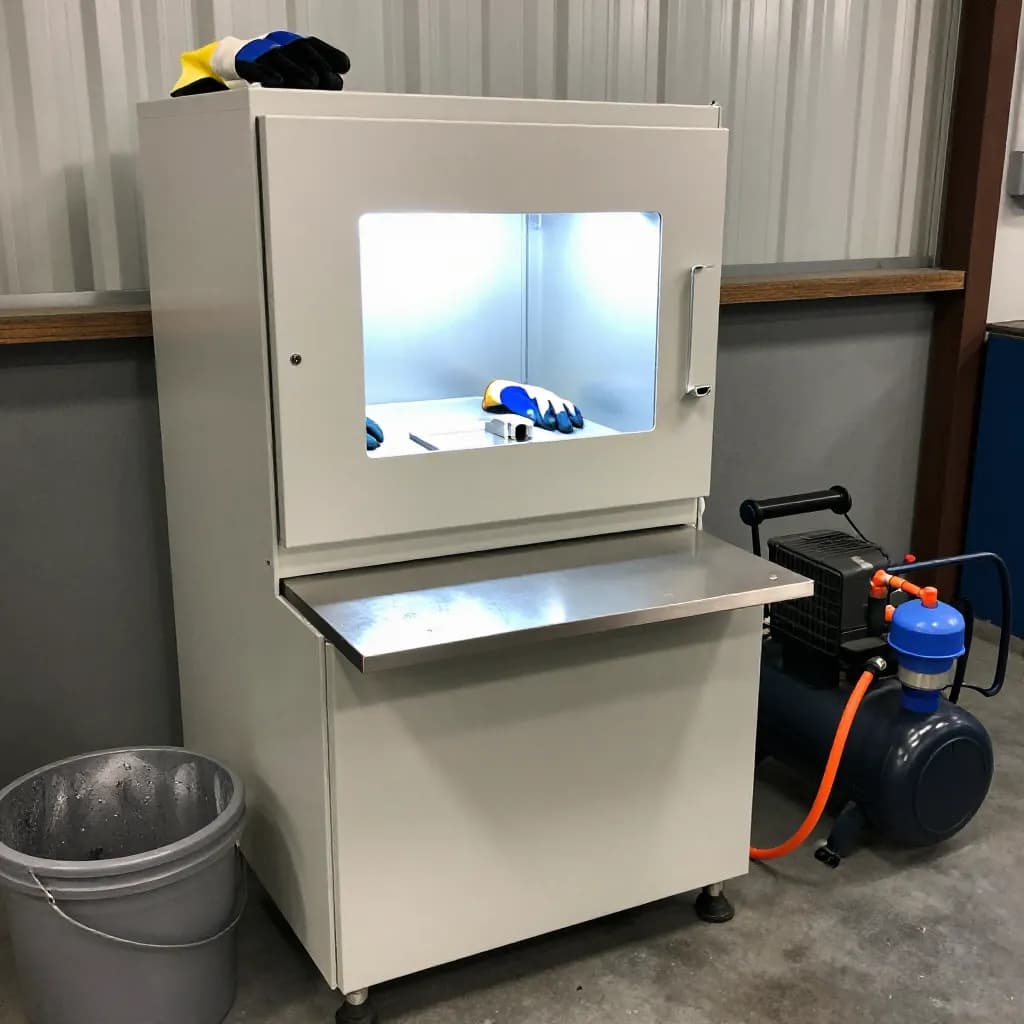
A blast cabinet is an enclosed box with a viewing window, internal lighting, arm holes with gloves, and a blast gun mounted inside. You place the part inside the cabinet, close the door, and blast through the gloves while watching through the window. The cabinet contains all the dust and spent media, which falls to the bottom and is recirculated back to the gun through a siphon or gravity feed system.
Blast cabinets are the most popular choice for DIY powder coaters because they are self-contained, relatively clean, and allow you to blast in a garage or workshop without creating a dust storm. They are ideal for small to medium parts — brackets, valve covers, small wheels, tools, and hardware. The main limitation is size: standard hobby-grade cabinets have interior dimensions of roughly 24 by 18 by 18 inches, which limits the parts you can process. Larger cabinets are available but take up more floor space and cost more.
Pressure blasting systems use a pressurized vessel (pressure pot) to force media through the blast hose and nozzle at high velocity. They are significantly more aggressive than siphon-feed cabinet guns, stripping material much faster and handling heavier coatings and rust with ease. Pressure blasters are the right choice for large parts like frames, wheels, and furniture that will not fit in a cabinet.
The trade-off with pressure blasting is containment. Unless you build or buy an enclosed blast room, pressure blasting is typically done outdoors, which means dealing with dust, media scatter, and weather. Some DIY coaters build simple blast enclosures from tarps or plywood to contain the mess while still accommodating large parts.
Choosing the Right Blasting Media
The blasting media you choose affects stripping speed, surface profile, substrate safety, and cost. There is no single best media — the right choice depends on what you are blasting and what surface finish you need for powder coating.
Aluminum oxide is the workhorse media for powder coating preparation. It is aggressive enough to strip paint and rust quickly, creates an excellent surface profile for coating adhesion, and is reusable for many cycles before it breaks down. Aluminum oxide works well on steel, iron, and aluminum, making it the most versatile choice for a DIY shop that processes a variety of parts. It is available in various grit sizes, with 80 to 120 grit being the most common for powder coating prep.
Glass bead is a gentler option that cleans and peens the surface without removing significant material. It produces a smooth, satin finish rather than the aggressive profile of aluminum oxide. Glass bead is a good choice for aluminum parts where you want to clean without etching, or for parts where dimensional tolerance matters. It is also useful for cosmetic cleaning of parts that will be clear-coated.
Silicon carbide is the most aggressive common media, cutting faster than aluminum oxide. It is useful for heavy rust and thick coatings but can be too aggressive for thin or delicate parts. Garnet, walnut shell, and plastic media are softer options for specialized applications. Walnut shell is gentle enough for cleaning without profiling, while plastic media is used for stripping coatings from substrates that must not be damaged.
Never use regular sand for blasting. Silica sand creates respirable crystalline silica dust that causes silicosis, a serious and irreversible lung disease. Use only manufactured blasting media designed for the purpose.
Compressor Sizing: The Most Common DIY Mistake
Undersized compressors are the number one frustration for DIY blasters. Abrasive blasting consumes enormous amounts of compressed air, and a compressor that cannot keep up will leave you waiting for the tank to refill every few seconds, turning a 10-minute job into an hour of start-and-stop misery. Understanding your air requirements before buying a compressor — or before buying a blast system — will save you significant frustration.
Blast nozzle size is the primary determinant of air consumption. A small 3/32-inch nozzle at 80 PSI consumes roughly 10-12 CFM. A 1/4-inch nozzle at the same pressure consumes 50-60 CFM. Most hobby blast cabinets come with small nozzles specifically because they are designed to work with smaller compressors, but even these modest nozzles demand more air than many garage compressors can deliver continuously.
For a blast cabinet with a small siphon-feed gun, a compressor delivering at least 10-12 CFM at 90 PSI is the minimum. This typically means a compressor with a 60-gallon or larger tank and a pump rated for continuous duty. Smaller pancake or hot-dog compressors rated at 2-4 CFM are completely inadequate for blasting — they will run continuously and still cannot keep up.
For pressure blasting, air requirements jump dramatically. Even a modest pressure pot with a 1/4-inch nozzle needs 50+ CFM, which requires a large stationary compressor or a gas-powered portable unit. Many DIY coaters who pressure blast invest in a dedicated high-CFM compressor specifically for blasting, separate from their general shop compressor. If you are planning a pressure blast setup, budget for the compressor as a major line item — it will likely be the most expensive component of your blasting system.
Dust Collection and Workshop Air Quality
Abrasive blasting generates enormous amounts of fine dust, even inside an enclosed cabinet. The dust consists of pulverized media, removed coating material, rust particles, and metal fines — none of which you want to breathe. Managing this dust is essential for your health and for keeping your workshop functional.
Blast cabinets have built-in dust collection, but the systems included with budget cabinets are often inadequate. Most come with a small filter bag or cartridge that clogs quickly and allows fine dust to escape into the workshop. Upgrading the dust collection on a blast cabinet is one of the best modifications you can make. Options include connecting the cabinet to a shop vacuum with a HEPA filter, adding a cyclone separator to extend filter life, or installing a larger cartridge filter with more surface area.
If you are pressure blasting outdoors or in an open area, dust management is more challenging. Position yourself upwind of the blast area so dust blows away from you. Wear a full-face respirator rated for particulate exposure — a simple dust mask is not adequate for blasting operations. Consider building a simple blast enclosure with a tarp or plywood back wall to contain the worst of the dust and media scatter.
Inside your workshop, an ambient air filtration unit can help capture fine dust that escapes from the blast cabinet or drifts in from outdoor blasting. These ceiling-mounted units continuously filter workshop air and are a worthwhile investment for any shop that generates fine particulates. Keep your blasting area separated from your spray booth and oven area as much as possible — blast dust is a major source of contamination in powder-coated finishes.
Setting Up Your Blast Cabinet for Maximum Efficiency
A well-set-up blast cabinet is a pleasure to use; a poorly set-up one is an exercise in frustration. Start with the viewing window — if you cannot see clearly, you cannot blast effectively. Replace the stock protective film on the window with a fresh sheet, and add interior lighting if the cabinet did not come with it. LED strip lights mounted inside the cabinet above the window provide excellent illumination without taking up much space.
The gloves that come with most budget cabinets are thin and wear through quickly. Replace them with heavier-duty blast gloves that will last longer and protect your hands from media ricochet. Make sure the gloves are long enough to give you comfortable reach to all areas of the cabinet interior.
Organize your media flow for consistent blasting. The siphon pickup tube at the bottom of the cabinet should be positioned in the lowest point where media naturally collects. If your cabinet has a sloped floor, make sure the slope directs media toward the pickup. Some coaters add a vibrator motor to the cabinet floor to keep media flowing and prevent bridging.
Keep your media clean by sieving it periodically to remove fines and debris. Contaminated media blasts less effectively and can embed contaminants in the surface you are trying to clean. A simple screen or mesh sieve shaken over a bucket separates good media from spent fines. Replace media entirely when it becomes rounded and loses its cutting ability — dull media takes longer to strip and produces a less effective surface profile.
Finally, maintain your blast gun and nozzle. Nozzles wear over time, especially with aggressive media like aluminum oxide. A worn nozzle produces a wider, less focused blast pattern and consumes more air. Replace nozzles when they show visible wear or when you notice decreased blasting performance.
Blasting Techniques for Powder Coating Preparation
Effective blasting technique is about consistency and thoroughness, not speed. Hold the blast nozzle 4 to 6 inches from the surface and move it in overlapping passes, similar to how you would spray paint. Work systematically across the part rather than randomly jumping from spot to spot. This ensures complete coverage and a uniform surface profile.
Adjust your blasting pressure based on the substrate and the condition of the part. For heavy rust and thick paint on steel, use full pressure (80-100 PSI) with aggressive media. For aluminum, reduce pressure to 40-60 PSI and use glass bead or fine aluminum oxide to avoid warping thin sections or creating an excessively rough profile. For delicate parts, further reduce pressure and use gentler media.
Blast to a consistent finish across the entire part. The surface should have a uniform matte appearance with no shiny spots, rust stains, or remnants of old coating. Pay special attention to edges, corners, and recessed areas where old coating tends to hide. These areas are also where powder coating is most likely to fail if the surface is not properly prepared.
After blasting, handle parts with clean gloves to avoid transferring skin oils to the prepared surface. Oils from your hands will cause adhesion failures in the powder coating. If you cannot coat the part immediately after blasting, store it in a clean, dry area and wipe it with a solvent like acetone or denatured alcohol before coating to remove any surface contamination that may have accumulated.
Time is the enemy of a freshly blasted surface. Bare steel will begin to flash rust within hours in humid conditions. Plan your workflow so that blasted parts move to the coating booth as quickly as possible. If flash rust does appear, a light re-blast or chemical treatment can restore the surface, but prevention through prompt coating is always better.
Frequently Asked Questions
What size compressor do I need for a blast cabinet?
For a siphon-feed blast cabinet with a small nozzle, you need at least 10-12 CFM at 90 PSI, which typically requires a 60-gallon or larger tank compressor. Small pancake or portable compressors rated at 2-4 CFM are completely inadequate for blasting and will leave you waiting for the tank to refill constantly.
What is the best blasting media for powder coating prep?
Aluminum oxide in 80-120 grit is the most versatile choice for powder coating preparation. It strips paint and rust effectively, creates an excellent surface profile for adhesion, and is reusable for many cycles. Use glass bead for gentler cleaning on aluminum or when you need a smoother finish.
Can I use regular sand for sandblasting?
No. Never use silica sand for blasting. It creates respirable crystalline silica dust that causes silicosis, a serious and irreversible lung disease. Always use manufactured blasting media such as aluminum oxide, glass bead, garnet, or other purpose-made abrasives.
How do I keep my blast cabinet dust under control?
Upgrade the stock dust collection by connecting the cabinet to a shop vacuum with a HEPA filter, adding a cyclone separator, or installing a larger cartridge filter. The stock filter bags on budget cabinets clog quickly and allow fine dust to escape into your workshop.
How soon after blasting should I powder coat the part?
As soon as possible. Bare steel can begin flash rusting within hours in humid conditions. Plan your workflow so blasted parts move directly to the coating booth. If delays are unavoidable, store parts in a clean dry area and wipe with acetone before coating to remove any surface contamination.
Ready to Start Your Project?
From one-off customs to 15,000-part production runs — get precise pricing in 24 hours.