A dedicated spray booth is one of the most important investments you can make in your DIY powder coating setup. While it is technically possible to spray powder in an open garage, doing so creates problems that will frustrate you and compromise your results. Airborne powder drifts everywhere, contaminating surfaces, tools, and other projects. Wind and air currents disrupt your spray pattern and cause uneven coverage. Dust and debris in the ambient air settle on your freshly coated parts, creating defects that are visible after curing.
DIY
DIY Powder Coating Booth Setup: Ventilation, Lighting, and Filtration
Sundial Powder Coating·April 22, 2026·11 min
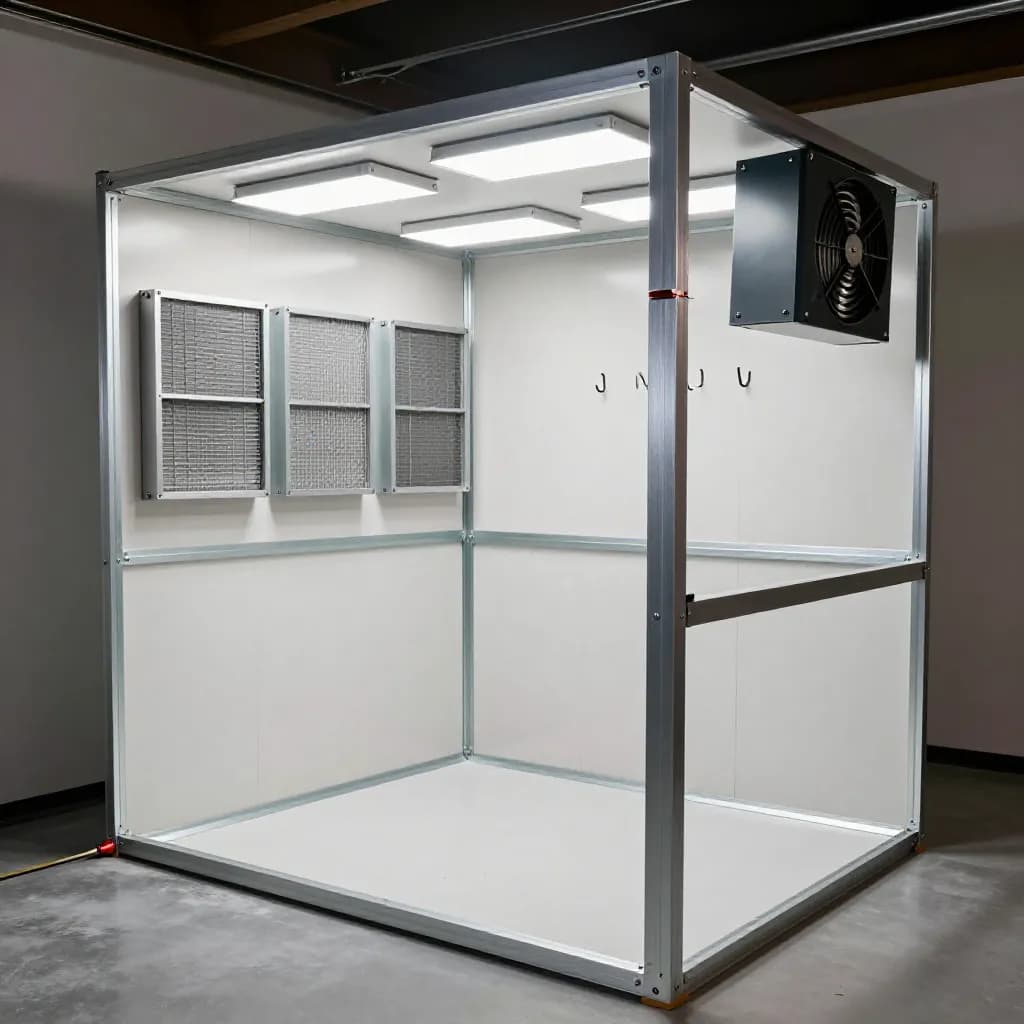
A well-designed booth solves all of these problems. It contains the powder overspray within a defined space, protects your parts from contamination, provides controlled airflow that carries overspray away from the work area, and creates a clean environment where you can focus on application technique without fighting environmental variables.
Ready to Start Your Project?
From one-off customs to 15,000-part production runs — get precise pricing in 24 hours.
On This Page
Why a Proper Spray Booth Matters for DIY Powder Coating
The booth also serves critical safety functions. Powder coating materials are finely ground particles that become airborne during spraying. While powder coatings are generally less hazardous than liquid paints, inhaling any fine particulate matter is harmful to your lungs over time. A booth with proper filtration and ventilation protects your respiratory health and keeps your workshop air clean.
For the home hobbyist, a spray booth does not need to be elaborate or expensive. Many effective DIY booths are built from readily available materials like PVC pipe, sheet plastic, furnace filters, and box fans. The key is understanding the principles of airflow, filtration, and containment so you can design a booth that works for your space and project needs.
Booth Design Options: Open-Face, Enclosed, and Portable
The simplest booth design is an open-face booth — essentially a three-sided enclosure with a filter bank on the back wall and an exhaust fan pulling air through the filters. The coater stands in front of the open face and sprays into the booth. This design is easy to build, provides good access to parts, and works well for small to medium items. The main limitation is that powder can escape from the open front if airflow is insufficient or if you spray at angles that direct powder toward the opening.
An enclosed booth adds a front wall with an opening or curtain, creating a more contained environment. This design captures overspray more effectively and provides better control over airflow patterns. Enclosed booths are ideal if you are coating in a shared space or need to minimize powder migration to other areas of your workshop. The trade-off is reduced access — you need to reach through the opening to manipulate parts, which can be awkward for larger items.
Portable or collapsible booths are a practical option for coaters with limited space. These booths can be assembled for coating sessions and broken down for storage when not in use. PVC pipe frames with plastic sheeting walls are a popular approach — they are lightweight, inexpensive, and can be configured to fit your available space. The downside is setup and teardown time, and the connections may not be as airtight as a permanent installation.
Regardless of design, size your booth to accommodate your largest parts with at least 12 inches of clearance on all sides. You need room to move the gun around the part and maintain proper spray distance without bumping into booth walls.
Ventilation and Airflow Design
Proper airflow is the foundation of an effective spray booth. The goal is to create a gentle, consistent flow of air from the open face of the booth toward the filter bank at the rear. This airflow carries overspray powder away from you and toward the filters, keeping the work area clear and protecting your lungs. The air velocity should be fast enough to capture overspray but not so fast that it disrupts the powder cloud between the gun and the part.
A face velocity of 100 to 150 feet per minute across the booth opening is a good target for powder coating. To calculate the required fan capacity, multiply the area of the booth opening (in square feet) by the desired face velocity (in feet per minute) to get the required airflow in cubic feet per minute (CFM). For a booth opening that is 4 feet wide by 6 feet tall, you would need 2,400 to 3,600 CFM — a substantial amount of air movement.
In practice, most DIY booths use one or more box fans or inline duct fans to create airflow. Position the fan behind the filter bank so it pulls air through the filters rather than pushing air into the booth. This negative-pressure arrangement ensures that any air leaks in the booth structure pull clean air in rather than pushing contaminated air out.
If your booth exhausts to the outdoors, ensure the exhaust point is away from windows, doors, and air intakes. If you are recirculating air back into the workshop, you must use high-quality filters that capture fine powder particles. A combination of a coarse pre-filter to catch large particles and a fine secondary filter for smaller particles provides the best balance of airflow and filtration efficiency.
Filtration Systems for Powder Recovery and Air Quality
Filtration serves two purposes in a powder coating booth: protecting air quality and recovering overspray powder for reuse. For the DIY coater, air quality is the primary concern, but powder recovery becomes increasingly important as you do more coating and want to minimize waste.
The most basic filtration approach uses standard furnace filters mounted in the back wall of the booth. These are inexpensive and widely available, but they have limited efficiency for fine powder particles. A MERV 8 furnace filter will catch most visible overspray but will let finer particles pass through. Upgrading to MERV 13 or higher filters significantly improves fine particle capture but also restricts airflow more, requiring a more powerful fan.
Cartridge filters offer much better performance than flat panel filters. These cylindrical or conical filters have a large surface area packed into a compact form factor, providing excellent filtration without excessive airflow restriction. Many DIY coaters build filter housings that accept standard industrial cartridge filters, which can be cleaned by blowing compressed air through them from the clean side. This extends filter life significantly and reduces ongoing costs.
For powder recovery, the most effective DIY approach is a cyclone separator positioned between the booth and the exhaust fan. The cyclone uses centrifugal force to separate powder particles from the airstream, collecting them in a container below while clean air continues to the fan. Cyclone separators can recover 80-90% of overspray powder, which can be sieved and reused. This is particularly valuable when working with specialty or custom-mixed powders. Building a cyclone from sheet metal or repurposing a dust collection cyclone from a woodworking supplier are both viable approaches.
Lighting Your Booth for Quality Results
Good lighting inside your spray booth is essential for seeing what you are doing and catching defects before they go into the oven. Powder coating is a visual process — you need to see the powder landing on the part, identify thin spots and heavy areas, and check for contamination or surface defects. Poor lighting leads to inconsistent coverage that only becomes apparent after curing, when it is too late to fix without stripping and recoating.
LED lighting is the best choice for a powder coating booth. LEDs produce bright, even illumination without generating significant heat, they are energy efficient, and they are available in a range of color temperatures. Choose lights in the 5000K to 6500K range (daylight to cool white) for the most accurate color rendering. Warm-toned lights can make it difficult to judge powder color and coverage accurately.
Mount lights on the outside of the booth shining in through clear panels, or use sealed LED fixtures rated for dusty environments if mounting inside the booth. Powder overspray will coat any exposed surface inside the booth, including light fixtures, so either protect them with removable covers or position them where they can be easily cleaned. Some coaters mount LED strip lights behind clear polycarbonate panels on the booth walls, which provides excellent illumination while keeping the lights protected from powder.
Aim for even illumination across the entire work area with minimal shadows. Position lights on multiple sides of the booth — top and both sides at minimum — to eliminate dark spots where defects could hide. A well-lit booth makes a noticeable difference in coating quality, especially when working with colors that are difficult to see during application, like white or light silver.
Grounding Your Booth and Workpieces
Proper grounding is fundamental to electrostatic powder coating. The charged powder particles from your gun are attracted to the grounded workpiece — without a solid ground connection, the powder will not adhere properly and your transfer efficiency will plummet. Grounding issues are one of the most common causes of poor results in DIY setups, and they are often the last thing beginners think to check.
Start with the workpiece itself. Every part you coat must have a clean, bare-metal contact point connected to earth ground. Paint, powder, rust, or oxidation at the grounding point will insulate the part and prevent proper charging. Use a dedicated grounding clamp or wire that connects the part to a known earth ground — a grounding rod driven into the earth, the ground terminal of your electrical panel, or a grounded metal water pipe.
Your hanging system must also maintain electrical continuity. If you hang parts from hooks or wire, ensure the hooks make clean metal-to-metal contact with both the part and the hanging rack, and that the rack itself is grounded. Powder buildup on hooks and racks from previous jobs will insulate them over time — clean or replace hooks regularly to maintain good ground contact.
The booth structure itself should be grounded if it is made of metal. This prevents static charge buildup on the booth walls, which can attract powder and reduce the amount that reaches your workpiece. Even if your booth is made of non-conductive materials like PVC and plastic, ground any metal components like filter frames, fan housings, or support brackets. Use a multimeter to verify continuity from your workpiece through the grounding system to earth ground — you should see near-zero resistance.
Space Requirements and Workshop Integration
Planning your booth location within your workshop requires balancing several competing needs: proximity to your oven, distance from dust-generating activities, access to electrical power and compressed air, and adequate space for maneuvering parts in and out. The ideal layout places the spray booth and oven in a dedicated area of the workshop, separated from grinding, sanding, and other operations that generate airborne contaminants.
Allow enough floor space around the booth for comfortable movement. You need room to walk around parts as you spray, space to stage parts before and after coating, and clearance for the air supply hose and gun cable. A minimum of 3 feet of clear space in front of the booth opening is recommended, with more being better. If you are coating long parts like motorcycle frames or fence sections, you may need to orient the booth so the longest dimension aligns with your available space.
Consider the path from booth to oven. After spraying, you need to transport freshly coated parts to the oven without bumping them or exposing them to dust and debris. The shorter and cleaner this path, the better your results will be. Some coaters position the booth and oven adjacent to each other with a shared hanging rail system that allows parts to slide directly from the booth into the oven.
Electrical requirements include circuits for the booth fan, lighting, and your powder coating gun's power supply. Compressed air lines need to reach the booth with minimal pressure drop — long, small-diameter air lines reduce pressure and flow. Plan your utility connections before building the booth to avoid awkward routing of cables and hoses after the fact.
Frequently Asked Questions
Can I powder coat without a spray booth?
While technically possible, spraying without a booth creates significant problems including powder contamination throughout your workspace, inconsistent results from air currents, and respiratory health risks from inhaling fine particles. Even a simple DIY booth made from PVC and plastic sheeting dramatically improves results and safety.
How much airflow does a powder coating booth need?
Aim for a face velocity of 100-150 feet per minute across the booth opening. Calculate required CFM by multiplying the opening area in square feet by the desired velocity. For a 4x6-foot opening, this means 2,400-3,600 CFM. Use fans that pull air through the filters rather than pushing air into the booth.
What filters should I use in my DIY powder coating booth?
At minimum, use MERV 13 or higher rated furnace filters for good fine particle capture. For better performance, use industrial cartridge filters that can be cleaned with compressed air and reused. Adding a cyclone separator before the filters improves both filtration life and powder recovery.
How do I ground my powder coating booth properly?
Ground all metal booth components to earth ground using a dedicated grounding wire. Ensure workpieces have clean bare-metal contact points connected to ground. Verify continuity with a multimeter — you should see near-zero resistance from the workpiece through the grounding system to earth ground.
What lighting is best for a powder coating booth?
LED lights in the 5000K-6500K color temperature range provide the best illumination for powder coating. Mount lights on multiple sides of the booth to eliminate shadows. Protect fixtures from overspray with clear covers or mount them outside the booth behind clear panels.
Ready to Start Your Project?
From one-off customs to 15,000-part production runs — get precise pricing in 24 hours.