Every powder coating setup revolves around one critical piece of equipment: the curing oven. Without reliable, consistent heat, even the best powder application will fail. Powder coatings require precise temperatures, typically between 350°F and 425°F (175°C–220°C), held for a specific duration to fully crosslink and form a durable finish. If your oven cannot reach or maintain these temperatures evenly, you will end up with undercured coatings that chip, peel, or chalk prematurely.
DIY
DIY Powder Coating Oven Build Guide: From Kitchen Ovens to Custom Builds
Sundial Powder Coating·April 22, 2026·12 min
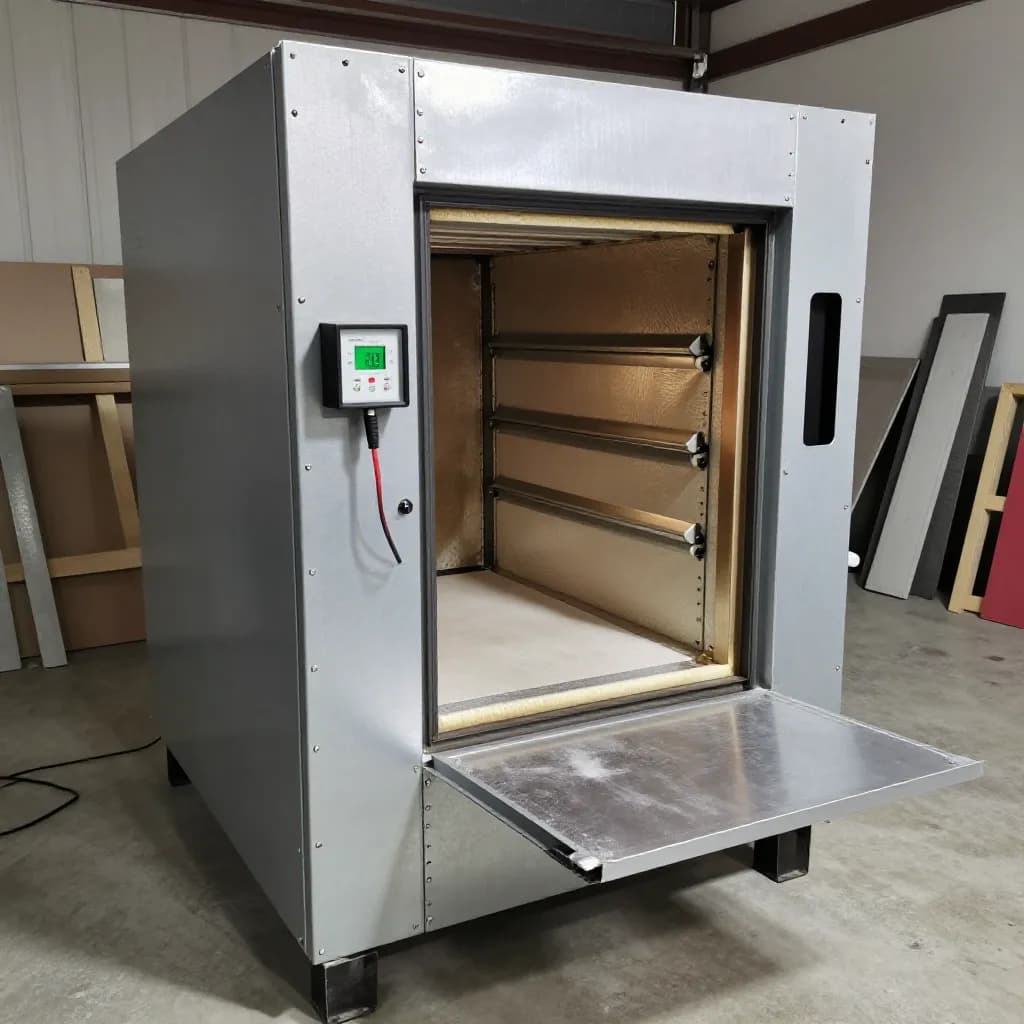
For the home hobbyist, there are two main paths: converting an existing kitchen oven or building a custom oven from scratch. Each approach has distinct advantages and limitations. A converted kitchen oven is the fastest and cheapest way to start, but it limits you to small parts. A custom-built oven requires more investment and effort, but it opens the door to coating larger items like wheels, frames, and furniture.
Ready to Start Your Project?
From one-off customs to 15,000-part production runs — get precise pricing in 24 hours.
On This Page
Why Your Oven Is the Heart of DIY Powder Coating
Before choosing your path, consider the types of projects you plan to tackle. If you are primarily coating small brackets, valve covers, and hand tools, a standard kitchen oven may serve you well for years. If you have ambitions to coat wheels, motorcycle frames, or patio furniture, you will want to plan for a larger oven from the start. Building a small oven first and upgrading later is a common and perfectly valid approach — many experienced DIY coaters started with a thrift store oven and graduated to a custom build as their skills and project demands grew.
Converting a Kitchen Oven for Powder Coating
The most accessible entry point for DIY powder coating is a used kitchen oven. You can find suitable electric ovens at thrift stores, garage sales, or online marketplaces for very little money. The key requirement is that the oven must be electric — never use a gas oven for powder coating, as the open flame creates a fire and explosion hazard with airborne powder particles.
When selecting a used oven, look for models with reliable temperature controls and good door seals. Test the oven with a standalone oven thermometer before committing to it. Many kitchen ovens have temperature swings of 25°F or more, which is acceptable for cooking but can cause issues with powder curing. Place the thermometer in several locations inside the oven to check for hot and cold spots.
Once you have your oven, the conversion process is straightforward. Remove any non-essential interior components like racks you will not use. Clean the interior thoroughly to remove grease and food residue. Consider adding a second oven thermometer that you can read without opening the door — some coaters drill a small hole and mount a probe thermometer through the side wall. The biggest limitation of a kitchen oven is size. A standard 30-inch oven has an interior cavity of roughly 24 inches wide by 16 inches deep by 14 inches tall. This accommodates valve covers, small brackets, light fixtures, and similar items, but wheels and larger parts will not fit. Accept this limitation or plan your custom build.
Planning a Custom Powder Coating Oven Build
Building a custom oven allows you to size it for the parts you want to coat. The most common DIY approach uses a welded or bolted steel frame lined with insulation and heated by electric heating elements. Before cutting any metal, spend time planning your oven dimensions, heating requirements, and placement in your workshop.
Start by identifying the largest part you want to coat and add at least 6 inches of clearance on all sides. For wheels, a common interior dimension is 36 inches wide by 36 inches deep by 36 inches tall. For motorcycle frames, you may need 48 inches or more in one dimension. Remember that parts need to hang freely inside the oven, so account for hanging hardware and hooks in your height calculation.
The outer shell is typically built from 18-gauge or 20-gauge sheet steel, either welded to a steel angle-iron frame or screwed to a frame using self-tapping screws. A double-wall construction with insulation between the inner and outer shells is essential for heat retention and energy efficiency. Without proper insulation, your oven will take forever to reach temperature, struggle to maintain it, and waste enormous amounts of electricity.
Sketch your design on paper or in a simple CAD program before you start building. Include the door design, hinge placement, latch mechanism, element mounting locations, thermocouple placement, and any ventilation openings. A well-planned build goes together much faster than one you are designing on the fly.
Insulation and Heat Retention Strategies
Insulation is what separates a functional powder coating oven from an energy-wasting box that cannot hold temperature. The most popular insulation material for DIY ovens is mineral wool (rock wool) batts, typically 2 to 3 inches thick. Mineral wool is rated for temperatures well above what powder coating requires, it is non-combustible, and it is readily available at building supply stores.
Ceramic fiber blanket is another excellent option, offering superior insulation per inch of thickness. It is lighter than mineral wool and easier to cut and fit into irregular spaces. However, it costs more and requires careful handling — wear gloves, long sleeves, and a respirator when cutting and installing ceramic fiber products, as the fibers are irritating to skin and lungs.
Avoid using standard fiberglass home insulation in a powder coating oven. While fiberglass can handle moderate temperatures, the paper or foil facing and the binders used in residential fiberglass batts may not be rated for sustained temperatures above 350°F. Stick with mineral wool or ceramic fiber for safety and longevity.
Install insulation between the inner and outer shells of your oven, ensuring complete coverage with no gaps or compressed areas. Pay special attention to the door — a poorly insulated door is the single biggest source of heat loss in most DIY ovens. Use high-temperature silicone gasket material or ceramic fiber rope around the door perimeter to create a tight seal when closed. Check for heat leaks by running the oven to temperature and carefully feeling around the door edges and panel joints with your hand.
Heating Elements and Electrical Wiring
Electric heating elements are the standard heat source for DIY powder coating ovens. The most commonly used elements are tubular calrod-style heaters, similar to those found in kitchen ovens but available in higher wattages and various lengths. You can also use infrared heating elements, which heat surfaces directly rather than heating the air, but they are more expensive and require more careful placement to avoid hot spots.
Calculating your heating requirement is essential. A general rule of thumb is 100 watts per cubic foot of oven interior volume, but this assumes good insulation. For a 36 x 36 x 36-inch oven (approximately 27 cubic feet), you would need roughly 2,700 watts minimum. Most builders add a safety margin and aim for 3,000 to 4,500 watts to ensure the oven can reach temperature quickly and recover after door openings.
Electrical wiring for a powder coating oven must be done safely and to code. Most DIY ovens run on a 240-volt circuit, which is more efficient than 120 volts for high-wattage applications. Use appropriately rated wire, connectors, and a dedicated circuit breaker. All wiring should be high-temperature rated where it passes through or near the oven shell. If you are not comfortable with electrical work, hire a licensed electrician to wire your oven — this is not an area where mistakes are acceptable.
Mount heating elements near the bottom of the oven for natural convection, or add a high-temperature circulation fan to distribute heat evenly throughout the chamber. Forced convection significantly improves temperature uniformity and reduces cure time variations between parts at different locations in the oven.
Temperature Control and Monitoring
Accurate temperature control is critical for consistent powder coating results. The simplest approach is an analog infinite-switch controller, similar to what kitchen ovens use, but this provides only rough temperature control and no precise setpoint capability. A much better option is a PID (Proportional-Integral-Derivative) temperature controller, which maintains your setpoint within a few degrees by continuously adjusting power to the heating elements.
PID controllers are available from industrial supply companies and online retailers. Look for a controller that accepts a K-type thermocouple input, has a relay or SSR (Solid State Relay) output, and supports auto-tuning. Auto-tuning allows the controller to learn the thermal characteristics of your specific oven and optimize its control parameters automatically. Pair the PID controller with a solid state relay rated for your heating element load — SSRs switch faster and last longer than mechanical relays for this application.
Mount the thermocouple probe inside the oven at the approximate center of where your parts will hang. Avoid placing it directly next to a heating element or against the oven wall, as this will give you a reading that does not represent the actual air temperature around your parts. Some builders install two thermocouples — one for the controller and one for an independent monitoring thermometer — to verify accuracy.
Consider adding a simple timer or programming your PID controller with a soak timer if it supports one. Powder coatings require a specific time at temperature — typically 10 to 20 minutes after the part reaches full cure temperature. A timer helps you track this accurately without constantly watching the clock.
Oven Safety Essentials You Cannot Skip
A powder coating oven operates at temperatures that can cause serious burns, start fires, and create electrical hazards. Safety must be designed into your oven from the beginning, not added as an afterthought. Start with the electrical system — all wiring must be properly rated, connections must be secure, and the oven must be on a dedicated circuit with an appropriately sized breaker. Ground the oven frame to the electrical ground to prevent shock hazards.
Ventilation is another critical safety consideration. During the curing process, powder coatings release small amounts of volatile gases as they crosslink. While these emissions are minimal compared to liquid paint, they should not accumulate in an enclosed space. If your oven is inside a garage or workshop, ensure adequate ventilation by opening doors or windows, or install an exhaust fan that activates during curing cycles.
Fire safety requires attention to what goes into the oven and what surrounds it. Never cure parts with excessive powder buildup, as thick accumulations can ignite. Keep the area around the oven clear of flammable materials, including powder containers, solvents, rags, and cardboard. Have a fire extinguisher rated for electrical fires (Class C or ABC) mounted within easy reach of the oven.
The oven exterior will be hot during operation. If your workshop is shared with family members or others, consider adding warning signs and a physical barrier to prevent accidental contact. Use high-temperature paint on the exterior to prevent rust and make the oven easier to identify as a hot surface. Always wear heat-resistant gloves when loading and unloading parts, and never reach into a hot oven without proper protection.
Testing and Calibrating Your New Oven
Before coating your first part, thoroughly test and calibrate your oven. Start by running it empty to full cure temperature — typically 400°F (204°C) — and holding it there for at least 30 minutes. Monitor the temperature with an independent thermometer placed at several locations inside the oven to map hot and cold spots. Temperature variation of 10°F or less across the oven interior is a good target; variations of 25°F or more indicate a need for better air circulation or element placement adjustments.
During this initial test run, check the exterior for excessive heat. The outer shell should be warm but not too hot to touch briefly. If any area is extremely hot, you likely have an insulation gap that needs to be addressed. Also check the door seal — hold a piece of tissue paper near the door edges while the oven is at temperature. If the paper flutters, you have air leaks that will waste energy and create temperature inconsistencies.
Once you are satisfied with temperature uniformity, run a test cure on a scrap piece of metal. Apply powder to a clean, prepped piece of steel and cure it according to the powder manufacturer's specifications. After cooling, test the finish by trying to scratch it with a coin or your fingernail. A properly cured coating will be hard and resistant to scratching. If the coating is soft, gummy, or scratches easily, it is undercured — check your temperature calibration and cure time.
Document your oven's performance characteristics. Note the preheat time from cold to 400°F, the temperature recovery time after opening the door, and any consistent hot or cold spots. This information will help you position parts optimally and adjust cure times as needed for different powder formulations.
Frequently Asked Questions
Can I use a gas oven for powder coating?
No. Gas ovens have open flames that create a fire and explosion hazard when airborne powder particles are present. Always use an electric oven for powder coating. This applies to both converted kitchen ovens and custom-built ovens.
How big should I build my powder coating oven?
Size your oven based on the largest parts you plan to coat, plus at least 6 inches of clearance on all sides. For wheels, a 36x36x36-inch interior is common. For motorcycle frames, you may need 48 inches or more in one dimension. Start with your most ambitious project and build accordingly.
What temperature does a powder coating oven need to reach?
Most powder coatings cure between 350°F and 425°F (175°C–220°C), with 400°F (204°C) being the most common cure temperature. Your oven should be able to reach at least 450°F to provide a margin above typical cure temperatures and account for heat loss during door openings.
How much does it cost to build a DIY powder coating oven?
A converted kitchen oven can be set up for very little if you find a used oven. A custom-built oven typically requires sheet steel, insulation, heating elements, a PID controller, and electrical components. The total investment varies based on size and materials chosen, but building your own is significantly less expensive than purchasing a commercial unit.
What insulation should I use in a powder coating oven?
Mineral wool (rock wool) batts rated for high temperatures are the most popular choice, typically 2-3 inches thick. Ceramic fiber blanket is another excellent option with superior insulation per inch. Avoid standard fiberglass home insulation, as it may not be rated for sustained temperatures above 350°F.
Ready to Start Your Project?
From one-off customs to 15,000-part production runs — get precise pricing in 24 hours.