A well-designed workshop layout makes powder coating easier, faster, and more enjoyable. A poorly designed layout has you carrying parts back and forth across the garage, tripping over air hoses, and contaminating freshly coated parts with blast dust because your blasting and coating areas are too close together. Taking time to plan your layout before setting up equipment pays dividends in every coating session.
DIY
DIY Powder Coating Garage Workshop Layout: Workflow, Electrical, and Storage
Sundial Powder Coating·April 22, 2026·11 min
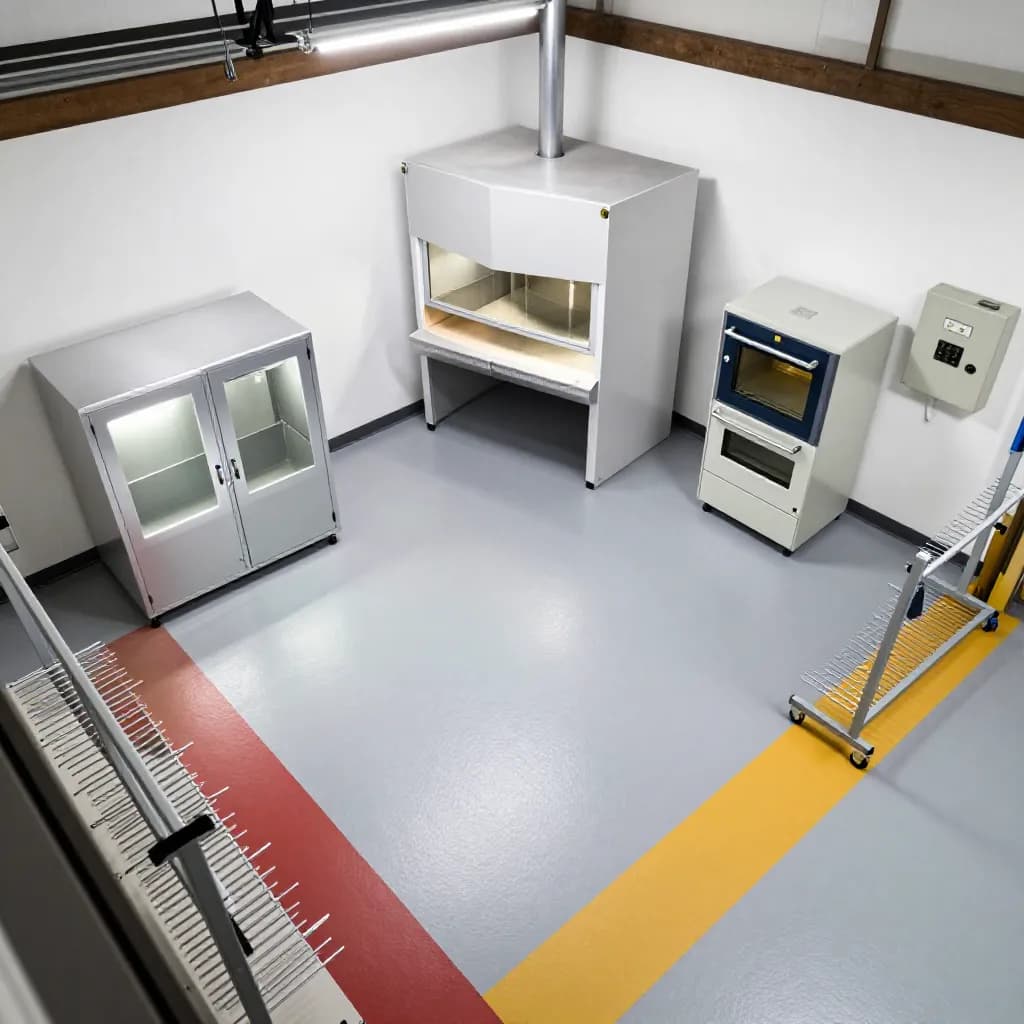
The fundamental principle of workshop layout is workflow — arranging your equipment and work areas in the sequence you use them. A typical powder coating workflow moves through five stages: cleaning and stripping, blasting, coating, curing, and cooling and inspection. Your layout should allow parts to flow through these stages with minimal backtracking and handling.
Ready to Start Your Project?
From one-off customs to 15,000-part production runs — get precise pricing in 24 hours.
On This Page
Designing a Powder Coating Workshop That Works
Most home powder coating workshops are set up in a two-car garage, which provides roughly 400 to 500 square feet of floor space. This is enough for a complete setup if you plan carefully, but space is tight and every square foot matters. Single-car garages (roughly 200 square feet) can work for a minimal setup but require creative space management and may limit the size of parts you can process.
Before moving any equipment, sketch your garage dimensions on paper and cut out scaled shapes representing each piece of equipment. Move the shapes around to test different arrangements before committing to a layout. Consider door locations, electrical outlet positions, window placement for ventilation, and the path you will walk carrying parts through the process.
Workflow Zones: Organizing by Process Stage
Divide your workshop into distinct zones for each stage of the powder coating process. Keeping these zones separated prevents cross-contamination and creates an organized, efficient workspace.
The prep zone is where you strip, clean, and degrease parts. This area needs a workbench, chemical storage, and access to water for rinsing. Position it near the garage door for ventilation when using chemical strippers and solvents. A utility sink is a luxury but extremely useful — if plumbing is not practical, a large plastic tub on the workbench serves the same purpose.
The blasting zone houses your blast cabinet and media storage. This area generates the most dust in the workshop, so position it as far from the spray booth as possible. Ideally, the blasting zone is on the opposite side of the garage from the coating zone, with the prep zone in between. If space does not allow this separation, install a curtain or partition between the blasting and coating areas to prevent dust migration.
The coating zone contains your spray booth, powder coating gun, and powder storage. This area must be the cleanest zone in the workshop — any dust or contamination here ends up in your finish. Position the booth where it has access to ventilation (near a window or exterior wall) and where airflow from the booth exhaust does not blow toward the blasting area.
The curing zone is where your oven lives. Position the oven as close to the spray booth as practical to minimize the distance you carry freshly coated parts. The oven needs clearance on all sides for heat dissipation and safe access. Keep flammable materials at least 3 feet from the oven on all sides.
The cooling and inspection zone is a clean area where cured parts cool and are inspected. A simple rack or table with good overhead lighting serves this purpose. Position it near the oven for convenient unloading but away from dust-generating activities.
Electrical Requirements and Planning
Electrical planning is one of the most important and most overlooked aspects of workshop setup. Powder coating equipment has significant electrical demands, and a standard residential garage circuit is often inadequate without upgrades.
Your curing oven is the biggest electrical load. A custom-built oven typically requires a dedicated 240-volt circuit rated for 20 to 30 amps, depending on the heating element wattage. This is similar to the circuit used for an electric clothes dryer or range. If your garage does not have a 240-volt outlet, you will need an electrician to install one from your electrical panel.
Your compressor is the second largest load. A large shop compressor may require a dedicated 240-volt circuit as well, or at minimum a dedicated 120-volt 20-amp circuit. Running a compressor on a shared circuit with other equipment can trip breakers and cause voltage drops that affect compressor performance.
The powder coating gun power supply, booth fan, lighting, and other accessories can typically share a standard 120-volt 20-amp circuit, but avoid overloading it. Add up the amperage of everything on the circuit and ensure the total does not exceed 80 percent of the circuit's rating (16 amps on a 20-amp circuit).
Plan your outlet locations based on your equipment layout. Having outlets where you need them eliminates extension cords, which are a tripping hazard and can cause voltage drops with high-amperage equipment. If you are adding circuits, install outlets at the locations where your equipment will be positioned.
All outlets in the workshop should be GFCI protected, especially those near water sources and the powder coating gun. Install adequate lighting throughout the workshop — LED shop lights are energy-efficient and provide excellent illumination. Good lighting in every zone improves your work quality and safety.
Compressed Air System Layout
Your compressed air system serves both the blast cabinet and the powder coating gun, and its layout affects the performance of both. Plan your air distribution system to deliver clean, dry air at adequate pressure and flow to every point of use.
Position your compressor where it has adequate ventilation for cooling and where the noise is least disruptive. Compressors generate significant heat and noise during operation. Near the garage door or an exterior wall is ideal. If noise is a concern, consider building a simple sound-dampening enclosure or placing the compressor in an adjacent room or closet with ventilation.
Run hard pipe (copper, aluminum, or galvanized steel) from the compressor to your work areas rather than relying on long runs of rubber hose. Hard pipe maintains pressure better over distance, is less prone to kinking, and provides a more professional installation. Use 3/4-inch pipe for the main trunk line and reduce to 1/2-inch at individual drops. Slope the pipe slightly downward from the compressor to allow moisture to drain to a low point where you install a drain valve.
Install moisture separation at two points: immediately after the compressor (a large water separator) and at each point of use (a smaller filter-regulator-lubricator unit, minus the lubricator for powder coating). Moisture in the air line is the enemy of both blasting and powder coating — it causes media clumping in the blast cabinet and adhesion failures in the powder coat.
If your budget allows, add a refrigerated air dryer or desiccant dryer to the system. These remove moisture far more effectively than simple water separators and are especially valuable in humid climates. Position the dryer after the compressor's aftercooler and before the distribution piping.
Storage Solutions for Powder, Media, and Supplies
Organized storage keeps your workshop functional and your materials in good condition. Powder coating involves numerous supplies — powders in multiple colors, blasting media, chemicals, masking materials, hanging hardware, and safety equipment — that need dedicated storage to stay organized and uncontaminated.
Powder storage requires a cool, dry location away from heat sources. A dedicated cabinet or shelving unit in the cleanest area of your workshop works well. Store powder in sealed containers, clearly labeled with color name, manufacturer, chemistry, cure schedule, and purchase date. Organize by color family or frequency of use for easy access. Keep the storage area away from the oven and any heat-generating equipment.
Blasting media storage should be near the blast cabinet for convenience. Store media in sealed containers to prevent moisture absorption and contamination. If you use multiple media types (aluminum oxide, glass bead, etc.), label containers clearly to prevent mixing. Keep a supply of fresh media on hand so you are not caught short mid-project.
Chemical storage requires attention to safety. Store solvents, strippers, and degreasers in a ventilated cabinet away from heat sources and ignition sources. Keep containers sealed when not in use. A small metal flammable-storage cabinet is ideal if your budget allows — otherwise, a well-ventilated shelf away from the oven and electrical equipment works.
Hanging hardware — hooks, wire, clips, and fixtures — accumulates quickly and becomes disorganized if not managed. Dedicate a pegboard, drawer, or bin system to hanging hardware. Organize by size and type so you can quickly find the right hook for each project. Keep a supply of clean hooks ready for use — hooks with powder buildup need to be cleaned or replaced before each use.
Safety equipment should be stored in a clean, accessible location near the entrance to the workshop. Respirators, gloves, safety glasses, and hearing protection should be easy to grab before starting any task. A wall-mounted organizer or dedicated shelf near the door encourages consistent PPE use.
Maximizing a Small Garage Space
If you are working in a single-car garage or a small two-car garage that also needs to accommodate a vehicle, space optimization becomes critical. Several strategies can help you fit a functional powder coating setup into a limited footprint.
Use vertical space aggressively. Wall-mounted shelving, pegboard tool storage, and ceiling-mounted racks keep supplies and equipment off the floor. Mount your spray booth fan and filtration system on the wall rather than using floor space. Hang your air hose and gun cable from ceiling-mounted reels that retract when not in use.
Make equipment mobile. Mount your blast cabinet, workbench, and supply storage on heavy-duty casters so they can be rolled out of the way when not in use. A blast cabinet on wheels can be pushed against the wall when you need floor space for coating, and rolled into position when you need to blast.
Consider a collapsible spray booth that can be set up for coating sessions and broken down for storage. PVC frame booths with plastic sheeting walls can be assembled in minutes and stored flat against a wall when not in use. This approach sacrifices convenience for space efficiency.
If your oven is a converted kitchen oven, it can be placed on a heavy-duty rolling cart that tucks against the wall when not in use. For a custom-built oven, consider building it tall and narrow rather than wide and deep to minimize its floor footprint.
Share space with other workshop activities by creating clear boundaries between zones. A rolling curtain or partition separates the powder coating area from a general workshop area, preventing contamination while allowing the space to serve multiple purposes. When you are not coating, the coating zone becomes available for other projects.
Ventilation and Climate Control
Ventilation is both a safety requirement and a quality factor in your workshop layout. Proper airflow removes hazardous fumes and dust, prevents powder contamination, and helps control temperature and humidity — all of which affect your coating results.
Your spray booth exhaust is the primary ventilation system. It should exhaust to the outdoors through a wall or window, with the exhaust point directed away from windows, doors, and air intakes. If outdoor exhaust is not possible, recirculate through high-quality filters, but understand that this is a compromise — outdoor exhaust is always preferred.
General workshop ventilation supplements the booth exhaust. A large exhaust fan in the garage door or wall provides whole-shop air exchange that removes residual dust, fumes, and heat. Position the exhaust fan on the opposite side of the workshop from the fresh air intake (typically the garage door) to create cross-ventilation that sweeps the entire space.
Temperature and humidity affect powder coating quality. Powder does not apply well in extremely cold conditions (below 50°F) because the electrostatic charge is less effective and the powder does not fluidize properly. High humidity causes moisture problems in the air supply and can affect powder charging and adhesion. If you coat in a climate with temperature or humidity extremes, consider adding heating for winter and dehumidification for summer.
In hot climates, the oven adds significant heat to the workshop. Plan your layout so the oven heat can be vented outdoors rather than heating the entire garage. Position the oven near the garage door or an exhaust fan so heat dissipates quickly after curing cycles. Coating in the early morning during summer months avoids the worst of the heat buildup.
Frequently Asked Questions
How much garage space do I need for a powder coating workshop?
A two-car garage (400-500 sq ft) provides comfortable space for a complete setup. A single-car garage (200 sq ft) can work for a minimal setup with mobile equipment and creative space management. The key is separating blasting and coating zones to prevent contamination.
What electrical upgrades does a powder coating workshop need?
At minimum, a dedicated 240V circuit for the curing oven (20-30 amps) and a dedicated circuit for the compressor. All outlets should be GFCI protected. Plan outlet locations based on equipment placement to avoid extension cords. Hire a licensed electrician for 240V installations.
How do I prevent blast dust from contaminating my powder coating?
Separate the blasting and coating zones as far apart as possible. Install a curtain or partition between them. Upgrade your blast cabinet's dust collection. Clean the workshop between blasting and coating sessions. Keep the spray booth area as the cleanest zone in the workshop.
Should I run hard pipe or rubber hose for compressed air?
Hard pipe (copper, aluminum, or galvanized steel) is preferred for the main distribution system. It maintains pressure better over distance, allows moisture to drain, and provides a more reliable installation. Use 3/4-inch pipe for the main trunk and 1/2-inch at individual drops. Short rubber hoses at the point of use are fine.
How do I manage powder coating in a garage that also parks a car?
Use mobile equipment on casters that can be rolled aside. Build a collapsible spray booth. Create clear zone boundaries with rolling curtains. Store supplies on wall-mounted shelving to keep floor space clear. Schedule coating sessions when the vehicle is out of the garage.
Ready to Start Your Project?
From one-off customs to 15,000-part production runs — get precise pricing in 24 hours.