Your first powder coating project should be chosen for learning value, not ambition. The goal is to practice every step of the process — preparation, application, and curing — on a part where mistakes are low-stakes and easy to redo. Resist the temptation to start with your prized valve covers or a set of expensive wheels. Instead, pick something simple, small, and expendable.
DIY
Your First DIY Powder Coating Project: A Step-by-Step Beginner Guide
Sundial Powder Coating·April 22, 2026·11 min
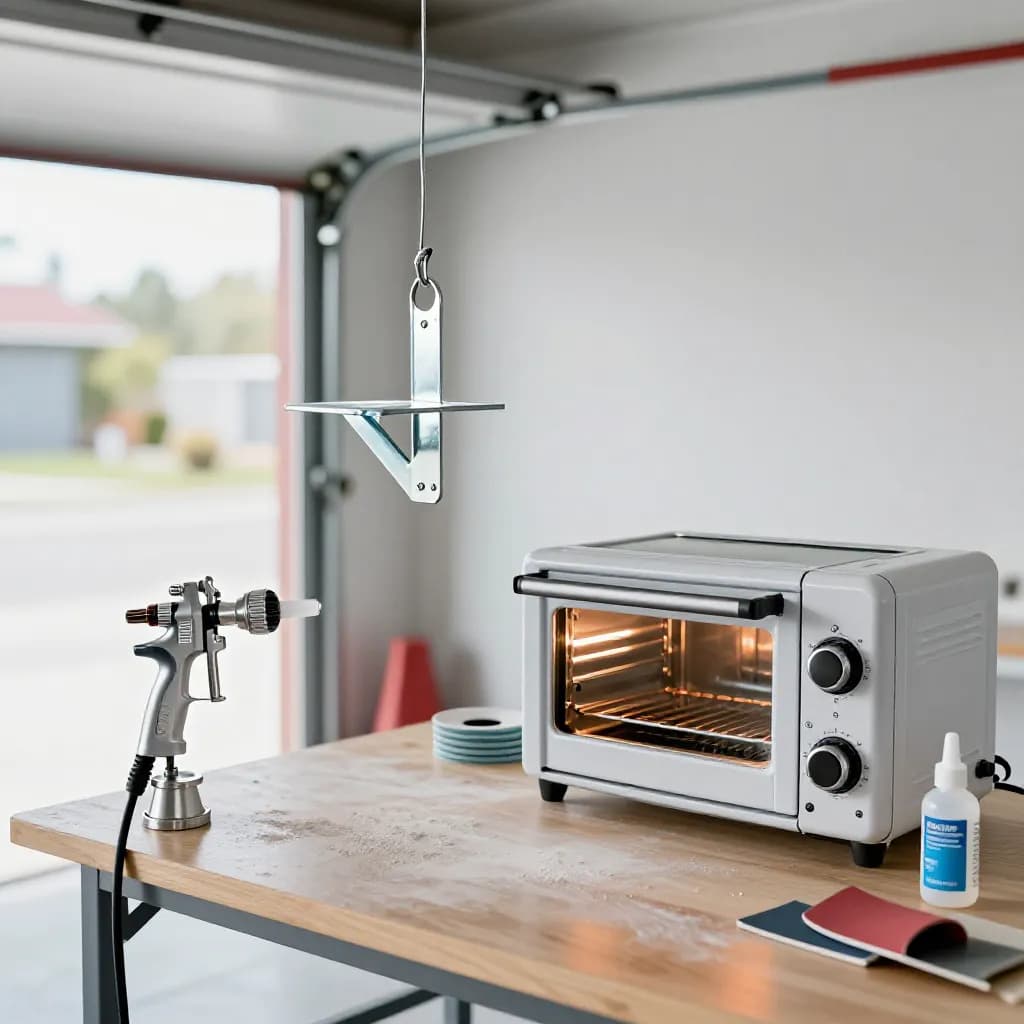
Ideal first projects include small steel brackets, hinges, simple hand tools, mailbox parts, or steel shelf brackets from the hardware store. These parts are inexpensive, have simple geometries, and are small enough to fit in any oven. They also give you a useful finished product — a freshly powder-coated set of shelf brackets or a restored mailbox looks great and gives you something to show for your practice.
Ready to Start Your Project?
From one-off customs to 15,000-part production runs — get precise pricing in 24 hours.
On This Page
Choosing the Right First Project
Avoid complex geometries for your first attempt. Parts with deep recesses, tight inside corners, or intricate shapes create Faraday cage challenges that require technique adjustments you have not learned yet. Stick with relatively flat or gently curved surfaces that are forgiving of imperfect spray technique. You will tackle complex parts soon enough, but your first project should build confidence, not frustration.
Also consider the substrate. Start with mild steel, which is the most forgiving material for powder coating. Steel heats evenly, holds a ground well, blasts easily, and does not have the outgassing issues that aluminum and cast metals can present. Once you have a few successful steel projects under your belt, you can move on to aluminum and other substrates with confidence.
Gathering Your Materials and Equipment
Before starting your first project, make sure you have everything you need assembled and ready. Nothing kills momentum like discovering mid-project that you are missing a critical supply. Here is what you need for a basic first project.
For surface preparation, you need a degreaser or pre-treatment cleaner, clean lint-free rags or paper towels, and either a blast cabinet with media or sandpaper and chemical etch primer as a fallback. Nitrile gloves are essential for handling cleaned parts without contaminating them with skin oils.
For application, you need your powder coating gun with a power supply, a container of powder in your chosen color, compressed air supply with moisture filtration, hanging hooks or wire for suspending the part, and a grounding wire or clamp. If you have a spray booth, set it up. If not, work in a clean, draft-free area with a drop cloth to catch overspray.
For curing, you need your oven preheated to the temperature specified on the powder container, an independent thermometer to verify oven temperature, heat-resistant gloves for handling hot parts, and a timer. Read the powder manufacturer's cure schedule before you start — typical schedules call for 10 to 20 minutes at 350°F to 400°F, but this varies by product.
For safety, you need safety glasses, a dust mask or respirator rated for fine particulates, and nitrile gloves. If you are blasting, add hearing protection and a full-face shield or blast hood. Have a fire extinguisher accessible near your oven.
Step 1: Surface Preparation
Start by degreasing your part thoroughly. Even new parts from the hardware store have oils, cutting fluids, or handling residue on them. Spray or wipe the part with your degreaser, scrub any visible contamination, and wipe clean with a fresh rag. Repeat until the rag comes away clean. Let the part dry completely.
Next, create a surface profile for the powder to grip. If you have a blast cabinet, blast the entire part with aluminum oxide or glass bead media until it has a uniform matte finish with no shiny spots. Work systematically, covering every surface including edges and any holes or slots. The blasted surface should look consistently dull and feel slightly rough to the touch.
If you do not have blasting equipment, sand the part thoroughly with 120 to 180 grit sandpaper, then apply a chemical etch primer designed for powder coating adhesion. This is not as effective as blasting, but it will work for your first project. Plan to add blasting capability to your setup as soon as practical.
After blasting or sanding, do a final wipe with acetone or denatured alcohol to remove any remaining dust or contamination. From this point forward, handle the part only with clean nitrile gloves. Any oil from your skin will cause adhesion failures. If you set the part down, place it on a clean surface — not on a dusty workbench or oily shop rag.
Inspect the prepared surface carefully. Look for any remaining rust, old coating, or contamination. Check edges and corners where old finish tends to hide. If you find any issues, address them now. It is much easier to fix preparation problems before coating than to strip and redo the entire part.
Step 2: Hanging and Grounding the Part
How you hang your part affects both the coating process and the final result. The hanging point will not receive powder coating, so choose a location that is either hidden or unimportant. For brackets, hang from a mounting hole. For tools, hang from the handle end. Think about which surfaces matter most and orient the part so those surfaces face the gun during spraying.
Use steel wire or purpose-made hanging hooks. The hook must make clean metal-to-metal contact with the part — if the contact point has powder residue, paint, or rust, scrape it clean. The hook also needs to support the part securely through the entire process, including the oven cure cycle where the part will be at 400°F. Make sure the hook is strong enough that the part will not fall during handling or curing.
Connect your grounding wire to the hanging hook or directly to the part at a clean metal contact point. Run the ground wire to a known earth ground. Test the ground connection with a multimeter — you should see near-zero resistance from the part through the hook and wire to ground. A poor ground connection is one of the most common causes of poor powder adhesion, and it is easy to verify before you start spraying.
Hang the part at a comfortable working height in your spray booth or coating area. You should be able to reach all surfaces of the part with the gun without straining or contorting. If the part rotates freely on the hook, that is actually helpful — you can spin it to access different sides without moving your feet. Make sure the part is stable and will not swing excessively when hit by the air stream from the gun.
Step 3: Applying the Powder
With your part hung, grounded, and your oven preheating, it is time to apply powder. Turn on your gun and set it to a moderate voltage — around 60 to 70 percent of maximum is a good starting point. Set the powder flow to a low-to-medium rate. You can always add more powder, but removing excess is difficult.
Hold the gun 8 to 12 inches from the part surface. Begin spraying with smooth, steady passes across the part, moving at a consistent speed. Overlap each pass by about 50 percent to ensure even coverage. Do not try to build full coverage in one pass — two or three light passes produce a much better result than one heavy pass.
Watch the powder as it lands on the part. It should adhere in a smooth, even layer that gradually obscures the metal surface. If powder is bouncing off or not sticking, check your ground connection. If you see a textured or rough buildup, you may be applying too much or your voltage may be too high. If the powder looks thin and patchy, increase your flow rate slightly or make additional passes.
Coat all surfaces of the part, including edges and any areas that will be visible in the finished installation. Edges tend to get light coverage because the electrostatic field wraps around them, so give edges a dedicated pass or two. Rotate the part on its hook to access all sides.
When you are satisfied with the coverage, stop and inspect the part from multiple angles. Look for thin spots, heavy areas, and any bare metal showing through. The uncured powder should look like a uniform, slightly fuzzy coating. If you see problems, you can add more powder to thin areas or gently blow off heavy accumulations with low-pressure air from a distance. Once you are happy with the coverage, carefully transport the part to the oven.
Step 4: Curing in the Oven
Your oven should be preheated to the temperature specified on the powder container — typically 375°F to 400°F (190°C to 204°C) for most standard polyester powders. Verify the temperature with your independent thermometer before loading the part.
Carefully place or hang the part in the oven without bumping it against the oven walls or other surfaces. Uncured powder is fragile and will smudge or fall off if touched. Close the oven door gently to avoid creating air currents that could disturb the powder.
Now comes the part that trips up most beginners: timing the cure correctly. The cure schedule on the powder container specifies time at temperature — for example, 10 minutes at 400°F. This means the part itself must be at 400°F for 10 minutes, not that the oven must be at 400°F for 10 minutes. After you load a room-temperature part into a hot oven, the oven temperature will drop and then recover, and the part will gradually heat up to oven temperature. For a small steel bracket, this might take 5 to 8 minutes. For a heavier part, it could take 15 minutes or more.
Watch the part through the oven window if you have one. You will see the powder go through distinct phases: first it melts and flows into a smooth, glossy liquid, then it begins to gel and crosslink. The flow-out phase is fascinating to watch and tells you the process is working. Start your cure timer when the part reaches full temperature, not when you close the oven door.
When the cure time is complete, turn off the oven or remove the part (with heat-resistant gloves) and allow it to cool. Do not quench hot parts in water — the thermal shock can crack the coating or warp the part. Let it air cool on a clean rack until it is cool enough to handle.
Step 5: Inspecting Your First Finished Part
Once your part has cooled completely, it is time to evaluate your work. Hold the part under good lighting and examine it from all angles. A well-cured powder coating should be smooth, uniform in color and gloss, and free of defects like orange peel, runs, thin spots, or contamination specks.
Run your fingernail across the surface. A properly cured coating is hard and scratch-resistant — your fingernail should not leave a mark. If the coating feels soft, gummy, or scratches easily, it is undercured. This means either your oven temperature was too low, the cure time was too short, or the part did not reach full temperature before you started timing. The fix is to put the part back in the oven for an additional cure cycle.
Check adhesion by pressing a piece of masking tape firmly onto the coating and pulling it off sharply. If the coating comes off with the tape, you have an adhesion problem, likely caused by surface contamination or inadequate preparation. Unfortunately, the only fix for adhesion failure is to strip the part and start over with better preparation.
Examine the edges and corners. These areas are prone to thin coverage and are where coating failures typically start in service. If the edges look thin or bare, note this for your next project — you may need to give edges extra attention during application or adjust your technique.
Finally, compare the color and gloss to the powder manufacturer's specifications or color chip. Significant deviations in color or gloss can indicate curing problems. Yellowing or darkening suggests overcuring, while a higher-than-expected gloss on a matte powder may indicate undercuring. Document your results and any observations for future reference.
Building Confidence for Your Next Projects
Your first project is a learning experience regardless of the outcome. If it turned out well, congratulations — you now have a tangible result that proves the process works and that you can do it. If it did not turn out perfectly, you have valuable information about what to improve. Either way, you are further ahead than you were before you started.
Before moving on to more ambitious projects, consider doing two or three more simple parts to reinforce what you learned. Try a different color to practice gun cleaning and color change procedures. Try a slightly more complex geometry to start developing your technique for recessed areas. Try a part with both flat and curved surfaces to practice maintaining consistent coverage across different contours.
Keep notes on every project. Record the powder type and color, gun settings (voltage and flow), spray distance, oven temperature, cure time, and the result. Over time, these notes become an invaluable reference that helps you dial in settings for new powders and part types. When something goes wrong, your notes help you identify what changed.
As your confidence grows, gradually increase the complexity and value of your projects. Move from brackets and hardware to valve covers, small automotive parts, and household items. Each project teaches you something new about the process and builds the skills you need for the big projects — wheels, frames, and furniture — that probably inspired you to get into powder coating in the first place.
The DIY powder coating community is a tremendous resource as you develop your skills. Online forums and social media groups are full of experienced coaters who remember being beginners and are generous with advice and encouragement. Share your results, ask questions, and learn from others' experiences.
Frequently Asked Questions
What is the best first powder coating project for beginners?
Small steel parts like brackets, hinges, shelf brackets, or mailbox components are ideal first projects. They are inexpensive, have simple geometries, fit in any oven, and give you practice with every step of the process. Avoid complex shapes and valuable parts until you have built confidence with simpler items.
Do I need a blast cabinet for my first powder coating project?
A blast cabinet produces the best results, but you can start without one by sanding with 120-180 grit sandpaper and using a chemical etch primer. This approach works for learning the process, but plan to add blasting capability soon — it dramatically improves adhesion and surface quality.
How do I know when the powder coating is fully cured?
A properly cured coating is hard and scratch-resistant — your fingernail should not leave a mark. The color and gloss should match the manufacturer's specifications. Cure time starts when the part reaches full cure temperature, not when the oven reaches temperature. Use a thermometer to verify part temperature.
What if my first powder coating project does not turn out well?
Most first attempts are imperfect, and that is expected. Evaluate what went wrong — thin spots suggest technique issues, peeling indicates preparation problems, and soft coating means undercuring. Strip the part, fix the identified issue, and try again. Each attempt teaches you something valuable about the process.
How many practice projects should I do before tackling important parts?
Do at least three to five simple projects before moving to parts you care about. Practice different colors, slightly more complex geometries, and both flat and curved surfaces. This builds the muscle memory and process understanding you need to produce consistent results on valuable parts.
Ready to Start Your Project?
From one-off customs to 15,000-part production runs — get precise pricing in 24 hours.