Color consistency is one of the most demanding quality requirements in powder coating, particularly for architectural, automotive, and consumer product applications where coated components from different production batches, coating facilities, or suppliers must match visually when assembled or installed side by side. The human eye is remarkably sensitive to color differences — trained observers can detect color shifts as small as 0.5 Delta E units under controlled lighting conditions, and even untrained consumers notice mismatches of 1-2 Delta E on adjacent panels.
Technical
Digital Color Matching in Powder Coating: Spectrophotometry and Cloud-Based Management
Sundial Powder Coating·April 22, 2026·11 min
Achieving this level of consistency across a powder coating supply chain is challenging because color is influenced by numerous variables: powder formulation and pigment dispersion, film thickness, cure temperature and time, substrate color and texture, and the viewing conditions under which the color is evaluated. A powder that produces an acceptable color match in one facility may appear noticeably different when applied at a different film thickness, cured at a slightly different temperature, or viewed under different lighting.
Ready to Start Your Project?
From one-off customs to 15,000-part production runs — get precise pricing in 24 hours.
On This Page
The Challenge of Color Consistency in Powder Coating
Digital color management technology addresses these challenges by replacing subjective visual assessment with objective, instrument-based measurement and by creating digital color standards that can be communicated precisely across global supply chains. The transition from physical color chips and visual comparison to spectrophotometric measurement and cloud-based color data represents a fundamental improvement in how the powder coating industry manages color quality.
Spectrophotometer Technology and Measurement Principles
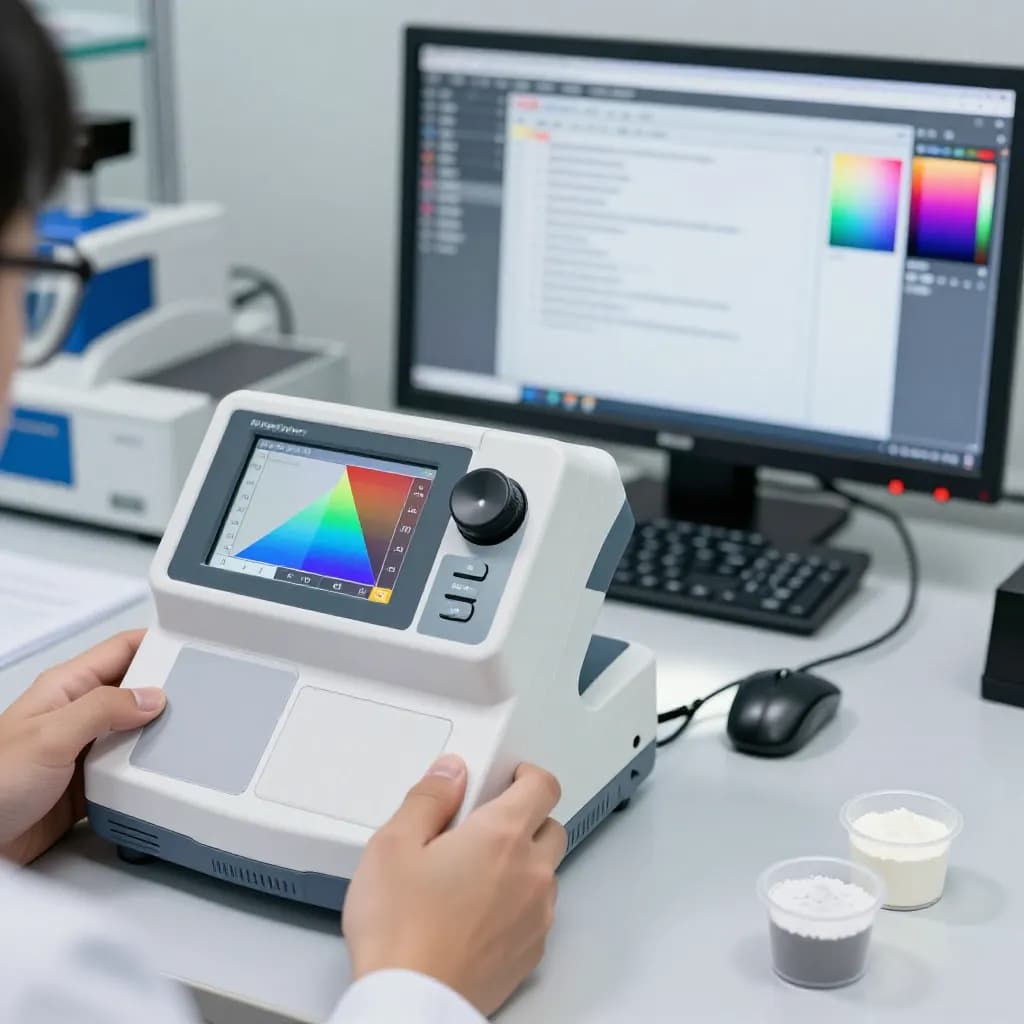
Spectrophotometers are the foundation of digital color management in powder coating. These instruments measure the spectral reflectance of a coated surface — the percentage of light reflected at each wavelength across the visible spectrum from approximately 400 to 700 nanometers. This spectral data provides a complete, objective description of the surface's color that is independent of the observer's perception or the viewing illuminant.
From the spectral reflectance data, color coordinates are calculated using standardized mathematical models. The CIE Lab* color space is the most widely used system in the coatings industry, where L* represents lightness from black to white, a* represents the red-green axis, and b* represents the yellow-blue axis. Color differences between a sample and a standard are expressed as Delta E — the Euclidean distance between two points in Lab* space — with smaller values indicating closer matches.
Modern spectrophotometers for powder coating quality control are available in benchtop and portable configurations. Benchtop instruments offer the highest precision and repeatability, with inter-instrument agreement of 0.1-0.2 Delta E, and are used for laboratory color development and reference measurements. Portable instruments enable on-line and in-field measurements with slightly lower precision but sufficient accuracy for production quality control. Multi-angle spectrophotometers, which measure reflectance at multiple viewing angles, are essential for metallic and effect powder coatings where color appearance changes with viewing geometry.
Cloud-Based Color Management Platforms
Cloud-based color management platforms have transformed how powder coating manufacturers, applicators, and end users communicate and manage color across distributed supply chains. These platforms store digital color standards — spectral reflectance data, color coordinates, and tolerance specifications — in centralized databases accessible to authorized users worldwide. When a new color is developed or a standard is updated, the digital data is instantly available to all stakeholders, eliminating the delays and inconsistencies associated with distributing physical color samples.
The workflow begins with the color standard being measured on a calibrated spectrophotometer and uploaded to the cloud platform. Tolerance limits are defined — typically as Delta E maximum values, with tighter tolerances for critical applications — along with any additional requirements such as gloss range, texture specification, or metamerism limits. Powder manufacturers access the digital standard to formulate matching powders, measuring their development samples against the cloud-stored reference. Production batches are measured and compared to the standard before shipment, with pass/fail decisions based on the defined tolerances.
Applicators receiving powder can verify incoming material against the same digital standard using their own calibrated spectrophotometers, ensuring that any color drift introduced during powder manufacturing is detected before application. Finished coated parts are measured and documented, creating a complete color quality record from formulation through application. This end-to-end digital color chain provides traceability, accountability, and consistency that physical color chip systems cannot achieve, particularly across multi-site, multi-supplier operations.
Virtual Proofing and Digital Color Approval
Virtual proofing technology enables color approval decisions to be made using digital color data and calibrated display systems, reducing or eliminating the need for physical sample panels to be shipped between stakeholders for visual approval. This capability is particularly valuable for global projects where architects, designers, and specifiers are located far from the powder manufacturer, and where shipping physical samples introduces weeks of delay into the color approval process.
Calibrated wide-gamut monitors, profiled to display colors accurately under standardized viewing conditions, can render the appearance of a powder-coated surface from its spectral data with sufficient accuracy for preliminary color selection and approval. The rendered image can show the color on a simulated building facade, vehicle panel, or product housing, providing context that a flat color chip cannot. Multiple color options can be compared side by side on screen, and the visual impact of color differences within the specified tolerance range can be evaluated.
Virtual proofing does not entirely replace physical samples for final approval — the tactile qualities of texture, the depth of metallic effects, and the interaction of color with real-world lighting conditions are difficult to reproduce digitally. However, virtual proofing dramatically reduces the number of physical sample iterations required, accelerating the color approval process from weeks to days. For standard colors within established tolerance ranges, virtual approval may be sufficient. For custom colors, critical color matches, or effect finishes, virtual proofing serves as an efficient screening step that narrows the options before physical samples are produced for final confirmation.
Supply Chain Color Consistency Strategies
Maintaining color consistency across a powder coating supply chain requires a systematic approach that addresses every source of variation from pigment procurement through finished part inspection. The strategy begins with raw material control — specifying pigment suppliers, grades, and incoming inspection criteria that ensure consistent colorant inputs to the powder manufacturing process.
Powder manufacturers implement statistical process control on color measurements during production, tracking batch-to-batch variation and adjusting formulations proactively when trends indicate drift toward tolerance limits. Color correction algorithms in formulation software can calculate pigment adjustments needed to bring a batch back to target based on spectrophotometric measurement of the initial production sample, reducing the number of correction iterations and minimizing waste.
For multi-source supply chains where the same color is produced by different powder manufacturers or at different production sites, inter-laboratory correlation programs ensure that spectrophotometric measurements are consistent across all locations. This involves regular exchange of calibration standards, round-robin testing of reference samples, and alignment of measurement procedures including sample preparation, instrument geometry, and calculation parameters. Without this measurement alignment, two facilities could both measure a sample as within tolerance against their local instruments while producing visibly different colors.
End-user quality programs should define not only the color tolerance for individual parts but also the maximum acceptable variation between adjacent parts in the final assembly. This adjacency tolerance is often tighter than the individual part tolerance and may require powder batch management strategies such as reserving single batches for adjacent components or blending batches to minimize inter-batch variation.
Metallic and Effect Color Measurement Challenges
Metallic, pearlescent, and textured powder coatings present unique color measurement challenges that require specialized instrumentation and evaluation methods. These effect coatings change appearance depending on the angle of illumination and observation — a phenomenon known as gonioapparent color — which cannot be fully characterized by a single-angle spectrophotometer measurement.
Multi-angle spectrophotometers measure reflectance at multiple combinations of illumination and observation angles, typically including near-specular angles that capture the bright face color, intermediate angles that show the transition, and high-angle measurements that reveal the flop or travel of the effect. Common multi-angle geometries include the BYK-mac's six measurement angles and the X-Rite MA series instruments. The color data from each angle is evaluated independently, and tolerance specifications must define acceptable ranges for each angle.
Texture and sparkle — the visual impression of individual metallic flake reflections — add further complexity. Sparkle is influenced by flake size, orientation, and distribution, and it varies with illumination conditions. Dedicated sparkle measurement instruments quantify this attribute using high-resolution imaging sensors that detect individual flake reflections. For complete characterization of metallic powder coatings, a measurement protocol combining multi-angle spectrophotometry for color, gloss measurement for surface sheen, and sparkle measurement for flake effect provides the most comprehensive quality assessment. Digital communication of these multi-dimensional quality parameters requires cloud platforms capable of storing and comparing multi-angle data sets.
Emerging Technologies: AI Color Formulation and Hyperspectral Imaging
Artificial intelligence is beginning to transform color formulation in powder coating. Traditional color matching relies on experienced colorists who use formulation software with databases of pigment optical properties to predict the color of pigment combinations. AI-enhanced formulation systems learn from historical formulation data — thousands of previous color matches with their pigment recipes and measured results — to predict optimal formulations more quickly and accurately than conventional algorithms.
AI formulation systems can account for complex interactions between pigments, resins, and process conditions that conventional models simplify or ignore. They can predict not only the color but also the metamerism behavior, opacity, and weathering stability of proposed formulations, enabling first-shot color matches that reduce development time and material waste. As these systems accumulate more data, their predictions improve continuously, creating a competitive advantage for manufacturers who invest in AI-driven color technology.
Hyperspectral imaging represents another emerging technology for color quality control. Unlike point-measurement spectrophotometers that measure a small area of the surface, hyperspectral cameras capture spectral data for every pixel in an image, creating a complete color map of the coated surface. This enables detection of color non-uniformity, streaking, and blending artifacts that point measurements might miss. Inline hyperspectral inspection systems can evaluate the color of every coated part at production speed, providing 100% color quality coverage. The combination of AI formulation, cloud-based color management, and hyperspectral inspection is creating a fully digital color quality ecosystem for the powder coating industry.
Frequently Asked Questions
What Delta E tolerance should I specify for powder coating color matching?
Typical tolerances range from Delta E 0.5-1.0 for critical automotive and consumer product applications to Delta E 1.0-2.0 for architectural and industrial applications. Adjacent-part tolerances should be tighter than individual part tolerances. The appropriate tolerance depends on the application, viewing conditions, and the visual sensitivity of the end user. Consult with your powder supplier to establish achievable tolerances for your specific color and finish.
Do I need a multi-angle spectrophotometer for metallic powder coatings?
Yes. Single-angle spectrophotometers cannot fully characterize the gonioapparent color of metallic and pearlescent powder coatings. Multi-angle instruments measuring at three to six angles are essential for accurate color evaluation and quality control of effect finishes. The additional investment in multi-angle instrumentation is justified for any operation regularly producing metallic or pearlescent powder coatings.
How often should spectrophotometers be calibrated?
Spectrophotometers should be calibrated at the start of each working day using the manufacturer's calibration standards. Monthly verification against certified reference tiles confirms ongoing accuracy. Annual factory recalibration or certification is recommended. For multi-site operations, regular inter-instrument correlation checks ensure measurement consistency across locations.
Can virtual proofing replace physical color samples?
Virtual proofing can replace physical samples for preliminary color selection and screening, significantly reducing the number of physical iterations needed. However, final approval of custom colors, critical matches, and effect finishes typically still requires physical samples evaluated under controlled lighting conditions. Virtual proofing is most effective as a complement to, rather than replacement for, physical sample evaluation.
What causes color variation between powder coating batches?
Batch-to-batch color variation can result from pigment lot variations, minor formulation differences, extrusion process variations affecting pigment dispersion, and grinding differences affecting particle size distribution. Application variables including film thickness, cure temperature, and substrate color also influence the final color. Digital color management with spectrophotometric measurement at each stage helps identify and control these sources of variation.
Ready to Start Your Project?
From one-off customs to 15,000-part production runs — get precise pricing in 24 hours.