The proliferation of electronic devices, wireless communication systems, and high-frequency circuits has created an increasingly congested electromagnetic environment. Every electronic device both emits and is susceptible to electromagnetic interference, making EMI shielding a critical design requirement for product compliance, performance, and safety. Regulatory frameworks including FCC Part 15 in the United States, the EU EMC Directive, and CISPR standards mandate that electronic equipment must not emit excessive electromagnetic radiation and must operate reliably in the presence of external electromagnetic fields.
Technical
Conductive Powder Coatings for EMI Shielding and ESD Protection
Sundial Powder Coating·April 22, 2026·12 min
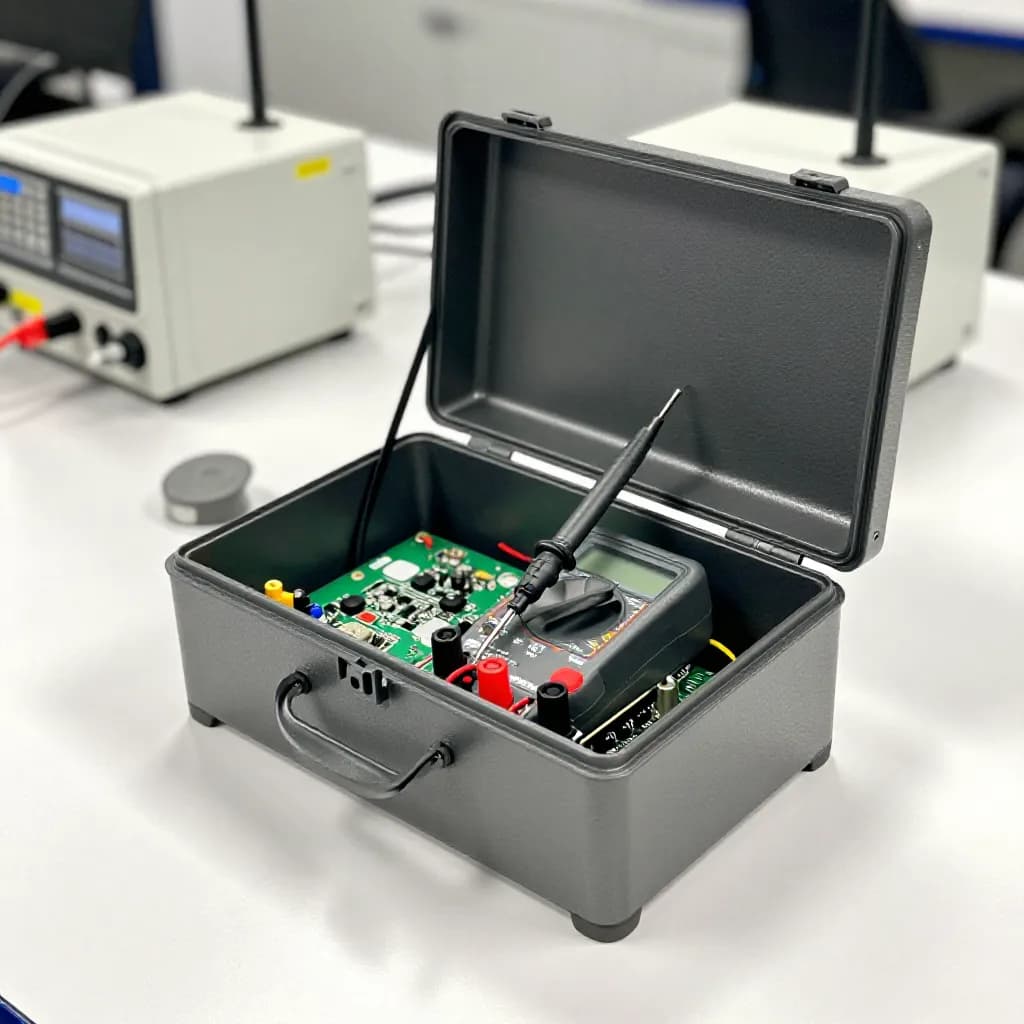
Traditionally, EMI shielding has been achieved through metal enclosures — steel, aluminum, or zinc-plated housings that form a Faraday cage around sensitive electronics. However, as product designs evolve toward lighter materials, complex geometries, and non-metallic substrates such as engineering plastics and composites, alternative shielding approaches are needed. Conductive coatings applied to the interior or exterior of enclosures provide electromagnetic shielding without the weight and design constraints of solid metal housings.
Ready to Start Your Project?
From one-off customs to 15,000-part production runs — get precise pricing in 24 hours.
On This Page
Why Electromagnetic Shielding Matters for Modern Electronics
Conductive powder coatings represent the next evolution of this approach, combining the shielding effectiveness of conductive surface treatments with the environmental and performance advantages of powder coating technology. By eliminating the solvents, heavy metals, and hazardous waste associated with traditional conductive paints and electroless plating processes, conductive powder coatings offer a cleaner, more sustainable path to EMI compliance.
Conductive Filler Technologies in Powder Coatings
The electrical conductivity of powder coatings is achieved by incorporating conductive fillers into the polymer matrix at concentrations above the percolation threshold — the point at which filler particles form continuous conductive pathways through the cured film. The choice of conductive filler determines the coating's conductivity level, shielding effectiveness, appearance, and cost.
Carbon-based fillers are the most widely used conductive additives in powder coatings. Carbon black provides moderate conductivity at relatively low cost and is effective for ESD protection applications requiring surface resistivities in the range of 10^4 to 10^9 ohms per square. Carbon nanotubes and graphene nanoplatelets offer significantly higher conductivity at lower loading levels due to their high aspect ratios, which facilitate percolation network formation at concentrations as low as 1-3% by weight. However, these advanced carbon materials are more expensive and can be challenging to disperse uniformly during powder manufacturing.
Metallic fillers — including silver-coated glass spheres, nickel-coated graphite, copper flakes, and stainless steel fibers — provide the highest conductivity levels and are used for demanding EMI shielding applications requiring attenuation of 40 dB or more. Silver-coated fillers offer excellent conductivity and oxidation resistance but at premium cost. Nickel-based fillers provide a good balance of performance and economy. The filler morphology — spherical, flake, or fiber — significantly influences both the percolation threshold and the shielding effectiveness, with high-aspect-ratio particles generally providing better performance at lower loading levels.
EMI Shielding Effectiveness and Measurement
Shielding effectiveness is the primary performance metric for conductive powder coatings used in EMI applications, measured in decibels as the ratio of electromagnetic field strength without the shield to the field strength with the shield in place. The required shielding effectiveness depends on the application: consumer electronics typically require 20-40 dB of attenuation, telecommunications equipment may need 40-60 dB, and military or medical devices can require 60-100 dB or more.
Shielding effectiveness is frequency-dependent and is determined by three mechanisms: reflection, absorption, and multiple internal reflections. Reflection loss depends on the impedance mismatch between the electromagnetic wave and the conductive coating surface — higher conductivity produces greater reflection. Absorption loss depends on the coating thickness and the material's skin depth at the frequency of interest. For highly conductive coatings, the skin depth at GHz frequencies can be just a few microns, meaning that even thin conductive powder coating films can provide significant absorption.
Measurement of shielding effectiveness follows standardized methods including IEEE 299 for large enclosures, ASTM D4935 for planar materials, and MIL-STD-285 for military applications. Testing is performed across a frequency range relevant to the application, typically from 30 MHz to 10 GHz or higher. Conductive powder coatings with optimized metallic filler systems can achieve 40-60 dB of shielding effectiveness across this range, meeting the requirements for most commercial and industrial electronics applications. For the highest shielding requirements, conductive powder coatings may be used in combination with other shielding strategies such as conductive gaskets and filtered connectors.
ESD Protection Applications
Electrostatic discharge protection is a distinct but related application for conductive powder coatings. ESD events — sudden transfers of static charge between objects at different electrical potentials — can damage sensitive electronic components, ignite flammable atmospheres, and disrupt electronic systems. ESD-protective coatings are designed to safely dissipate static charges before they can accumulate to damaging levels.
ESD-protective coatings are classified by their surface resistivity into three categories. Conductive coatings have surface resistivities below 10^5 ohms per square and rapidly drain static charges to ground. Static-dissipative coatings have surface resistivities between 10^5 and 10^12 ohms per square and drain charges more slowly, reducing the risk of spark discharge. Anti-static coatings have surface resistivities between 10^9 and 10^14 ohms per square and prevent charge accumulation on the surface.
For electronics manufacturing environments, static-dissipative powder coatings are typically preferred because they drain charges at a controlled rate that avoids the rapid discharge events that can themselves damage sensitive components. These coatings are applied to workstation surfaces, equipment housings, flooring, shelving, and storage containers throughout the electronics production and handling chain. The powder coating format offers advantages over conductive liquid paints in these applications: the thicker, more uniform film provides more consistent resistivity across the surface, the solvent-free application eliminates contamination risks in cleanroom environments, and the mechanical durability of powder coatings withstands the wear and cleaning cycles typical of manufacturing facilities.
Electronics Enclosure Design and Application
Designing electronics enclosures with conductive powder coatings requires consideration of the complete shielding system, not just the coating itself. Shielding effectiveness is only as good as the weakest point in the enclosure, which is typically at seams, joints, ventilation openings, and cable penetrations rather than across the coated panels. A conductive powder coating providing 60 dB of attenuation across a panel surface is of limited value if the enclosure has unshielded gaps at panel joints that allow electromagnetic leakage.
For metal enclosures, conductive powder coatings serve a dual purpose: providing corrosion protection and decorative finish on the exterior while maintaining electrical continuity for grounding and shielding on the interior. The coating system must be designed so that grounding points, gasket contact surfaces, and fastener locations maintain metal-to-metal contact or use conductive coating on mating surfaces. Masking these areas during coating application is one approach; alternatively, the conductive powder coating itself can serve as the grounding path if its conductivity is sufficient.
For non-metallic enclosures made from plastics or composites, conductive powder coatings provide the primary shielding layer. Application to plastic substrates requires low-temperature cure formulations — typically below 150°C — to avoid substrate deformation. The coating must achieve uniform thickness and continuous coverage, including inside corners and recessed features, to prevent shielding gaps. Electrostatic powder application to non-conductive substrates also requires special techniques such as conductive primers, substrate preheating, or triboelectric charging to achieve adequate powder deposition and adhesion.
Formulation and Processing Considerations
Formulating conductive powder coatings requires balancing electrical performance against mechanical properties, appearance, and processability. High filler loading levels improve conductivity but can compromise film flexibility, impact resistance, adhesion, and surface finish. The percolation threshold — the minimum filler concentration for continuous conductive pathways — varies significantly with filler type and morphology, ranging from less than 1% for carbon nanotubes to 20-40% for spherical metal particles.
The extrusion process used in powder coating manufacture must be optimized to achieve uniform filler dispersion without damaging filler particles. High-aspect-ratio fillers such as carbon nanotubes, metal fibers, and graphene platelets are particularly susceptible to breakage during high-shear extrusion, which reduces their effective aspect ratio and increases the percolation threshold. Lower shear extrusion conditions, pre-dispersion of fillers in carrier resins, and masterbatch approaches can mitigate this issue.
Curing conditions also influence the final conductivity of the coating. During the melt and flow phase of curing, conductive filler particles can rearrange within the polymer matrix, potentially disrupting or enhancing conductive pathways depending on the filler-polymer interactions and the viscosity profile of the resin system. Some formulations exhibit a significant increase in conductivity after curing as filler particles settle and align, while others show decreased conductivity if the flowing resin separates filler particles. Understanding and controlling these dynamics is essential for producing coatings with consistent, predictable electrical properties.
Industry Standards and Compliance Requirements
Conductive powder coatings for EMI shielding and ESD protection must comply with a range of industry standards that define performance requirements, test methods, and application-specific criteria. For EMI shielding, the primary standards include FCC Part 15 for unintentional radiators, CISPR 32 for multimedia equipment, and the EU EMC Directive 2014/30/EU. Military applications reference MIL-STD-461 for electromagnetic emission and susceptibility requirements.
ESD protection standards include IEC 61340 series for electrostatics, ANSI/ESD S20.20 for ESD control programs, and specific industry standards such as JEDEC for semiconductor handling. These standards define surface resistivity ranges, charge decay times, and grounding requirements that conductive powder coatings must meet for specific applications.
Certification and testing typically involve third-party laboratories that measure shielding effectiveness, surface resistivity, and charge decay time using calibrated equipment and standardized test fixtures. For product-level EMC compliance, the coated enclosure is tested as a complete assembly, including all seams, openings, and cable penetrations, in an anechoic chamber or GTEM cell. Manufacturers of conductive powder coatings must provide technical data sheets with measured electrical properties, recommended film thickness ranges, and application guidelines that enable end users to achieve the specified performance in their enclosure designs.
Future Developments in Conductive Powder Coatings
The conductive powder coating field is advancing rapidly, driven by the expanding demand for EMI shielding in 5G telecommunications, electric vehicles, autonomous driving systems, and the Internet of Things. Higher operating frequencies in 5G and millimeter-wave applications require shielding solutions effective at frequencies above 30 GHz, pushing the development of coating formulations optimized for high-frequency attenuation.
Nanomaterial-based conductive fillers represent the most promising avenue for performance improvement. Graphene-enhanced powder coatings are under active development, offering the potential for high conductivity at low filler loading levels, which preserves the mechanical properties and appearance of the base coating. Carbon nanotube-polymer composite powders, produced through in-situ polymerization or solution blending followed by spray drying, can achieve percolation at concentrations below 1%, enabling conductive coatings that are visually indistinguishable from standard decorative powder coatings.
Multi-functional conductive powder coatings that combine EMI shielding with thermal management, corrosion protection, and aesthetic finish in a single coating layer are another area of active development. As electronic devices become more compact and generate more heat, coatings that can simultaneously shield electromagnetic emissions and conduct heat away from hot spots provide significant design advantages. The convergence of conductive, thermal, and protective functionalities in a single powder coating application represents a compelling value proposition for electronics manufacturers seeking to simplify their finishing processes while meeting increasingly demanding performance requirements.
Frequently Asked Questions
How much EMI shielding can conductive powder coatings provide?
Conductive powder coatings with optimized metallic filler systems can achieve 40-60 dB of shielding effectiveness across the 30 MHz to 10 GHz frequency range. Carbon-based systems typically provide 20-40 dB. The actual shielding effectiveness depends on filler type, loading level, film thickness, and the integrity of the complete enclosure including seams and openings.
Can conductive powder coatings be applied to plastic enclosures?
Yes, conductive powder coatings can be applied to plastic and composite enclosures using low-temperature cure formulations that cure below 150°C to avoid substrate deformation. Special application techniques such as conductive primers or substrate preheating may be needed to achieve adequate powder deposition on non-conductive substrates.
What is the difference between EMI shielding and ESD protection coatings?
EMI shielding coatings are highly conductive and designed to block electromagnetic radiation from entering or leaving an enclosure. ESD protection coatings are designed to safely dissipate static charges and may be conductive, static-dissipative, or anti-static depending on the required charge drain rate. The filler types and loading levels differ significantly between the two applications.
Do conductive powder coatings look different from standard powder coatings?
At moderate filler loading levels, conductive powder coatings can achieve acceptable decorative finishes, though the color range may be limited by the filler color. Carbon-based fillers produce dark gray to black coatings, while metallic fillers can produce silver or gray metallic appearances. For applications requiring specific colors, a decorative topcoat can be applied over the conductive layer.
Are conductive powder coatings environmentally better than conductive paints?
Yes. Conductive powder coatings eliminate the solvents, heavy metals such as hexavalent chromium, and hazardous waste associated with traditional conductive liquid paints and electroless plating processes. They produce zero VOC emissions, achieve high material utilization through overspray reclaim, and avoid the wastewater treatment requirements of plating operations.
Ready to Start Your Project?
From one-off customs to 15,000-part production runs — get precise pricing in 24 hours.