Chemical Agent Resistant Coating, universally known as CARC, is a specialized military coating system designed to resist the absorption of chemical warfare agents into painted surfaces. Unlike conventional paints that can absorb and retain toxic agents such as mustard gas (HD) and nerve agents (VX, GB), CARC creates a non-porous barrier that allows contaminated surfaces to be effectively decontaminated using standard military decontamination solutions. This capability is critical for maintaining operational readiness in chemically contaminated environments, as it enables military personnel to continue using vehicles and equipment after decontamination rather than abandoning them.
Technical
CARC Coating: The Complete Guide to Chemical Agent Resistant Coatings
Sundial Powder Coating·April 20, 2026·14 min
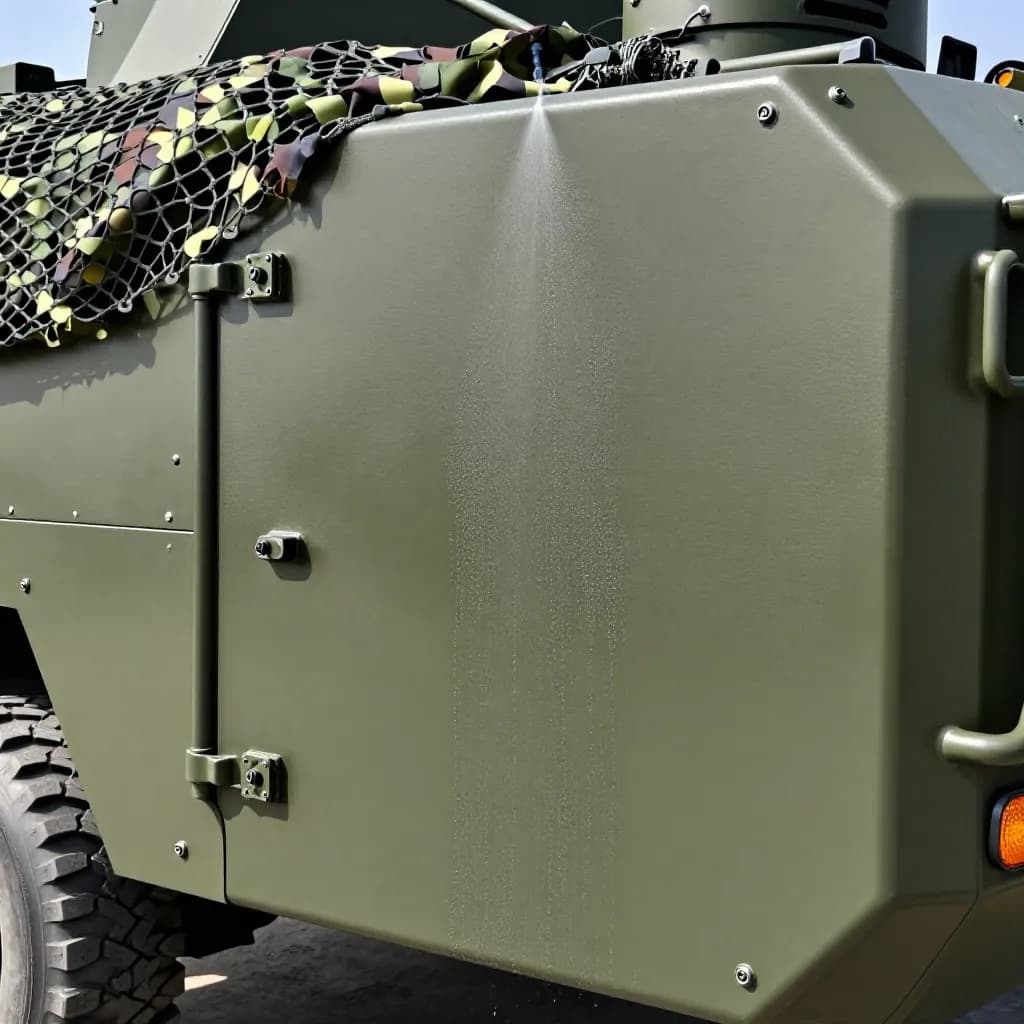
CARC is not a single product but rather a complete coating system consisting of pretreatment, primer, and topcoat layers that work together to provide chemical agent resistance, corrosion protection, camouflage performance, and durability. The system is applied to virtually all US military tactical equipment including ground vehicles, aircraft, shelters, generators, trailers, weapons systems, and support equipment. Every component that may be exposed to chemical agents in a combat environment is a candidate for CARC.
Ready to Start Your Project?
From one-off customs to 15,000-part production runs — get precise pricing in 24 hours.
On This Page
What Is CARC (Chemical Agent Resistant Coating)?
Beyond chemical agent resistance, CARC coatings must meet stringent requirements for near-infrared (NIR) reflectance to provide camouflage effectiveness against night vision devices, ultraviolet stability for long-term color retention, and mechanical durability to withstand the harsh conditions of military operations. This combination of requirements makes CARC one of the most technically demanding coating systems in use today.
History and Development of CARC
The development of CARC began in the late 1970s when the US Army recognized that its existing coating systems — primarily alkyd enamels and lacquers — were highly vulnerable to chemical warfare agent absorption. During Cold War-era testing, it became clear that conventional military paints absorbed chemical agents deeply into the film, making thorough decontamination virtually impossible. Equipment coated with standard paints would remain contaminated and hazardous to personnel long after decontamination attempts, effectively rendering it unusable.
The US Army Research Laboratory at Aberdeen Proving Ground, working with coating manufacturers, developed the CARC system through the late 1970s and early 1980s. The key breakthrough was the adoption of polyurethane topcoat chemistry, which provided the non-porous, chemical-resistant surface needed to prevent agent absorption. The two-component polyurethane topcoat, combined with an epoxy primer system, created a coating that could be effectively decontaminated using DS2 (decontaminating solution number 2) and later Super Tropical Bleach (STB) and the M291 decontamination kit.
CARC was officially adopted as the standard military coating system in the mid-1980s and has been continuously refined since. Early CARC formulations were exclusively solvent-based with high VOC content, but the system has evolved to include waterborne CARC topcoats and, more recently, powder CARC coatings under MIL-PRF-32348. These developments reflect the military's commitment to reducing the environmental footprint of coating operations while maintaining the critical chemical agent resistance capability.
The CARC System Layers
The CARC coating system is a multi-layer system with four essential steps: cleaning, pretreatment, priming, and topcoating. Each layer serves a specific function, and the system's performance depends on proper execution of every step. Skipping or inadequately performing any step compromises the entire system's effectiveness.
The process begins with thorough surface cleaning to remove all oils, grease, dirt, rust, and old coatings. For new fabrication, this typically involves solvent cleaning per SSPC-SP1 followed by abrasive blasting to SSPC-SP6 (commercial blast) or SSPC-SP10 (near-white blast). The cleaned surface then receives a pretreatment — either zinc phosphate conversion coating per MIL-DTL-16232 for steel substrates or chromate conversion coating per MIL-DTL-5541 for aluminum. This pretreatment provides an additional layer of corrosion protection and promotes adhesion of the primer coat.
The primer layer uses either MIL-DTL-53022 epoxy primer (Type I standard or Type II moisture-curing) or MIL-DTL-53030 epoxy primer, applied at 0.9 to 1.1 mils dry film thickness. The epoxy primer provides the primary corrosion protection for the substrate and serves as the adhesion bridge between the pretreatment and topcoat. Finally, the topcoat is applied using MIL-DTL-64159 two-component aliphatic polyurethane at 1.6 to 2.4 mils dry film thickness. This topcoat provides the chemical agent resistance, camouflage performance, UV stability, and abrasion resistance that define the CARC system. The total system thickness is typically 2.5 to 3.5 mils.
Key MIL-SPEC Specifications for CARC
The CARC system is governed by a family of military specifications that define material requirements, application procedures, and performance standards. Understanding these specifications is essential for anyone involved in military coating operations.
MIL-DTL-53072 is the overarching application specification that defines how CARC systems are to be applied. It covers surface preparation requirements, environmental conditions for application, coating system selection, application procedures, quality control, and inspection criteria. This specification is the primary reference document for CARC application facilities and is regularly updated to incorporate new materials and procedures. MIL-DTL-64159 defines the requirements for the CARC polyurethane topcoat, including chemical agent resistance, color and gloss, NIR reflectance, flexibility, adhesion, impact resistance, fluid resistance, and accelerated weathering performance. MIL-DTL-53022 covers the epoxy primer used in the CARC system, specifying adhesion, corrosion resistance, flexibility, and compatibility with both the pretreatment and topcoat layers.
More recently, MIL-PRF-32348 was established to cover powder coating alternatives to liquid CARC. This specification defines requirements for powder CARC topcoats and primers that provide equivalent chemical agent resistance and camouflage performance to the traditional liquid system. Products qualified under MIL-PRF-32348 appear on the Qualified Products List (QPL) and represent a significant advancement in reducing the environmental impact of military coating operations. Additional relevant specifications include MIL-DTL-53030 for alternative epoxy primers, MIL-DTL-53039 for single-component CARC topcoat for field touch-up, and TM 43-0139 which provides detailed technical procedures for field-level coating maintenance and repair.
CARC Powder Coating
CARC powder coating, qualified under MIL-PRF-32348, represents a major evolution in military coating technology. Powder CARC eliminates the volatile organic compounds, hazardous air pollutants, and isocyanate exposure concerns associated with traditional two-component liquid CARC. Because powder coatings contain no solvents, they produce virtually zero VOC emissions during application and curing, dramatically reducing the environmental compliance burden for military coating facilities.
Powder CARC formulations must meet the same rigorous performance requirements as liquid CARC, including chemical agent resistance, NIR reflectance for camouflage effectiveness, salt spray corrosion resistance, humidity resistance, UV stability, flexibility, adhesion, and impact resistance. Achieving NIR compliance in powder formulations has been one of the most significant technical challenges, as the pigment systems and resin chemistries differ substantially from liquid coatings. However, several manufacturers have successfully qualified powder CARC products in the standard military camouflage colors.
The benefits of powder CARC extend beyond environmental compliance. Powder coatings offer superior edge coverage compared to liquid coatings, which tend to pull away from sharp edges during application. This improved edge coverage translates directly to better corrosion protection on the complex geometries typical of military equipment. Powder CARC also eliminates pot life concerns — unlike two-component liquid CARC, which must be used within hours of mixing, powder coating material has an extended shelf life and requires no mixing. Material utilization rates of 95% or higher are achievable with powder reclaim systems, compared to 50-65% for liquid CARC spray operations.
Application Requirements and Challenges
Applying CARC coatings correctly requires strict adherence to environmental conditions, surface preparation standards, and application parameters defined in MIL-DTL-53072. For liquid CARC, the ambient temperature must be between 60°F and 90°F (15°C to 32°C), the relative humidity must be below 85%, and the substrate temperature must be at least 5°F above the dew point. These conditions must be maintained not only during application but also throughout the curing period, which can extend 4 to 7 days for full chemical agent resistance development at ambient temperatures.
One of the most significant challenges with liquid CARC is the pot life of the two-component polyurethane topcoat. Once the base component and curing agent are mixed, the material must be applied within 4 to 8 hours depending on temperature. Any material remaining after the pot life expires must be discarded as hazardous waste. This creates scheduling pressure and material waste, particularly for small batch operations or touch-up work. The isocyanate curing agent in liquid CARC also presents health hazards, requiring supplied-air respirators and full protective equipment for applicators.
Recoat windows present another challenge. If a CARC topcoat needs a second coat or repair, it must be applied within a specific recoat window — typically within 24 to 72 hours of the first coat. If this window is missed, the surface must be abraded to promote adhesion of the new coat. For powder CARC, the challenges differ: parts must be able to withstand curing temperatures of 350°F to 400°F (177°C to 204°C), which limits application to individual components rather than fully assembled vehicles. Large or complex assemblies may require a combination of powder coating for components and liquid CARC for final assembly touch-up.
CARC Colors and Camouflage
CARC colors are defined by Federal Standard 595 (now SAE AMS-STD-595) color numbers, and each color must meet specific near-infrared reflectance requirements in addition to visual color matching. The most commonly used CARC colors include FS 34094 (olive drab green, used in woodland camouflage patterns), FS 33446 (desert sand, the standard single-color desert finish), FS 30051 (dark brown, used in woodland and NATO camouflage), FS 37030 (black, used as a camouflage pattern color and for specific equipment), and FS 383 (a green shade used in certain camouflage schemes). These colors are carefully formulated to match the reflectance characteristics of natural terrain in both the visible and near-infrared spectrum.
The US military uses several camouflage pattern schemes depending on the operational environment. The standard three-color woodland pattern uses FS 34094 green, FS 30051 brown, and FS 37030 black applied in an irregular pattern. Desert operations typically use a single-color FS 33446 desert sand finish or a three-color desert pattern. NATO allies use similar but not identical camouflage schemes — the German Bundeswehr, for example, uses a three-tone pattern based on RAL 6031 Bronze Green, RAL 8027 Leather Brown, and RAL 9021 Tar Black.
Color matching in CARC is more complex than in conventional coatings because the NIR reflectance must be controlled independently of the visible color. Two coatings that appear identical to the human eye may have very different NIR signatures, making one visible to night vision devices while the other blends with the background. This is why CARC colors cannot simply be matched using standard commercial color-matching systems — the pigment formulations must be specifically designed to achieve the correct reflectance across the entire visible and NIR spectrum from approximately 400nm to 1200nm.
Frequently Asked Questions
What does CARC stand for?
CARC stands for Chemical Agent Resistant Coating. It is a military coating system designed to resist the absorption of chemical warfare agents, allowing contaminated equipment to be effectively decontaminated and returned to service.
Can civilians buy CARC paint?
Yes, CARC paint is available to civilians through military coating suppliers, though it requires proper safety equipment for application due to the isocyanate content in the two-component polyurethane topcoat. Civilian buyers should be aware that CARC requires specific primers and pretreatments to perform correctly, and the two-component system has a limited pot life once mixed.
How long does CARC coating last?
When properly applied over the correct primer and pretreatment system, CARC topcoat typically lasts 5 to 8 years in normal military service before requiring repainting. Service life varies significantly based on operating environment, UV exposure, mechanical wear, and maintenance practices. Desert environments with intense UV tend to degrade CARC faster than temperate climates.
Is CARC the same as regular military paint?
No. CARC replaced older military paint systems (alkyd enamels and lacquers) in the 1980s specifically because those older coatings absorbed chemical warfare agents and could not be effectively decontaminated. CARC is a polyurethane-based system with specific chemical agent resistance properties that conventional military paints do not possess.
Can CARC be applied over existing paint?
CARC can be applied over existing CARC that is in good condition after proper surface preparation including sanding and cleaning. However, CARC should not be applied directly over non-CARC coatings such as alkyd enamel or lacquer, as adhesion and chemical agent resistance may be compromised. Old non-CARC coatings should be removed to bare metal before applying the full CARC system.
Ready to Start Your Project?
From one-off customs to 15,000-part production runs — get precise pricing in 24 hours.