Acrylic powder coatings are based on glycidyl methacrylate (GMA) functional acrylic resins — copolymers of GMA with other acrylic and methacrylic monomers such as methyl methacrylate, butyl acrylate, and styrene. The epoxy groups provided by the GMA monomer serve as the reactive sites for crosslinking, typically with dicarboxylic acid hardeners such as dodecanedioic acid (DDDA) or sebacic acid. This epoxy-acid reaction produces ester crosslinks and forms a dense, highly crosslinked polymer network.
Technical
Acrylic Powder Coatings for Automotive: Clear Coats, DOI, and OEM Applications
Sundial Powder Coating·April 22, 2026·14 min
The acrylic backbone provides several inherent advantages over polyester-based systems. Acrylic polymers have excellent UV transparency — they do not absorb UV radiation in the wavelength range that causes photodegradation of most organic polymers. This UV transparency means that acrylic coatings do not yellow or degrade under prolonged sunlight exposure, making them inherently suitable for exterior applications requiring long-term color and gloss stability.
Ready to Start Your Project?
From one-off customs to 15,000-part production runs — get precise pricing in 24 hours.
On This Page
Acrylic Resin Chemistry for Powder Coatings
The glass transition temperature (Tg) of GMA acrylic resins is typically higher than that of polyester resins used in powder coatings, ranging from 50-60°C compared to 40-55°C for most polyester systems. This higher Tg contributes to better storage stability and resistance to blocking (powder particles sticking together during storage), but it also means that acrylic powders require higher temperatures to achieve adequate melt flow, which can be a challenge for achieving smooth, defect-free films.
The molecular weight distribution of GMA acrylic resins is carefully controlled during polymerization to balance melt viscosity, reactivity, and final film properties. Lower molecular weight resins provide better flow and leveling but may sacrifice mechanical properties, while higher molecular weight resins produce tougher films but with more pronounced orange peel texture. Modern acrylic resin technology uses controlled radical polymerization techniques to achieve narrow molecular weight distributions that optimize both flow and performance.
Distinctness of Image and Automotive Appearance Standards
Distinctness of image (DOI) is the critical appearance metric for automotive coatings, measuring the sharpness and clarity of reflections in the coated surface. A high DOI value indicates a mirror-like surface that produces sharp, undistorted reflections — the hallmark of a premium automotive finish. DOI is measured instrumentally using wavescan or DOI meters that quantify the sharpness of reflected images on a scale where higher values indicate better appearance.
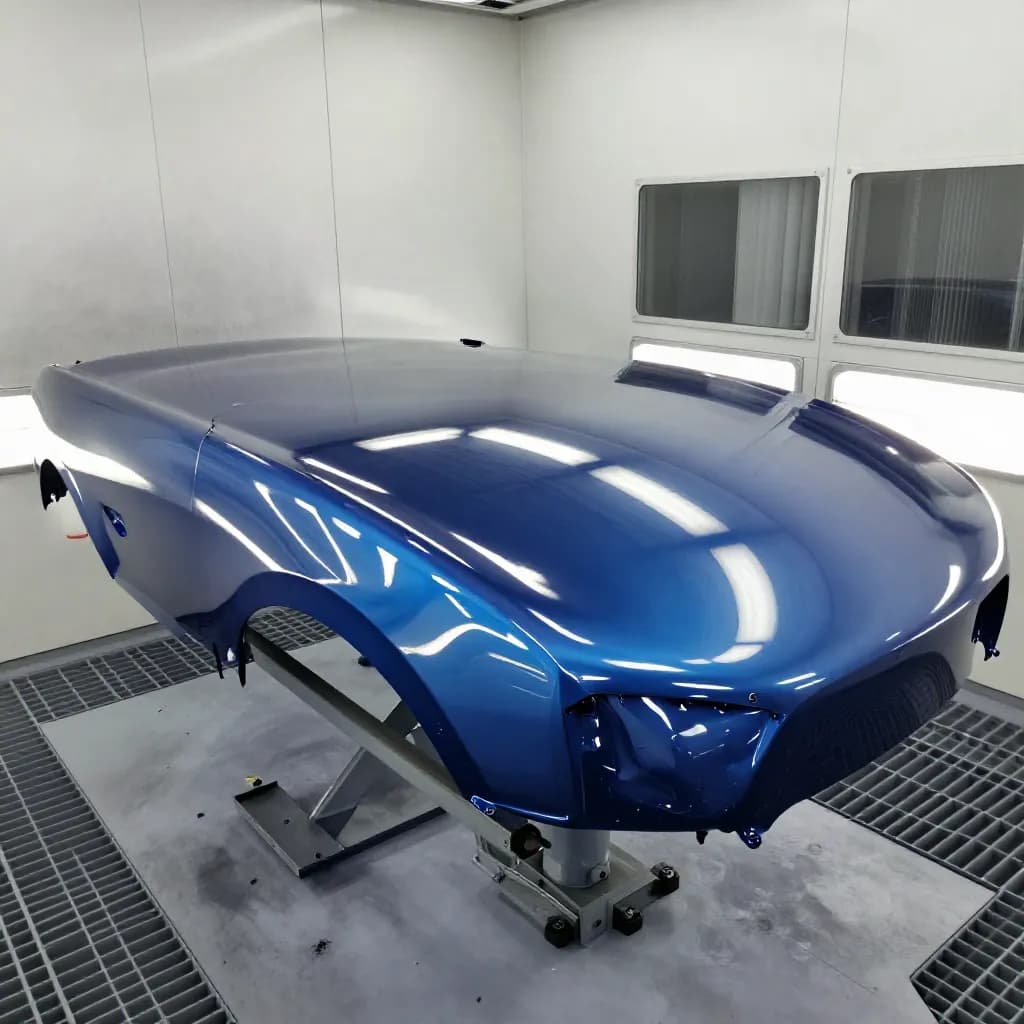
Acrylic powder coatings have historically been the preferred chemistry for automotive powder clear coats because of their ability to achieve DOI values approaching those of liquid automotive clear coats. The key to high DOI is surface smoothness at the micro-scale — the coating must flow and level to eliminate orange peel texture, particle boundaries, and other surface irregularities that scatter reflected light and reduce image clarity.
Achieving automotive-grade DOI with powder coatings requires optimization across the entire process chain. Powder particle size distribution must be tightly controlled, with a D50 of 25-35 microns and minimal coarse particles above 80 microns that create surface texture. The melt viscosity of the powder must be low enough to allow complete flow and leveling before crosslinking begins, requiring a carefully designed gel time window. Application parameters — film thickness, substrate temperature, electrostatic charge level, and spray pattern — must be precisely controlled to produce a uniform powder deposit that flows into a smooth film.
OEM automotive appearance standards are among the most demanding in any coating application. Specifications typically require long-wave (orange peel) values below 10 and short-wave (micro-texture) values below 20 on the wavescan scale, along with gloss values above 85 GU at 20° and DOI values above 80. Meeting these targets consistently in high-volume production requires the combination of optimized acrylic powder formulation, precise application equipment, and carefully controlled cure oven profiles.
Flow, Leveling, and Surface Quality Optimization
The flow and leveling behavior of acrylic powder coatings during the cure cycle is the single most important factor determining final surface quality. When powder particles melt in the curing oven, they must coalesce into a continuous film, flow to eliminate particle boundaries and surface irregularities, and achieve a smooth, uniform surface profile before the crosslinking reaction advances to the point where the film viscosity becomes too high for further flow. This sequence — melting, coalescence, flow, leveling, and gelation — occurs over a time window of typically 2-5 minutes, and the quality of the final surface depends on maximizing the flow and leveling that occurs within this window.
Melt viscosity is the primary formulation lever for controlling flow behavior. Lower melt viscosity allows faster and more complete leveling, but excessively low viscosity can cause sagging on vertical surfaces and edge pull-back on horizontal surfaces. The optimal melt viscosity profile shows a rapid decrease as the powder melts, a minimum viscosity plateau during the flow window, and then a rapid increase as crosslinking progresses. Formulators achieve this profile by selecting resin molecular weight, crosslinker reactivity, and flow additive type and level.
Flow additives — typically polyacrylate or polysiloxane-based surface-active agents — play a critical role in acrylic powder coating surface quality. These additives migrate to the coating surface during melting and reduce surface tension gradients that cause surface defects such as craters, pinholes, and Bénard cells. Polyacrylate flow additives (such as Resiflow or Modaflow types) are most commonly used in acrylic systems because they provide effective leveling without the surface slip and recoatability issues associated with silicone-based additives.
Substrate temperature management during cure is another critical factor. Preheating the substrate to 40-60°C before powder application can improve initial powder adhesion and promote faster, more uniform melting. The oven temperature ramp rate affects the duration of the flow window — a slower ramp extends the time available for leveling before gelation, while a faster ramp reduces it. Infrared boost zones at the oven entrance can accelerate initial melting without shortening the overall flow window.
Compatibility Challenges with Other Coating Chemistries
One of the most significant technical challenges with acrylic powder coatings is their incompatibility with polyester-based powder coatings. Acrylic and polyester resins are thermodynamically immiscible — when they come into contact in the molten state, they phase-separate rather than blending, creating surface defects such as craters, fisheyes, and crawling. This incompatibility has profound practical implications for powder coating operations that apply both acrylic and polyester products.
Cross-contamination between acrylic and polyester powders is the most common cause of surface defects in mixed-chemistry coating operations. Even trace amounts of polyester powder — as little as 0.1% contamination — in an acrylic powder batch can cause visible cratering defects in the cured film. Similarly, acrylic contamination of polyester powder produces comparable defects. This extreme sensitivity to cross-contamination requires rigorous housekeeping, dedicated equipment, and strict material handling procedures in facilities that process both chemistries.
In practice, many coating operations that apply acrylic powder clear coats maintain completely separate application equipment — spray guns, hoses, powder feed hoppers, and reclaim systems — for acrylic and polyester products. Some facilities go further, dedicating entire spray booths and oven zones to acrylic application to eliminate any possibility of cross-contamination. Color change procedures between acrylic and polyester products require thorough cleaning of all equipment surfaces that contact the powder.
The incompatibility issue also affects multi-coat systems where an acrylic clear coat is applied over a polyester basecoat. In these systems, the acrylic clear coat must be applied over a fully cured polyester basecoat to prevent intermixing at the interface. If the basecoat is undercured, residual reactive groups can interact with the acrylic clear coat during the second cure cycle, potentially causing intercoat adhesion problems or surface defects. Proper cure verification of the basecoat before clear coat application is essential for reliable multi-coat system performance.
OEM Automotive Applications and Production Integration
The integration of acrylic powder clear coats into automotive OEM production lines represents one of the most technically sophisticated applications of powder coating technology. Automotive assembly plants operate at high line speeds — typically 30-60 vehicles per hour — with zero tolerance for appearance defects, requiring powder coating systems that deliver consistent, automotive-grade quality at production volumes.
Several major automotive OEMs have adopted acrylic powder clear coats for specific vehicle platforms, primarily driven by environmental regulations limiting VOC emissions from paint shops. BMW pioneered the use of powder clear coats in automotive production in the late 1990s, and other European and Asian manufacturers have followed with their own implementations. The technology has been most widely adopted for premium vehicle segments where the environmental benefits justify the capital investment in powder application equipment.
The automotive powder clear coat application process typically uses robotic electrostatic spray systems with precise control of powder flow rate, electrostatic charge, spray pattern, and gun-to-part distance. Multiple robots apply powder to different zones of the vehicle body, with overlapping spray patterns to ensure uniform coverage on complex three-dimensional surfaces. Real-time film thickness monitoring using non-contact sensors provides feedback for process control and quality assurance.
Cure oven design for automotive powder clear coats must balance the need for rapid heating to initiate powder melting and flow with the requirement for uniform temperature distribution across the vehicle body. Combination ovens using infrared radiation for initial heating followed by convection for soak and cure are common. The oven profile is optimized to maximize the flow window for the specific acrylic powder formulation, with typical cure schedules of 140-160°C object temperature for 20-30 minutes.
Despite the technical successes, acrylic powder clear coats have not achieved universal adoption in the automotive industry. The capital cost of powder application equipment, the incompatibility issues requiring dedicated facilities, and the ongoing development of low-VOC liquid clear coat alternatives have limited powder clear coat penetration to a subset of OEM production lines.
Acrylic vs Polyester-Urethane Clear Coats
The choice between acrylic (GMA) and polyester-urethane (PU) powder clear coats for automotive and industrial applications involves trade-offs across multiple performance dimensions. Both chemistries can achieve automotive-grade appearance, but they differ in specific properties that may favor one over the other depending on application requirements.
Acrylic clear coats generally provide superior UV resistance and non-yellowing performance due to the inherent UV transparency of the acrylic backbone. Over extended outdoor exposure, acrylic clear coats maintain clarity and gloss more consistently than PU clear coats, which can develop slight yellowing due to oxidation of the urethane linkages. For applications requiring maximum long-term clarity — such as clear coats over metallic or pearlescent basecoats where any yellowing would shift the perceived color — acrylic chemistry is preferred.
PU clear coats offer advantages in scratch and mar resistance, chemical resistance, and flexibility. The urethane crosslinks provide a tougher, more elastic film that better resists the micro-scratching from car wash brushes, fingernails, and abrasive particles that causes swirl marks and gloss reduction on automotive surfaces. PU clear coats also show better resistance to environmental etching from acid rain, tree sap, and bird droppings — a significant concern for automotive OEMs dealing with warranty claims related to coating damage.
From a processing perspective, PU clear coats are generally easier to formulate for good flow and leveling because the polyester base resins have lower melt viscosities than GMA acrylic resins. However, PU systems face the oven fouling issue from blocking agent release during cure, which adds maintenance burden and operating cost. Acrylic systems produce no volatile byproducts during cure, resulting in cleaner oven operation.
The market trend in automotive powder clear coats has been toward hybrid approaches that combine elements of both chemistries. Some manufacturers have developed acrylic-modified polyester resins or polyester-acrylic blends that aim to capture the UV resistance of acrylics with the mechanical properties of polyesters, though achieving true compatibility between these inherently immiscible polymer types remains a formulation challenge.
Testing Standards and Quality Assurance for Automotive Acrylic Coatings
Quality assurance for automotive acrylic powder coatings encompasses a comprehensive battery of tests that evaluate appearance, mechanical properties, chemical resistance, weathering durability, and process consistency. OEM specifications — such as those from BMW (GS 90010), Ford (WSS-M2P191), General Motors (GMW15400), and Toyota (TSH 1503G) — define specific test methods, acceptance criteria, and qualification procedures that powder coating suppliers must satisfy.
Appearance testing goes beyond simple gloss measurement to include wavescan analysis (long-wave and short-wave values), DOI measurement, haze, and visual assessment under standardized lighting conditions. Color matching for clear coats focuses on transparency, clarity, and absence of haze or yellowing rather than chromatic color values. Appearance testing is typically performed on standardized test panels coated under controlled conditions as well as on production parts to verify process capability.
Mechanical testing for automotive clear coats includes adhesion (cross-cut and tape pull per ASTM D3359), pencil hardness (ASTM D3363), impact resistance (ASTM D2794), flexibility (conical mandrel bend per ASTM D522), and stone chip resistance (SAE J400 gravelometer test). The stone chip test is particularly critical for automotive applications — it simulates the impact of road debris on the coating system and evaluates the size and type of damage produced. Acceptable results require that chip damage is limited to small, well-defined areas without propagating cracks or large-scale delamination.
Environmental durability testing includes accelerated weathering (SAE J2527 xenon arc exposure, typically 2500-5000 hours), humidity resistance (ASTM D2247, typically 1000-2000 hours), cyclic corrosion testing (SAE J2334 or GMW14872, typically 60-120 cycles), and thermal cycling. Natural weathering exposure in South Florida and Arizona provides real-world validation of accelerated test results. The complete qualification process for a new automotive powder clear coat formulation typically requires 12-18 months of testing before production approval is granted.
Frequently Asked Questions
Why are acrylic powder coatings preferred for automotive clear coats?
Acrylic (GMA) powder coatings offer inherent UV transparency that prevents yellowing, excellent gloss and DOI potential, and zero volatile emissions during cure. These properties make them ideal for automotive clear coats where long-term clarity over metallic and pearlescent basecoats is critical.
What causes craters when mixing acrylic and polyester powders?
Acrylic and polyester resins are thermodynamically immiscible. When even trace amounts (as little as 0.1%) of one chemistry contaminate the other, the resins phase-separate in the molten state during cure, creating surface tension differences that produce craters, fisheyes, and crawling defects in the cured film.
What DOI values can acrylic powder clear coats achieve?
Optimized acrylic powder clear coats can achieve DOI values above 80, with long-wave (orange peel) values below 10 and short-wave (micro-texture) values below 20 on the wavescan scale. These values approach liquid automotive clear coat quality when powder particle size, melt viscosity, and cure profile are precisely controlled.
How do automotive OEMs prevent acrylic-polyester cross-contamination?
OEM facilities typically maintain completely separate application equipment for acrylic and polyester products, including dedicated spray guns, hoses, hoppers, and reclaim systems. Some plants dedicate entire spray booths to acrylic application. Rigorous cleaning procedures are followed during any chemistry changeover.
What is GMA in acrylic powder coatings?
GMA stands for glycidyl methacrylate, the functional monomer that provides the reactive epoxy groups in acrylic powder coating resins. GMA is copolymerized with other acrylic monomers to create the base resin, and the epoxy groups react with dicarboxylic acid hardeners during cure to form the crosslinked coating film.
Ready to Start Your Project?
From one-off customs to 15,000-part production runs — get precise pricing in 24 hours.