Orange peel — the slightly textured, dimpled surface appearance that resembles the skin of an orange — is a characteristic feature of powder coating that ranges from barely perceptible to clearly visible depending on the formulation, application parameters, and cure conditions. Unlike liquid paint, which can achieve a perfectly smooth, glass-like surface through solvent evaporation and extended flow time, powder coating's thermal cure process inherently produces some degree of surface texture.
Consumer
Why Does Powder Coating Orange Peel? Causes, Prevention, and Acceptable Levels
Sundial Powder Coating·April 22, 2026·11 min
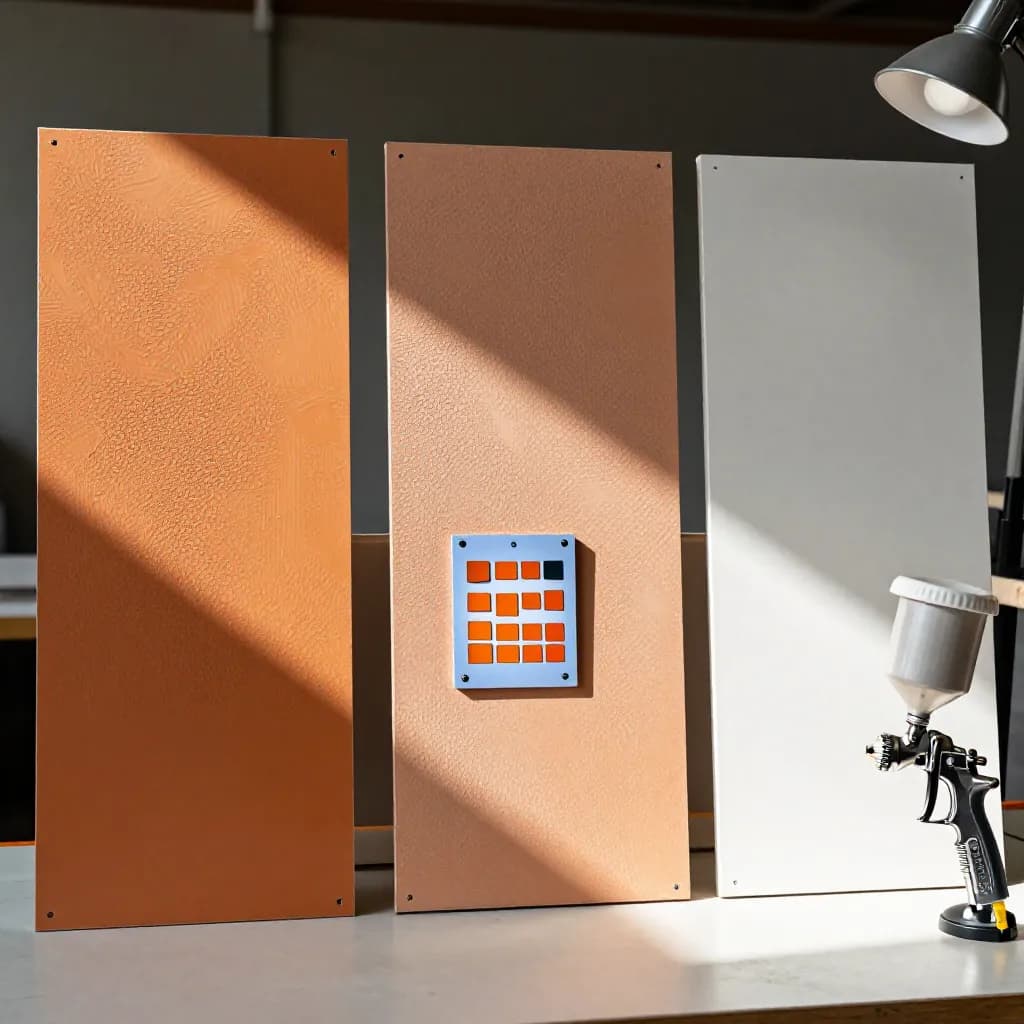
A mild level of orange peel is considered normal and acceptable in most powder coating applications. The powder coating industry, quality standards, and experienced specifiers recognize that powder coating surfaces will have a slightly different texture than high-quality liquid paint finishes. This is not a defect but a characteristic of the technology that can be minimized but not entirely eliminated in standard formulations.
Ready to Start Your Project?
From one-off customs to 15,000-part production runs — get precise pricing in 24 hours.
On This Page
Some Orange Peel Is Normal in Powder Coating
However, excessive orange peel — where the surface texture is pronounced, uneven, or significantly worse than expected for the formulation — indicates a process problem that should be investigated and corrected. The line between acceptable and excessive orange peel depends on the application, the specification, and the expectations of the end user.
Understanding what causes orange peel, how to minimize it, and what level is acceptable for different applications helps manufacturers optimize their coating process and helps consumers set realistic expectations for powder-coated product appearance.
The Physics Behind Orange Peel Formation
Orange peel in powder coating results from the competition between two physical processes during curing: the melting and flow of the powder particles, and the cross-linking reaction that solidifies the coating. The surface texture is determined by how completely the individual powder particles merge and level before the cross-linking reaction locks the surface in place.
When powder-coated parts enter the curing oven, the powder particles first melt and begin to flow together. Surface tension drives the molten coating to level out, smoothing the boundaries between individual particles and creating a uniform film. At the same time, the cross-linking reaction begins, progressively increasing the viscosity of the molten coating until it solidifies into a thermoset film.
If the coating achieves good flow and leveling before significant cross-linking occurs, the surface will be relatively smooth. If the cross-linking reaction advances too quickly relative to the flow and leveling process, the surface solidifies before it has fully leveled, preserving the texture of the incompletely merged powder particles as orange peel.
The balance between flow and cross-linking is influenced by the powder formulation, the particle size distribution, the film thickness, and the oven temperature profile. Formulations with longer gel times — the period between melting and the onset of significant cross-linking — have more time to flow and level, producing smoother surfaces. Formulations with short gel times solidify quickly, producing more orange peel.
The melt viscosity of the powder also affects leveling. Lower melt viscosity allows the molten coating to flow more easily under surface tension forces, promoting better leveling. Higher melt viscosity resists flow, preserving surface irregularities. Powder manufacturers adjust melt viscosity through resin selection and additive packages to achieve the desired balance of flow and other properties.
Common Causes of Excessive Orange Peel
While some orange peel is inherent to powder coating, excessive orange peel indicates that the flow and leveling process has been compromised. Several common causes can be identified and corrected.
Insufficient film thickness is one of the most frequent causes of excessive orange peel. Thinner films have less material available to flow and level, and the surface tension forces that drive leveling are less effective on thin films. Increasing the coating thickness from 50 microns to 80 microns can produce a noticeable improvement in surface smoothness for the same powder formulation.
Excessive film thickness can also cause orange peel, though through a different mechanism. Very thick films take longer to heat through, and the outer surface may begin cross-linking before the inner layers have fully melted and flowed. This creates a skin effect that traps surface irregularities. Maintaining film thickness within the manufacturer's recommended range avoids both thin-film and thick-film orange peel.
Oven temperature profile affects orange peel significantly. A rapid temperature rise causes the cross-linking reaction to initiate before the powder has had adequate time to melt and flow. A more gradual temperature rise allows the powder to melt, flow, and level before cross-linking begins in earnest. Infrared pre-heating followed by convection curing can optimize the temperature profile for better flow.
Powder condition affects flow and leveling. Powder that has been stored improperly — exposed to heat, humidity, or mechanical compaction — may have partially sintered or agglomerated, resulting in larger effective particle sizes and poorer flow. Fresh, properly stored powder produces better surface finish than degraded powder.
Application parameters including electrostatic voltage, powder flow rate, and gun-to-part distance affect the uniformity of the powder deposit, which in turn affects the leveling behavior during cure. Excessive voltage can cause back-ionization — a condition where accumulated charge on the powder layer repels incoming particles, creating an uneven deposit that cures with pronounced orange peel.
How to Minimize Orange Peel
Minimizing orange peel requires optimization across the entire powder coating process, from powder selection through application to curing. The following strategies, applied systematically, produce the smoothest possible surface finish.
Select a powder formulation designed for smooth finish. Powder manufacturers offer formulations specifically optimized for flow and leveling, incorporating flow additives, optimized particle size distributions, and resin systems with favorable melt viscosity and gel time characteristics. These smooth-finish formulations produce noticeably less orange peel than general-purpose products.
Optimize film thickness within the manufacturer's recommended range. For most smooth-finish formulations, the optimal thickness for surface appearance is 70 to 90 microns. Below this range, insufficient material limits leveling. Above this range, the skin effect can trap surface texture. Consistent thickness across the part produces the most uniform appearance.
Control the oven temperature profile to maximize flow time before cross-linking. A gradual initial temperature rise allows the powder to melt and flow before the cross-linking reaction accelerates. Some applicators use a two-stage cure profile with a lower initial temperature for flow followed by a higher temperature for cross-linking.
Maintain powder quality through proper storage and handling. Store powder in a cool, dry environment below 25 degrees Celsius. Avoid mechanical compaction during storage and transport. Use powder within its recommended shelf life. Sieve powder before use to remove any agglomerates that could affect surface finish.
Optimize application parameters to achieve a uniform powder deposit. Reduce electrostatic voltage if back-ionization is suspected — typical symptoms include a rough, textured deposit and poor coverage in recessed areas. Maintain consistent gun-to-part distance and powder flow rate across the part surface.
Ensure the substrate surface is smooth and free of defects. Surface roughness, weld marks, grinding scratches, and other substrate imperfections telegraph through the coating and contribute to the perception of orange peel. Smoother substrates produce smoother coated surfaces.
Measuring Orange Peel: Objective Assessment
Objective measurement of orange peel removes the subjectivity of visual assessment and provides quantifiable data for specification, quality control, and process optimization. Several measurement methods are available, ranging from simple visual comparison to sophisticated instrumental analysis.
Visual comparison panels provide the simplest assessment method. Sets of reference panels with calibrated levels of orange peel, rated on a numerical scale, are compared side by side with the production sample. The rating of the reference panel that most closely matches the production sample becomes the orange peel score. This method is inexpensive and quick but relies on the observer's judgment and lighting conditions.
Wavescan instruments, such as the BYK-Gardner wave-scan, provide objective, repeatable measurements of surface texture. These instruments scan a laser beam across the coating surface and analyze the reflected light to quantify surface waviness at different spatial frequencies. The results are reported as long-wave (orange peel structure) and short-wave (fine texture) values, with lower numbers indicating smoother surfaces.
The distinction between long-wave and short-wave texture is important for understanding orange peel. Long-wave texture (wavelengths of 1 to 10 millimeters) corresponds to the visible orange peel structure that is most apparent to the eye. Short-wave texture (wavelengths of 0.1 to 1 millimeter) corresponds to finer surface irregularities that affect the sharpness of reflected images. Both contribute to the overall perception of surface quality.
Profilometry using contact or optical profilometers provides detailed surface topography data that can be analyzed for roughness parameters including Ra (average roughness), Rz (average peak-to-valley height), and Rq (root mean square roughness). These parameters quantify the surface texture but do not directly correspond to the visual perception of orange peel, which is more closely related to the waviness parameters measured by wavescan instruments.
For quality control purposes, establishing a measurable acceptance criterion — such as a maximum wavescan long-wave value or a minimum visual comparison rating — provides a clear, objective standard that can be consistently applied across production batches and between different inspectors.
Acceptable Levels: Setting Realistic Expectations
What constitutes acceptable orange peel depends entirely on the application, the viewing conditions, and the expectations of the end user. Setting realistic expectations prevents unnecessary quality disputes and helps focus process optimization efforts where they matter most.
For industrial and functional applications — structural steel, equipment housings, electrical enclosures, and agricultural equipment — moderate orange peel is universally accepted and often preferred. The slight texture helps hide minor surface imperfections in the substrate and provides a practical, workmanlike appearance. Specifying a smooth finish for these applications adds cost without functional benefit.
For consumer products — furniture, appliances, automotive accessories, and sporting goods — a smoother finish is expected, and visible orange peel may be perceived as a quality deficiency. These applications warrant the use of smooth-finish powder formulations and optimized application parameters. However, consumers should understand that powder coating will not achieve the mirror-smooth finish of high-quality automotive liquid paint.
For architectural applications, the acceptable level of orange peel is defined by the relevant specification. Qualicoat and GSB standards include surface appearance requirements that set expectations for architectural powder coating. These standards recognize that some texture is inherent to powder coating and set acceptance criteria accordingly.
For premium and decorative applications where the smoothest possible finish is required, specialty ultra-smooth powder formulations, optimized cure profiles, and careful process control can achieve surfaces that approach liquid paint smoothness. These applications may also benefit from post-cure polishing or buffing to further improve surface appearance.
Viewing distance is an important consideration when evaluating orange peel acceptability. Orange peel that is clearly visible at arm's length may be imperceptible at the normal viewing distance for the product. Architectural cladding viewed from street level, industrial equipment viewed from several meters away, and structural steel viewed from a distance all have different effective viewing distances that affect the perception of surface texture.
The key principle is to match the surface finish specification to the actual requirements of the application. Over-specifying surface smoothness increases cost and reject rates without improving the end user's experience, while under-specifying can lead to customer dissatisfaction.
Consumer Expectations and Communication
Managing consumer expectations regarding powder coating surface finish is an important aspect of customer satisfaction. Many consumers are accustomed to the smooth finish of liquid-painted products and may perceive the slight texture of powder coating as a defect if they are not informed about the characteristics of the technology.
Educating consumers about the nature of powder coating helps set appropriate expectations. Explaining that the slight texture is a normal characteristic of a coating technology that provides superior durability, environmental performance, and value helps consumers appreciate the trade-off between surface smoothness and overall performance.
Providing physical samples or reference panels that show the expected surface finish for a specific product allows consumers to evaluate the appearance before purchase. This is particularly important for custom coating work where the consumer may have specific expectations based on their experience with liquid-painted products.
For manufacturers, clearly communicating the surface finish specification in product literature and sales materials prevents misunderstandings. Describing the finish as smooth, semi-smooth, or textured, and providing photographs or samples that accurately represent the actual product appearance, helps consumers make informed purchasing decisions.
When consumers do raise concerns about orange peel, a knowledgeable response that explains the technology, demonstrates that the finish meets the applicable specification, and highlights the durability and environmental advantages of powder coating usually resolves the concern. Most consumers, once they understand the trade-offs, appreciate the overall value proposition of powder coating.
For applications where consumer expectations demand the smoothest possible finish, investing in premium smooth-finish powder formulations, optimized process parameters, and rigorous quality control demonstrates commitment to quality and helps differentiate products in competitive markets. The additional cost of achieving a smoother finish is justified when surface appearance is a key purchasing criterion for the target market.
Frequently Asked Questions
Is orange peel a defect in powder coating?
Mild orange peel is a normal characteristic of powder coating, not a defect. The thermal cure process inherently produces some surface texture. However, excessive orange peel beyond what is expected for the formulation indicates a process problem that should be corrected.
Can you get a perfectly smooth powder coating finish?
Powder coating cannot achieve the mirror-smooth finish of high-quality liquid paint, but specialty ultra-smooth formulations with optimized cure profiles can come very close. Post-cure polishing can further improve smoothness for premium applications.
What causes excessive orange peel in powder coating?
Common causes include incorrect film thickness (too thin or too thick), rapid oven temperature rise that triggers cross-linking before adequate flow, degraded powder from improper storage, excessive electrostatic voltage causing back-ionization, and rough substrate surfaces.
How do you measure orange peel in powder coating?
Orange peel is measured objectively using wavescan instruments that quantify surface waviness, or subjectively using visual comparison with calibrated reference panels. Wavescan instruments report long-wave and short-wave values, with lower numbers indicating smoother surfaces.
Does thicker powder coating reduce orange peel?
Up to a point. Increasing thickness from very thin films (below 50 microns) to the optimal range (70-90 microns) improves leveling and reduces orange peel. However, excessively thick films can develop a skin effect that actually increases orange peel. Staying within the manufacturer's recommended range produces the best results.
Ready to Start Your Project?
From one-off customs to 15,000-part production runs — get precise pricing in 24 hours.