Properly formulated and correctly applied powder coating should not crack during normal service. When cracking does occur, it indicates a specific problem with the coating process, the formulation selection, or the service conditions that can be identified and corrected. Cracking is a defect, not an expected behavior of powder coating.
Consumer
Why Does Powder Coating Crack? Causes, Prevention, and Repair
Sundial Powder Coating·April 22, 2026·11 min
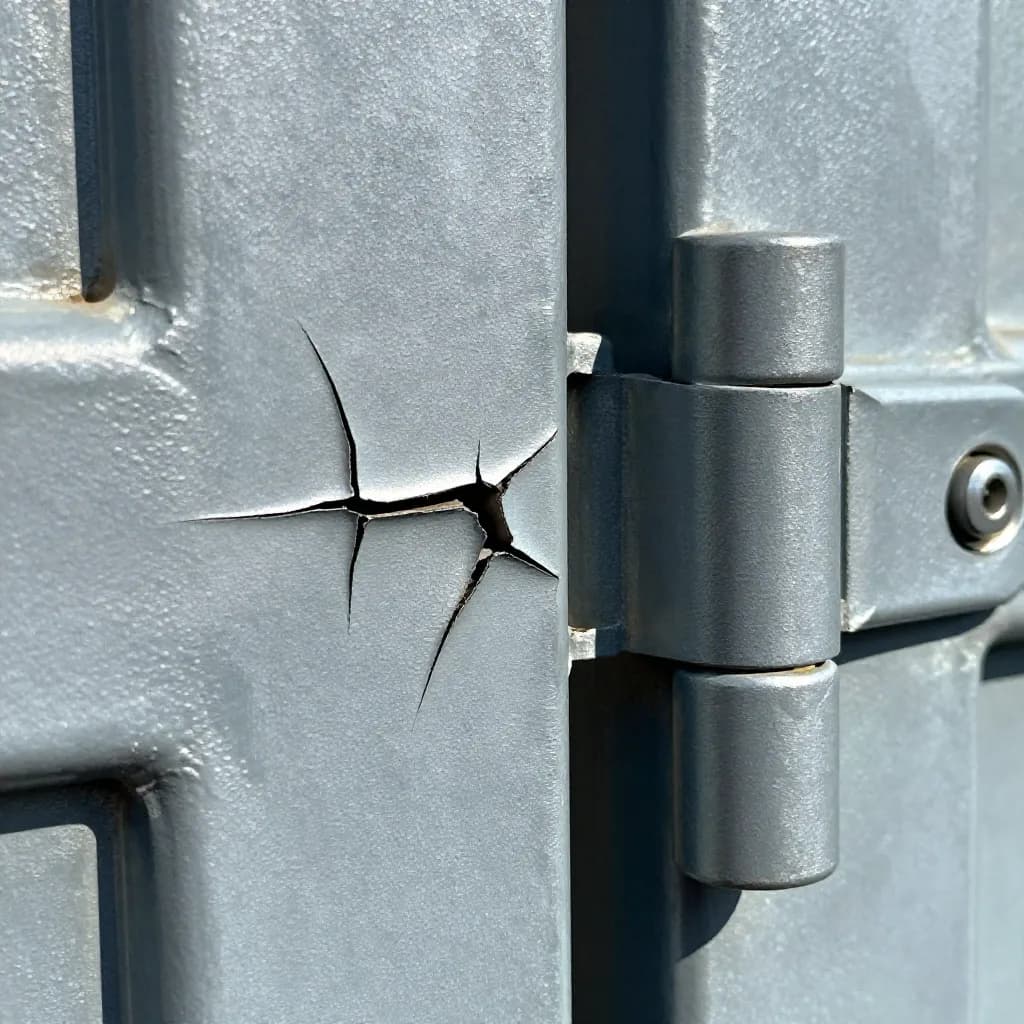
The most common causes of powder coating cracking are over-curing, substrate movement or flexing, impact damage, thermal cycling beyond the coating's design limits, and UV degradation over extended outdoor exposure. Each cause produces a characteristic cracking pattern that helps diagnose the root cause and guide corrective action.
Ready to Start Your Project?
From one-off customs to 15,000-part production runs — get precise pricing in 24 hours.
On This Page
Cracking Is Not Normal and Always Has an Identifiable Cause
Cracking compromises both the appearance and the protective function of the coating. Cracks allow moisture, oxygen, and corrosive substances to reach the substrate, initiating corrosion that can spread beneath the intact coating and cause further adhesion loss. For this reason, cracking should be addressed promptly through repair or recoating to prevent secondary damage.
Understanding why powder coating cracks enables manufacturers to prevent the problem through proper process control and formulation selection, and helps consumers identify whether a cracking problem is a manufacturing defect or a result of service conditions that exceed the coating's design capabilities.
Over-Curing: The Most Common Cause of Cracking
Over-curing is the single most frequent cause of powder coating cracking, and it is entirely preventable through proper process control. Over-curing occurs when the coating is exposed to temperatures or times significantly exceeding the powder manufacturer's recommended cure schedule, causing excessive cross-linking that makes the coating hard, brittle, and prone to cracking.
The chemistry behind over-cure embrittlement is straightforward. During normal curing, the resin molecules cross-link to form a three-dimensional polymer network with a balance of rigidity and flexibility. When curing continues beyond the optimal point, additional cross-links form that restrict molecular mobility excessively. The resulting over-cross-linked film cannot accommodate even minor mechanical stress without fracturing.
Over-curing can result from several process errors. Oven temperature set too high is the most obvious cause. Extended time in the oven — due to line stoppages, slow conveyor speeds, or parts being forgotten in a batch oven — produces the same effect. Thin parts that heat up quickly may reach over-cure conditions while thicker parts in the same load are still reaching cure temperature.
The visual signs of over-curing often include color shift (darkening or yellowing), gloss change (either increased or decreased depending on the formulation), and a surface that feels harder and more brittle than properly cured coating. These visual indicators can serve as early warnings before cracking occurs.
Prevention requires accurate oven temperature control, proper cure schedule documentation, and regular temperature profiling using thermocouples attached to representative parts. The cure window — the range of time and temperature combinations that produce acceptable results — should be clearly defined and communicated to all oven operators. Parts should be removed from the oven promptly when the cure cycle is complete.
Substrate Movement and Flexing
When the substrate beneath a powder coating flexes, bends, or deforms, the coating must accommodate that movement. If the coating's flexibility is insufficient for the degree of substrate movement, cracking occurs. This is a mismatch between the coating's mechanical properties and the demands of the application.
Thin sheet metal panels that flex under wind load, thermal expansion, or mechanical pressure can crack rigid powder coatings at stress concentration points. The cracking typically appears at corners, bends, and attachment points where the stress is highest. Large flat panels are particularly susceptible because they can flex significantly under wind or thermal loads.
Welded assemblies can experience cracking at or near weld lines due to residual stress in the weld zone. As the welded assembly cools and ages, residual stresses can cause slight movement at the weld, which may be enough to crack a rigid coating. Stress-relieving the assembly before coating, or using a more flexible coating formulation, addresses this problem.
Dissimilar metal assemblies can crack coatings at the junction between metals with different thermal expansion coefficients. As temperature changes, the two metals expand and contract at different rates, creating shear stress at the interface that can crack the coating bridging the joint.
The solution to substrate movement cracking is either to reduce the movement (through design changes, stiffening, or stress relief) or to increase the coating's flexibility (through formulation selection). Flexible powder coating formulations with lower cross-link density and longer resin chain segments can accommodate significantly more substrate movement than standard rigid formulations.
For applications where substrate movement is expected, specifying a flexibility requirement — such as a mandrel bend test result or T-bend rating — ensures that the selected coating can accommodate the anticipated deformation without cracking.
Impact Damage and Mechanical Stress
Impact damage is a straightforward cause of cracking — the coating is struck with sufficient force to exceed its mechanical strength, causing fracture. While powder coating has excellent impact resistance compared to liquid paint, it is not indestructible, and sufficiently severe impacts will cause cracking and chipping.
The severity of impact required to crack powder coating depends on the coating formulation, thickness, cure quality, and temperature. Standard powder coatings withstand 80 to 160 inch-pounds of direct impact in Gardner testing, which is substantial but not unlimited. Impacts from dropped tools, forklift collisions, stone chips during transport, and assembly operations can exceed this threshold.
Temperature significantly affects impact resistance. At low temperatures, the polymer chains have less molecular mobility, and the coating becomes more brittle and more susceptible to impact cracking. A coating that withstands a given impact at room temperature may crack under the same impact at minus 20 degrees Celsius. For products used in cold environments, specifying impact resistance testing at the expected minimum service temperature ensures adequate performance.
Repeated sub-threshold impacts can also cause cracking through fatigue. Each impact creates microscopic damage in the coating that accumulates over time. Eventually, the accumulated damage reaches a critical level and a visible crack forms. This fatigue cracking is relevant for products subject to repeated mechanical contact, vibration, or cyclic loading.
Preventing impact cracking involves a combination of coating selection, design, and handling practices. Choosing formulations with high impact resistance, applying adequate coating thickness, designing parts to avoid impact-prone geometries, and implementing careful handling procedures during manufacturing and transport all contribute to reducing impact cracking risk.
Thermal Cycling and Temperature Extremes
Thermal cycling — repeated heating and cooling — can cause powder coating to crack through a mechanism related to differential thermal expansion. The coating and the metal substrate expand and contract at different rates as temperature changes, creating shear stress at the coating-metal interface and tensile stress within the coating film.
During heating, the metal substrate typically expands more than the coating, placing the coating in compression. During cooling, the metal contracts more than the coating, placing the coating in tension. If the tensile stress during cooling exceeds the coating's tensile strength, cracking occurs. The severity of thermal cycling stress depends on the temperature range, the rate of temperature change, and the difference in thermal expansion coefficients between the coating and the substrate.
Products that experience wide temperature swings are most susceptible to thermal cycling cracking. Outdoor equipment in climates with large diurnal temperature variations, engine components that cycle between ambient and operating temperatures, and industrial equipment that undergoes process heating and cooling cycles all face this challenge.
The number of thermal cycles is also important. A coating that survives a single temperature excursion may crack after hundreds or thousands of cycles as fatigue damage accumulates. Accelerated thermal cycling testing, where coated panels are repeatedly cycled between temperature extremes, evaluates the coating's resistance to this failure mode.
Preventing thermal cycling cracking requires selecting a coating formulation with adequate flexibility and thermal cycling resistance for the expected service conditions. Coatings with lower glass transition temperatures and greater elongation at break generally perform better under thermal cycling. Reducing the temperature range through insulation or design changes also reduces thermal cycling stress.
For high-temperature applications such as exhaust systems, engine components, and industrial ovens, specialty high-temperature powder coatings formulated with silicone or ceramic-modified resins provide the thermal stability needed to resist cracking at elevated temperatures and through repeated thermal cycles.
UV Degradation and Weathering-Related Cracking
Extended outdoor exposure can eventually cause cracking in powder coatings through UV degradation of the polymer network. This is a long-term failure mode that typically occurs after years of exposure, as cumulative UV damage progressively weakens the coating's mechanical properties until it can no longer withstand the normal stresses of thermal cycling and substrate movement.
The UV degradation process begins at the coating surface, where UV radiation breaks chemical bonds in the resin molecules. This surface degradation initially manifests as chalking and fading — cosmetic changes that do not affect the coating's structural integrity. However, as degradation progresses deeper into the film over years of exposure, the coating's flexibility and tensile strength decrease, making it increasingly susceptible to cracking.
The cracking pattern from UV degradation is typically a network of fine surface cracks, sometimes called checking or crazing, that gradually deepens and widens over time. This pattern differs from the larger, more localized cracks caused by impact or thermal cycling, helping to identify UV degradation as the root cause.
Resin selection is the primary defense against UV-related cracking. Super-durable polyester and fluoropolymer powder coatings are formulated to resist UV degradation for 15 to 25 years or more, delaying the onset of weathering-related cracking well beyond the expected service life of most products. Epoxy coatings, with their poor UV resistance, can develop surface cracking within one to two years of outdoor exposure.
UV stabilizer additives — UV absorbers and hindered amine light stabilizers — provide additional protection by intercepting UV radiation and scavenging the free radicals that propagate degradation. These additives extend the coating's useful life by slowing the rate of UV damage accumulation.
Regular maintenance including cleaning and, where appropriate, application of UV-protective wax or sealant can slow the progression of UV degradation and delay the onset of cracking. When UV-related cracking does eventually occur, recoating with fresh powder coating restores the surface and provides another full service life.
Prevention and Repair Strategies
Preventing powder coating cracking requires addressing the specific cause relevant to each application. A systematic approach to prevention covers formulation selection, process control, design considerations, and maintenance practices.
For over-cure prevention, establish and enforce documented cure schedules based on the powder manufacturer's recommendations. Use oven temperature profiling to verify that parts reach the correct metal temperature for the correct duration. Install oven temperature alarms that alert operators to temperature excursions. Train oven operators on the consequences of over-curing and the importance of timely part removal.
For substrate movement cracking, specify flexible powder coating formulations with mandrel bend or T-bend ratings appropriate to the expected deformation. Design parts to minimize flexing through stiffening ribs, adequate material thickness, and proper support. Stress-relieve welded assemblies before coating to reduce residual stress.
For impact cracking, specify coatings with high impact resistance ratings and apply adequate thickness. Design parts to protect coated surfaces from impact during handling and use. Implement careful handling procedures and protective packaging for coated parts during transport and assembly.
For thermal cycling cracking, select formulations tested for the expected temperature range and number of cycles. Consider specialty high-temperature coatings for applications involving elevated temperatures. Design assemblies to accommodate differential thermal expansion through flexible joints or expansion provisions.
When cracking has already occurred, repair options depend on the extent and cause of the damage. Localized cracking from impact can be repaired with touch-up coating after removing the damaged material and preparing the surface. Widespread cracking from over-cure, UV degradation, or systemic thermal cycling typically requires complete stripping and recoating, with the root cause corrected before the new coating is applied.
For critical applications, consider specifying accelerated aging tests that simulate the expected service conditions — thermal cycling, UV exposure, impact, and flexibility testing — to verify that the selected coating system will perform without cracking throughout its intended service life.
Frequently Asked Questions
Is it normal for powder coating to crack?
No. Properly formulated and correctly applied powder coating should not crack during normal service. Cracking always indicates a specific problem — over-curing, inadequate flexibility for the application, impact damage, or UV degradation — that can be identified and corrected.
Can over-baking cause powder coating to crack?
Yes. Over-curing is the most common cause of cracking. Excessive temperature or time in the oven creates too many cross-links in the polymer network, making the coating brittle. Prevention requires accurate oven temperature control and adherence to the powder manufacturer's cure schedule.
Why does powder coating crack in cold weather?
Cold temperatures reduce the molecular mobility of the polymer, making the coating more brittle. Combined with thermal contraction stress from cooling, this can cause cracking in coatings that perform well at room temperature. Specifying flexibility testing at the expected minimum service temperature prevents this issue.
Can cracked powder coating be repaired?
Localized cracking can be repaired by removing damaged coating, preparing the surface, and applying touch-up. Widespread cracking typically requires complete stripping and recoating. The root cause must be identified and corrected before recoating to prevent recurrence.
How do you prevent powder coating from cracking?
Match the coating formulation to the application requirements (flexibility, temperature range, UV exposure), follow the manufacturer's cure schedule precisely, design parts to minimize stress on the coating, and handle coated parts carefully to avoid impact damage.
Ready to Start Your Project?
From one-off customs to 15,000-part production runs — get precise pricing in 24 hours.