One of the traditional limitations of powder coating has been its curing temperature. Conventional thermosetting powders require 350-400F (175-200C) for 10-30 minutes - temperatures that limit application to metal substrates and exclude heat-sensitive materials like wood, plastics, and composites. UV-curable powder coatings are emerging as a transformative technology that maintains all the health and environmental benefits of powder coating while curing at much lower temperatures (100-120C) in seconds rather than minutes. This innovation dramatically expands the range of substrates suitable for powder coating and opens new application areas for government specifications.
powder-coating-benefits
UV-Curable Powder Coating: Low-Temperature Cure for Heat-Sensitive Substrates
Sundial Research Team·February 18, 2025·5 min
| Coating Type | Cure Temperature | Cure Time | Substrate Limitation |
|---|---|---|---|
| Epoxy-polyester hybrid | 350-375F (175-190C) | 15-20 min | Metals only |
| Pure polyester (TGIC) | 375-400F (190-200C) | 10-15 min | Metals only |
| Polyurethane powder | 375-400F (190-200C) | 15-20 min | Metals only |
| Acrylic powder | 350-375F (175-190C) | 15-20 min | Metals only |
Ready to Start Your Project?
From one-off customs to 15,000-part production runs — get precise pricing in 24 hours.
On This Page
UV-Curable Powder Coating: Low-Temperature Cure for Heat-Sensitive Substrates
The Temperature Challenge
Conventional Powder Coating Cure Requirements
These temperatures damage or deform:
- Wood (scorching, warping, resin exudation)
- Most plastics (melting, distortion)
- Composites (matrix degradation, delamination)
- Assembled products with heat-sensitive components (electronics, seals)
UV-Curable Powder Technology
How It Works
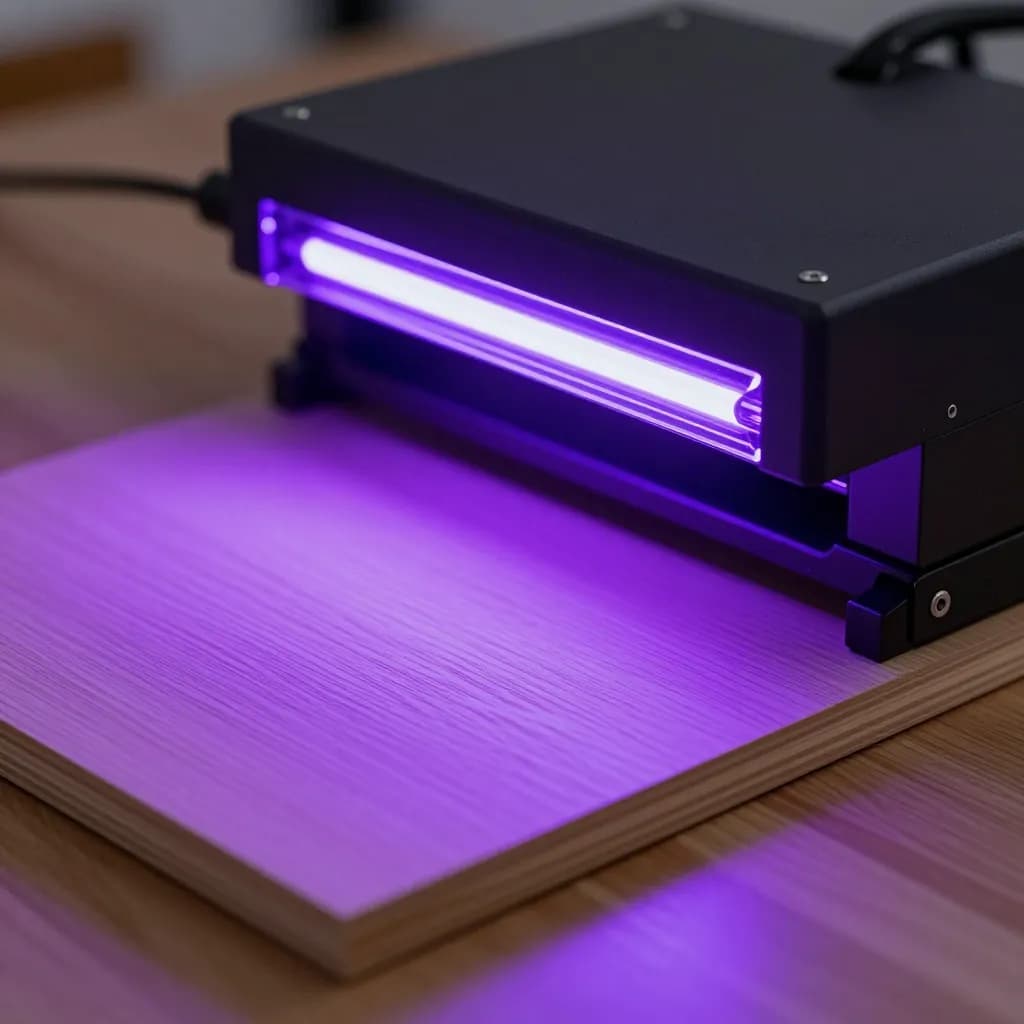
UV-curable powder coatings use a dual-cure mechanism:
-
Thermal melt and flow: Powder is heated to 100-120C (212-248F)
- Temperature is sufficient to melt and flow the powder
- Far below the degradation threshold of most substrates
- Short heating time (1-3 minutes)
-
UV light polymerization: UV lamps trigger instantaneous crosslinking
- Cure completes in seconds under UV light
- Photoinitiators absorb UV and generate free radicals
- Free radicals initiate rapid polymerization
- Film is fully cured immediately after UV exposure
Temperature Profile Comparison
| Stage | Conventional Powder | UV-Curable Powder |
|---|---|---|
| Preheat | 0-5 min at room temp | 0-1 min at room temp |
| Heat to flow | 5-10 min to 375F | 1-2 min to 120C |
| Hold at temperature | 10-20 min | 0 min |
| UV exposure | N/A | 1-3 seconds |
| Cool down | 5-10 min | 2-5 min |
| TOTAL CYCLE TIME | 20-45 minutes | 3-8 minutes |
Substrate Applications
Wood and Wood Composites
| Application | UV Powder Benefit | Government Relevance |
|---|---|---|
| Furniture | Zero VOC, durable finish | Office furniture, school desks |
| Cabinetry | Chemical resistance, moisture resistance | Laboratory cabinets, storage |
| Flooring | Abrasion resistance, stain resistance | Public buildings, schools |
| Doors and millwork | Durability, appearance | Courthouses, historic buildings |
| Engineered wood products | Consistent finish, no warping | Modular construction |
Plastics and Composites
| Substrate | Challenge | UV Powder Solution |
|---|---|---|
| ABS plastic | Low heat tolerance | 120C cure preserves dimensions |
| Polycarbonate | Yellowing at high temps | Low temp prevents degradation |
| Nylon | Melting, crystallization changes | Rapid cure minimizes heat exposure |
| FRP composites | Matrix degradation | Below resin Tg during cure |
| Carbon fiber | Delamination risk | Gentle thermal profile |
Assembled Products with Heat-Sensitive Components
| Product | Heat-Sensitive Element | UV Powder Advantage |
|---|---|---|
| Electronics enclosures | Circuit boards, solder joints | No thermal damage |
| Automotive assemblies | Seals, gaskets, plastics | Preserve component integrity |
| Appliances | Wiring, electronic controls | Gentle processing |
| Medical devices | Precision components, plastics | Maintain tolerances |
Performance Characteristics
Advantages
| Property | UV-Curable Powder | Notes |
|---|---|---|
| Cure speed | Seconds | Dramatic throughput increase |
| Energy consumption | 50-70% lower | Shorter heating, lower temperature |
| Floor space | Reduced | Shorter ovens, compact lines |
| Substrate range | Expanded | Wood, plastic, composites, assemblies |
| Zero VOC | Maintained | 100% solids, no solvents |
| Film thickness | 50-150 microns | Comparable to conventional powder |
| Gloss options | Matte to high gloss | Formulation dependent |
Limitations
| Limitation | Explanation | Mitigation |
|---|---|---|
| UV shadow areas | Complex geometries may have uncured recesses | Multiple UV lamps, rotational curing |
| Color range | Some deep colors challenging | Formulation advances expanding range |
| UV lamp maintenance | Lamps degrade over time | Regular replacement schedules |
| Higher material cost | Photoinitiators add cost | Offset by energy and throughput savings |
| Oxygen inhibition | Surface cure may be tacky | Inert atmosphere or formulation adjustments |
Government Applications
Expanding Powder Coating to New Areas
UV-curable powder enables zero-VOC coating for government assets previously limited to liquid paint:
| Asset Category | Previous Limitation | UV Powder Solution |
|---|---|---|
| Office furniture | Wood/melamine substrates | Direct wood coating |
| School furniture | Particleboard, MDF | Low-temp cure |
| Military shelters | Composite panels | Composite-compatible cure |
| Signage | Plastic substrates | Plastic-compatible |
| Interior fixtures | Mixed material assemblies | Gentle thermal profile |
| Restored historic elements | Wood, mixed materials | Preserves substrate integrity |
The Health and Environmental Benefits Persist
UV-curable powder maintains all the core advantages of conventional powder coating:
- Zero VOC emissions: No solvents, no coalescing aids
- No hazardous air pollutants: No benzene, formaldehyde, isocyanates
- Near-zero waste: Overspray collected and reused
- No hazardous waste disposal: No solvent sludge or contaminated thinner
- Worker protection: Eliminates solvent exposure, isocyanate exposure
- Indoor air quality: No post-application emissions
The Energy Advantage
UV-curable powder offers additional energy benefits beyond conventional powder:
| Energy Factor | Conventional Powder | UV-Curable Powder | Savings |
|---|---|---|---|
| Oven temperature | 375-400F | 100-120C | 60-70% lower |
| Oven time | 20-45 min | 3-8 min | 80% shorter |
| Total energy | Baseline | 40-60% of baseline | 40-60% savings |
| Carbon footprint | Baseline | Significantly lower | Proportional |
Current Market Status
Commercial Availability
UV-curable powder coatings are commercially available from major suppliers:
- Allnex: UVitex UV-curable powder line
- PPG: En-Virocron UV-curable powder
- AkzoNobel: Interpon Redox UV-curable
- Sherwin-Williams: Powdura UV-curable options
- Tiger Drylac: UV-curable developments
Application Equipment
UV powder coating requires:
- Standard electrostatic spray equipment
- IR or convection preheat (100-120C)
- UV lamp array (mercury, gallium, or LED UV)
- Conveyor or batch processing system
Equipment suppliers include:
- Nordson: UV powder coating systems
- Wagner: Spray and curing equipment
- IFS: Custom UV coating lines
Adoption Rate
UV-curable powder is still emerging:
- Early adopters: Furniture, automotive trim, electronics
- Growth rate: 15-25% annually in segments where applicable
- Market share: <5% of total powder coating market
- Future projection: Expected to grow significantly as technology matures
Specification Considerations
For government specifications considering UV-curable powder:
When to Specify
- Heat-sensitive substrates (wood, plastic, composites)
- Assembled products with temperature-sensitive components
- Applications requiring very fast cure cycles
- Energy reduction goals
- Substrate expansion objectives
Qualification Requirements
- Adhesion testing on specific substrates
- Durability testing for intended environment
- Color and gloss stability
- Chemical resistance validation
- UV lamp system specification
Conclusion
UV-curable powder coating represents a significant technological advance that preserves the health and environmental benefits of powder coating while eliminating the temperature limitation that has restricted its application. By curing at 100-120C in seconds rather than minutes at 375-400F, UV-curable powder opens the door to coating wood, plastics, composites, and assembled products that were previously incompatible with powder coating technology.
For government specifications, UV-curable powder is particularly relevant for furniture, interior fixtures, signage, and other applications where substrate limitations previously required liquid coatings. As the technology matures and costs decline, UV-curable powder may become the preferred specification for an expanding range of government assets - extending zero-VOC, zero-solvent coating benefits to applications that conventional powder could not address.
The emergence of UV-curable powder reinforces a core principle: the transition from hazardous liquid coatings to safer alternatives is not a static choice between existing technologies. It is a dynamic field where innovation continuously expands the range of applications where health-protective coating choices are available.
Ready to Start Your Project?
From one-off customs to 15,000-part production runs — get precise pricing in 24 hours.