Coating durability is not a matter of opinion — it is measured through standardized laboratory tests that simulate years of real-world abuse in controlled conditions. The cross-cut adhesion test scores how well a coating stays bonded to the substrate after a grid pattern is cut through the film and tape is applied and pulled. Impact resistance is measured by dropping a weighted dart onto the coated surface and examining the result for cracking or delamination.
Consumer
Powder Coating vs Wet Paint: Real-World Durability Compared
Sundial Powder Coating·April 20, 2026·9 min
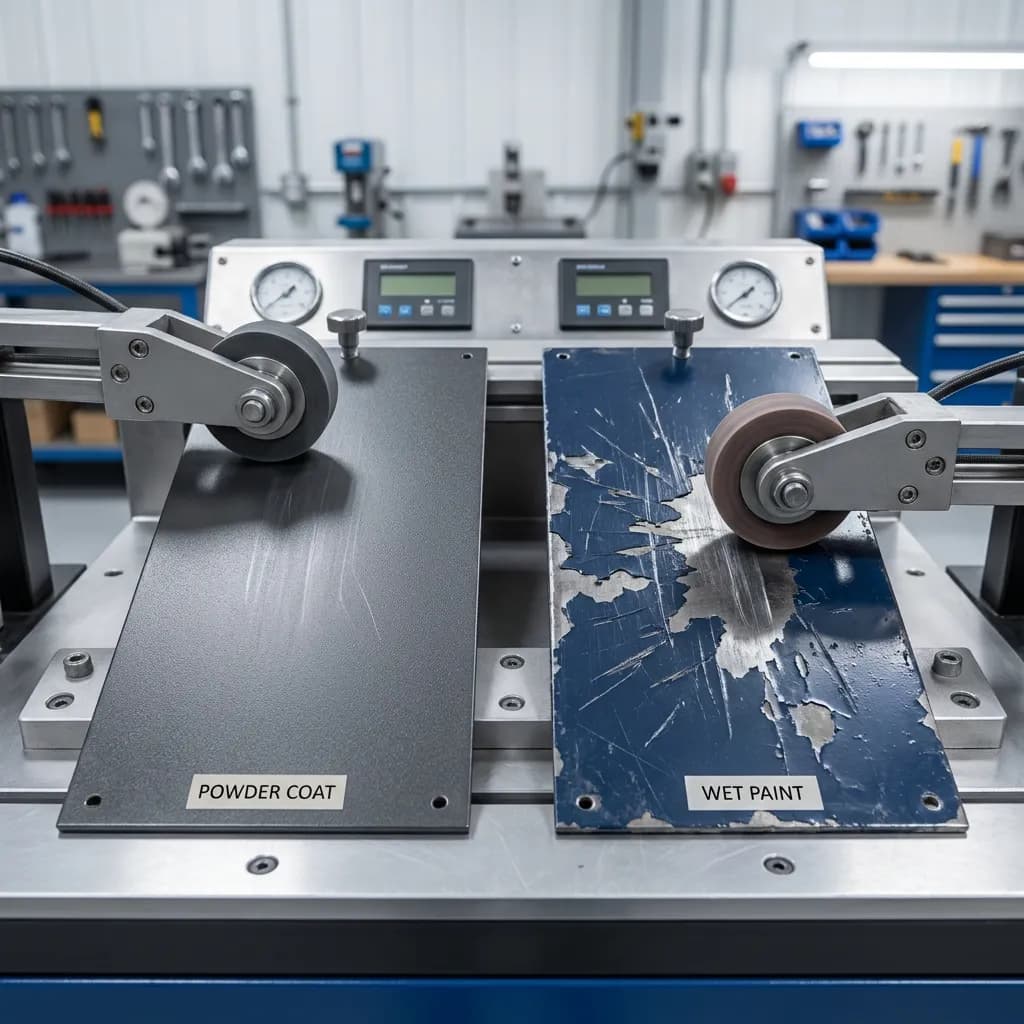
Salt spray testing places coated panels in a chamber of continuous salt fog at 35°C, simulating years of corrosive exposure in days or weeks. Results are measured by the degree of corrosion creep from a scribed line in the coating. The bend test wraps a coated panel around a mandrel of decreasing diameter to determine how far the coating can flex before cracking. Pencil hardness testing pushes increasingly hard pencil leads across the surface to determine the coating's scratch resistance.
Ready to Start Your Project?
From one-off customs to 15,000-part production runs — get precise pricing in 24 hours.
On This Page
How Durability Is Tested
These tests provide objective, repeatable data that allows direct comparison between coating systems. When powder coating and wet paint are tested side by side using the same standards, the results consistently tell the same story across virtually every metric.
Chip and Scratch Resistance
Powder coating's superior chip resistance comes down to film thickness and mechanical properties. A typical powder coat is 60 to 120 microns thick, compared to 25 to 50 microns for most liquid paint systems. This thicker film absorbs impact energy that would punch through a thinner paint layer. In direct impact testing, powder coatings routinely withstand impacts that crack and delaminate equivalent liquid paint finishes.
The cross-linked polymer structure of cured powder also contributes to its toughness. Unlike many liquid paints that remain somewhat brittle after drying, powder coating achieves a balance of hardness and flexibility that resists both scratching and chipping. It is hard enough to resist surface scratches from everyday contact but flexible enough to absorb impacts without cracking.
In practical terms, this means powder-coated parts survive handling, shipping, installation, and daily use with far fewer cosmetic defects than painted parts. Automotive components, industrial equipment, and outdoor furniture all benefit from this resilience. Parts that would show chips and scratches within weeks of painting can remain unmarked for years under a powder coat.
Chemical Resistance
Powder coating's fully cross-linked film provides excellent resistance to a wide range of chemicals that attack liquid paint. Fuels, hydraulic fluids, brake cleaners, solvents, and common household chemicals that would soften, stain, or dissolve many liquid paint finishes have little effect on a properly cured powder coat. This chemical resistance is inherent to the cross-linked polymer structure and does not diminish over time.
Liquid paints, particularly single-pack enamels and lacquers, are more vulnerable to chemical attack because their film structure is less densely cross-linked. Solvents can penetrate and soften the film, fuels can cause swelling and lifting, and acidic or alkaline cleaners can etch the surface. Two-pack polyurethane paints offer better chemical resistance than single-pack systems but still generally fall short of powder coating in standardized chemical resistance testing.
This advantage is particularly relevant for automotive, industrial, and workshop applications where parts are regularly exposed to aggressive chemicals. Engine bay components, tool boxes, workshop equipment, and garage furniture all benefit from powder coating's ability to shrug off chemical spills and splashes that would damage a painted finish.
UV and Weathering Performance
Outdoor durability is where the choice of coating chemistry matters most. Polyester powder coatings are specifically formulated for UV resistance and consistently outperform equivalent liquid paint systems in accelerated weathering tests. After thousands of hours of UV exposure in a QUV weathering chamber, polyester powder coatings retain significantly more gloss and color than standard liquid paints exposed to the same conditions.
The advantage is even more pronounced in real-world Florida exposure testing, where panels are mounted outdoors facing south at a 45-degree angle and evaluated over months and years. Powder-coated panels maintain their appearance longer, with less chalking, less fading, and better gloss retention than liquid-painted panels of comparable chemistry. Superdurable polyester powders extend this advantage further, meeting the stringent requirements of architectural specifications like Qualicoat Class 2 and GSB Master.
It is worth noting that the comparison is chemistry-dependent. A high-quality two-pack polyurethane liquid paint can approach the weathering performance of a standard polyester powder. However, when comparing systems of equivalent quality and chemistry, powder coating's thicker film and more complete cure consistently provide a measurable edge in long-term outdoor durability.
The Bottom Line on Durability
Across virtually every standardized durability test, powder coating outperforms wet paint on metal substrates. It is harder, tougher, more chemical-resistant, and more weather-durable than equivalent liquid paint systems. The combination of greater film thickness, complete cross-linking, and absence of solvent-related film defects gives powder coating a structural advantage that liquid paint cannot easily overcome.
The few areas where liquid paint holds an advantage are not related to durability. Liquid paint can achieve a smoother, higher-gloss finish — important for automotive body panels and high-end furniture. It can be applied to heat-sensitive substrates that cannot withstand oven curing. And it allows for easier on-site touch-up and repair. But when the primary concern is how long the finish will last and how much abuse it can withstand, powder coating wins decisively.
For any metal part that needs to look good and perform well over years of service, powder coating is the more durable choice. The testing data supports what millions of powder-coated parts in service around the world demonstrate every day: this finish is built to last.
Frequently Asked Questions
Is powder coating always more durable than paint?
On metal substrates, powder coating is more durable than equivalent liquid paint in nearly every measurable category. However, liquid paint can be applied to substrates that cannot be oven-cured, and high-end automotive liquid paint systems can achieve surface smoothness that powder coating cannot match. Durability and finish quality are different metrics.
Can you scratch powder coating with a fingernail?
A properly cured powder coat is too hard to scratch with a fingernail. It typically rates between 2H and 4H on the pencil hardness scale, meaning it resists scratching from anything softer than a hard graphite pencil. Everyday contact, keys, and normal handling will not scratch a quality powder coat.
Does powder coating chip easier than paint?
No, the opposite is true. Powder coating is significantly more chip-resistant than liquid paint due to its greater thickness and flexible cross-linked structure. Impacts that would chip through paint are absorbed by the thicker powder coat film without damage.
How does powder coating hold up to pressure washing?
Powder coating withstands normal pressure washing without damage. Use a fan tip at a reasonable distance rather than a zero-degree nozzle pressed close to the surface. Avoid directing high-pressure water at edges or any areas where the coating may already be chipped, as water pressure can lift coating from a damaged edge.
Ready to Start Your Project?
From one-off customs to 15,000-part production runs — get precise pricing in 24 hours.