Cerakote is a polymer-ceramic composite coating that is applied as a thin film and cured either in an oven or at room temperature, depending on the specific product series. Developed originally for the firearms industry, Cerakote has expanded into knives, automotive components, sporting goods, electronics, and other applications where a thin, durable, and highly customizable finish is needed.
Consumer
Powder Coating vs Cerakote: What's the Difference?
Sundial Powder Coating·April 20, 2026·8 min
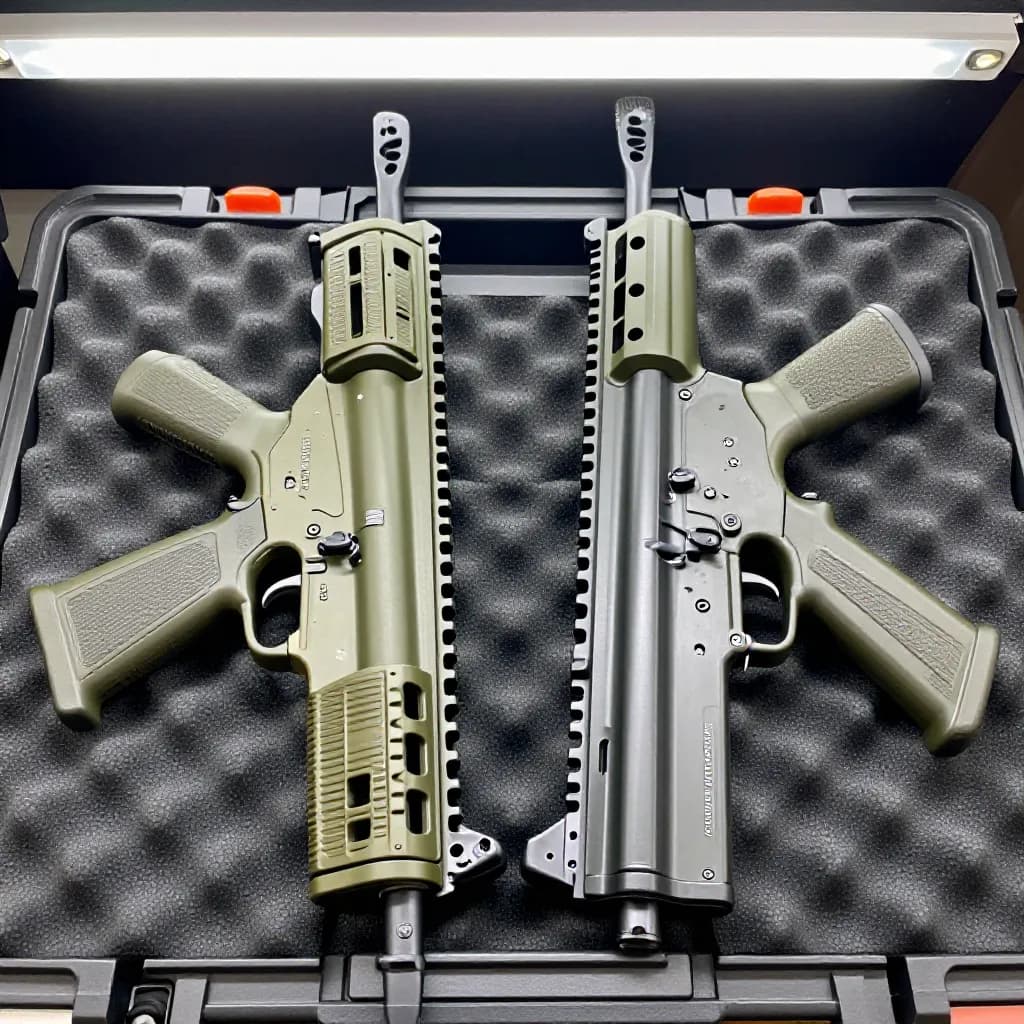
Unlike powder coating, which is applied as a dry powder using electrostatic charge, Cerakote is a liquid coating sprayed with a conventional HVLP spray gun, similar to automotive paint. It is applied in extremely thin layers, typically 0.5 to 1.0 mil (12 to 25 microns) per coat, which is a fraction of the thickness of a standard powder coating. This thin application is one of Cerakote's defining characteristics and a key reason it is chosen for precision applications.
Ready to Start Your Project?
From one-off customs to 15,000-part production runs — get precise pricing in 24 hours.
On This Page
What Is Cerakote
Cerakote is available in hundreds of colors and can be applied in complex patterns, camouflage designs, and multi-color graphics with relative ease. The thin film and liquid application method allow for fine detail work that would be difficult or impossible with powder coating. This versatility, combined with excellent hardness and chemical resistance, has made Cerakote a favorite among custom builders and enthusiasts.
How It Differs from Powder Coating
The most fundamental difference is film thickness. Powder coating typically builds a film of 2 to 5 mils (50 to 125 microns), while Cerakote is applied at 0.5 to 1.0 mil (12 to 25 microns). This difference has cascading effects on where each coating excels. Powder coating's thicker film provides a more substantial physical barrier against corrosion, impact, and abrasion. Cerakote's thinner film preserves tight dimensional tolerances and fine surface details.
The application methods are entirely different. Powder coating uses electrostatically charged dry powder particles that are attracted to a grounded metal part, then cured in an oven at 180 to 200 degrees Celsius. Cerakote is sprayed as a liquid, allowing for more precise control over coverage, patterns, and multi-color work. Some Cerakote series cure in an oven at lower temperatures around 120 to 150 degrees Celsius, while air-cure versions harden at room temperature over 24 to 48 hours.
The performance profiles differ as well. Powder coating excels in corrosion protection, UV resistance, and overall toughness for larger parts exposed to harsh environments. Cerakote excels in hardness relative to its thickness, chemical resistance, heat resistance in certain formulations, and the ability to coat complex, detailed parts without obscuring fine features.
When Cerakote Is the Better Choice
Firearms are the application most closely associated with Cerakote, and for good reason. The thin film does not interfere with the tight tolerances of slides, receivers, triggers, and other precision components. It provides excellent corrosion protection, chemical resistance against solvents and cleaning products, and a durable finish that withstands the heat and mechanical stress of firing. The ability to apply detailed patterns and camouflage designs is an additional benefit for tactical and hunting applications.
Small, detailed parts where dimensional accuracy matters are another strong use case. Knife blades, watch components, small tools, and precision hardware all benefit from a coating that adds protection without measurably changing dimensions. Where powder coating might fill in fine engravings or tighten threaded fits, Cerakote preserves every detail.
High-temperature applications can also favor Cerakote. Certain Cerakote formulations are rated for continuous exposure to temperatures well above what standard powder coatings can handle. Exhaust components, engine parts, and other heat-exposed surfaces can benefit from Cerakote's thermal stability, though specialized high-temperature powder coatings also exist for these applications.
When Powder Coating Is the Better Choice
For larger parts that need robust, long-lasting protection, powder coating is the clear winner. The thicker film provides a more substantial barrier against corrosion, stone chips, UV degradation, and mechanical wear. Wheels, frames, chassis components, outdoor furniture, railings, and architectural metalwork all benefit from the heavier protection that powder coating delivers.
Outdoor exposure is another area where powder coating has a strong advantage. Polyester and super-durable polyester powder coatings are specifically formulated for years of UV exposure without significant fading, chalking, or gloss loss. While Cerakote offers good UV resistance, the thicker powder coating film provides more material to absorb and resist the effects of prolonged sun exposure.
Powder coating is also more efficient for production runs and larger parts. The electrostatic application process coats complex shapes quickly and uniformly, overspray can be reclaimed and reused, and the single-cure process is straightforward. For high-volume work or large surface areas, powder coating offers a more practical and efficient workflow than the precision hand-spraying that Cerakote requires.
Can You Use Both Together?
Yes, and combining powder coating and Cerakote on the same project is more common than you might think. The strategy is simple: use each coating where it performs best. Powder coat the structural and high-exposure parts that need maximum protection and thickness, and Cerakote the precision components that need a thin, detailed finish.
A classic example is a firearm build where the receiver and barrel are Cerakoted for precision fit and detailed pattern work, while the accessories, mounts, and larger components are powder coated for rugged durability. In automotive applications, a chassis or frame might be powder coated for corrosion protection while smaller engine accessories or interior trim pieces receive Cerakote for its thin film and color versatility.
When using both coatings on a project, coordinate colors carefully. Because the two coatings use different chemistries and application methods, the same color name or code may not produce an identical visual match between powder coat and Cerakote. Request samples of both coatings in your chosen color and compare them side by side under the same lighting to ensure the combination looks cohesive.
Frequently Asked Questions
Is Cerakote stronger than powder coating?
Cerakote has higher hardness relative to its film thickness and excellent chemical resistance. However, powder coating provides a thicker physical barrier that offers more overall protection against corrosion, impact, and abrasion. Neither is universally stronger. Each excels in different performance categories, and the better choice depends on the specific demands of your application.
Can Cerakote be applied over powder coating?
Yes. Cerakote can be applied over a cured powder coating with proper surface preparation, typically light sanding and solvent cleaning. This combination gives you the thick corrosion barrier of powder coating with the detailed finish and color options of Cerakote on top. It is sometimes used for multi-color designs on powder-coated parts.
Does Cerakote last as long as powder coating?
Both coatings are highly durable when properly applied. Cerakote's thinner film means it has less material to sacrifice before the substrate is exposed, so in high-wear or high-impact situations, powder coating's thicker film may last longer. For applications within Cerakote's design parameters, such as firearms and precision parts, it provides excellent long-term performance.
Can I Cerakote at home like DIY powder coating?
Cerakote application requires an HVLP spray gun, proper surface preparation, and either an oven for oven-cure series or a clean environment for air-cure series. It is more accessible than powder coating for small parts because it does not require electrostatic equipment. However, achieving a professional result still demands practice, proper equipment, and careful technique.
Ready to Start Your Project?
From one-off customs to 15,000-part production runs — get precise pricing in 24 hours.