Tool boxes and cabinets occupy a unique position in the powder coating world — they must deliver industrial-grade durability while maintaining the premium appearance that consumers expect from a significant purchase. A professional mechanic's tool cabinet represents an investment of thousands of dollars and is expected to perform flawlessly for 20-30 years in a workshop environment filled with dropped tools, chemical splashes, and constant drawer cycling.
Consumer
Powder Coating for Tool Boxes and Cabinets: Tough Finishes for Workshop Storage
Sundial Powder Coating·April 22, 2026·11 min
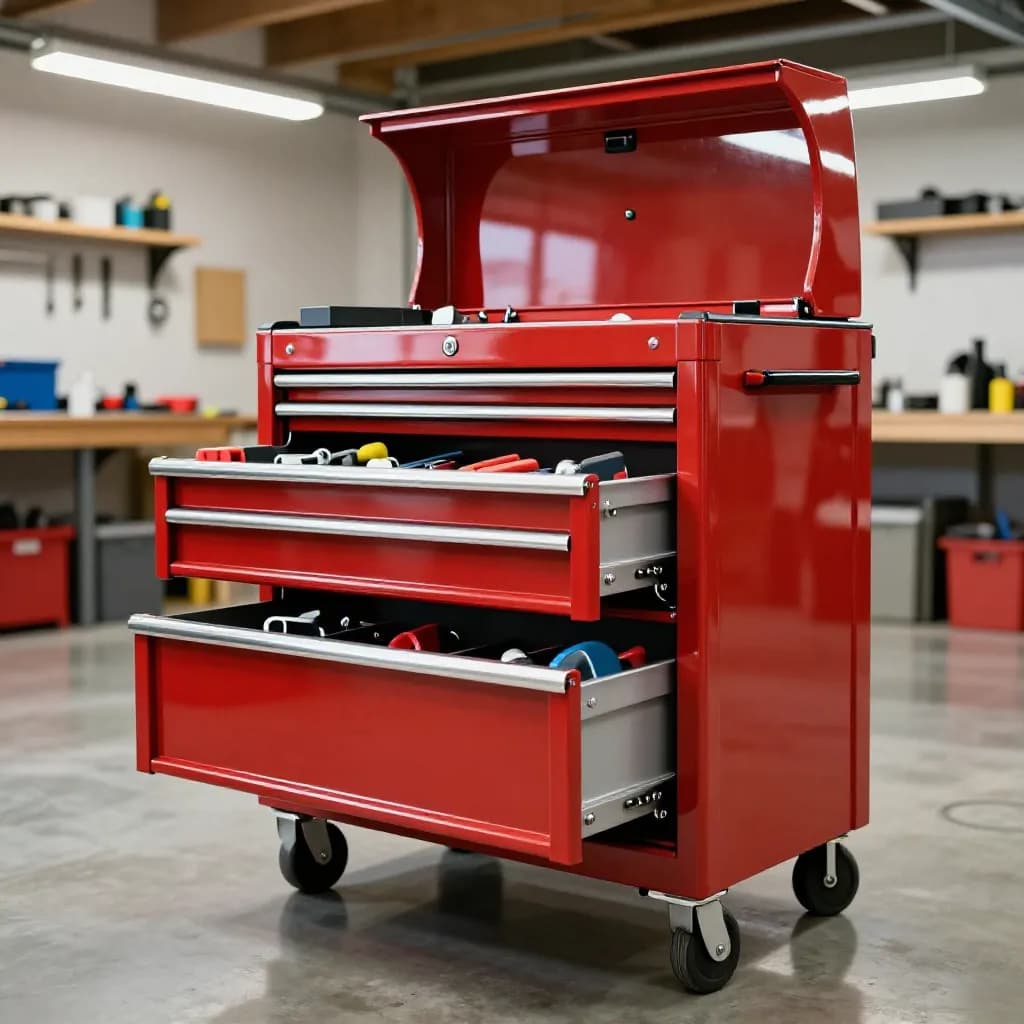
The coating on a tool box or cabinet faces a relentless combination of mechanical and chemical abuse. Heavy tools dropped onto drawer liners and cabinet tops generate impact forces that test chip resistance to its limits. Oils, greases, brake fluid, carburetor cleaner, and other automotive chemicals splash onto surfaces and sit for hours before being wiped away. Drawer slides cycle thousands of times per year, creating abrasion at contact points. And through all of this, the finish must maintain the glossy, showroom appearance that tool storage buyers demand.
Ready to Start Your Project?
From one-off customs to 15,000-part production runs — get precise pricing in 24 hours.
On This Page
Why Tool Storage Demands the Toughest Powder Coating
Powder coating became the standard finish for quality tool storage in the 1990s, replacing the baked enamel and lacquer finishes that were prone to chipping, yellowing, and chemical damage. Today, every major tool storage manufacturer — Snap-on, Matco, Mac Tools, Craftsman, Milwaukee, and Husky — uses powder coating as their primary finishing technology. The transition delivered dramatic improvements in chip resistance, chemical resistance, and long-term appearance retention that transformed consumer expectations for tool storage finish quality.
Steel Substrates and Forming Considerations
Tool boxes and cabinets are fabricated from cold-rolled steel in gauges ranging from 22 gauge (0.7 mm) for economy portable boxes to 14 gauge (1.9 mm) for professional-grade stationary cabinets. The steel undergoes extensive forming operations — bending, drawing, stamping, and spot welding — before entering the coating process. These forming operations create residual stresses and surface conditions that affect powder coating adhesion and performance.
Drawer bodies are typically deep-drawn from a single sheet of steel, creating complex three-dimensional shapes with tight radii at corners and edges. The drawing process stretches the steel, thinning it at corners and creating residual tensile stress that can promote coating adhesion failure if not properly managed. Post-forming stress relief through controlled heating (150-200°C for 30 minutes) can improve coating adhesion on heavily formed components, though this step is often omitted in high-volume production.
Spot welding is the primary joining method for tool box and cabinet assembly. Spot weld nuggets create localized heat-affected zones with surface discoloration and oxide formation that resist chemical pretreatment. The weld nuggets themselves are slightly raised, creating surface irregularities that can cause coating thickness variation. Proper weld parameter control minimizes surface disruption, and post-weld grinding of visible weld areas ensures a smooth surface for coating.
Pretreatment for tool storage steel follows standard multi-stage processes: alkaline cleaning, water rinse, iron phosphate or zinc phosphate conversion coating, and seal rinse. Zinc phosphate is preferred for professional-grade tool storage due to its superior corrosion protection and adhesion promotion. The conversion coating must uniformly cover all surfaces including formed areas, weld zones, and sheared edges to ensure consistent coating performance across the entire product.
Edge preparation is critical for tool storage because sheared edges on drawer openings, door edges, and panel joints are highly visible and vulnerable to corrosion. Deburring and edge radiusing (minimum 0.3 mm radius) improve powder coating coverage on edges and reduce the risk of coating thinning that leads to premature edge corrosion.
Powder Chemistry for Maximum Chip and Chemical Resistance
Tool storage powder coating specifications prioritize chip resistance and chemical resistance above all other properties. The coating must absorb the energy of dropped tools without chipping and resist the full range of automotive and industrial chemicals without softening or discoloration.
Hybrid epoxy-polyester powders in a 60:40 or 70:30 epoxy-to-polyester ratio are the standard chemistry for tool storage applications. The higher epoxy content provides superior chemical resistance against oils, greases, brake fluid, and solvents, while the polyester component contributes the flexibility needed for chip resistance. These formulations achieve pencil hardness of 2H-3H while maintaining direct impact resistance of 80-120 inch-pounds per ASTM D2794 — a combination that resists both scratching and chipping.
Chip resistance is the defining performance characteristic for tool storage coatings. ASTM D3170 (Gravelometer test) is the standard method for evaluating chip resistance, subjecting coated panels to a stream of gravel at controlled velocity and evaluating the resulting chip pattern. Tool storage coatings should achieve ratings of 7A or better (minimal chipping with no substrate exposure) to meet professional-grade specifications.
Chemical resistance testing for tool storage coatings includes exposure to motor oil (SAE 30), automatic transmission fluid, brake fluid (DOT 3 and DOT 4), carburetor cleaner, WD-40, acetone, MEK, and various degreasers. Test panels are exposed for 24 hours under cotton wool pads, then evaluated for softening, discoloration, blistering, or adhesion loss. Professional-grade tool storage coatings must show no effect from motor oil and transmission fluid, and only slight effect from the most aggressive solvents.
Film thickness for tool storage is typically specified at 65-90 microns — slightly higher than general industrial applications to provide additional chip and chemical resistance. The thicker film also provides better edge coverage on the numerous sheared edges present in tool box and cabinet construction.
Premium Finishes and Color Trends in Tool Storage
Tool storage aesthetics have become a significant differentiator in a competitive market. Professional mechanics and enthusiasts invest in tool storage that reflects their personal style and workshop identity, driving demand for premium finishes that go beyond basic solid colors.
Classic tool storage colors — red, blue, black, and grey — remain the highest-volume choices, but the palette has expanded dramatically. Matte black has become the fastest-growing color in the professional segment, projecting a modern, tactical aesthetic. Deep metallic colors — gunmetal grey, midnight blue, candy red — add depth and sophistication. Bright accent colors — lime green, orange, purple — appeal to enthusiasts who want their tool storage to make a statement.
Metallic powder coatings are particularly popular in the premium tool storage segment. Bonded metallic formulations with aluminum flake provide a consistent, sparkle-free metallic effect that projects quality and craftsmanship. The metallic effect adds visual depth to large flat surfaces like cabinet sides and drawer fronts, preventing the flat, lifeless appearance that solid colors can produce on large panels.
Two-tone and accent color schemes are a growing trend, with manufacturers offering contrasting colors on drawer fronts, trim pieces, and handle accents. This requires either selective masking during powder application or separate coating of accent components before assembly. Some manufacturers use powder coating for the base color and liquid paint for small accent details where powder coating's minimum film thickness would obscure fine detail.
Gloss levels for tool storage range from high-gloss (80-95 GU at 60°) for showroom-quality presentation to semi-gloss (40-60 GU) for a more understated professional look. Matte finishes (5-15 GU) are gaining market share but require careful handling during production and shipping because fingerprints and scuff marks are more visible on low-gloss surfaces. Some manufacturers apply a clear matte topcoat over a gloss base color to achieve the matte aesthetic while maintaining the depth and richness of the underlying color.
Texture finishes — fine orange peel, leather grain, and wrinkle — are used selectively on tool storage, typically on cabinet tops and work surfaces where texture provides practical benefits: hiding scratches, improving grip for placed items, and reducing the visibility of tool marks and chemical stains.
Drawer Slide and Hardware Interface Considerations
Tool boxes and cabinets contain numerous moving parts — drawer slides, hinges, latches, and casters — that interface directly with the powder-coated surfaces. The coating specification must account for these interfaces to ensure smooth operation and prevent premature wear.
Drawer slide mounting areas require precise film thickness control. Excessive coating thickness in slide mounting areas can cause binding, misalignment, and premature slide wear. Many manufacturers mask slide mounting surfaces during powder application to maintain bare metal contact for slide attachment, or specify maximum film thickness of 50 microns in these areas. The masking must be precise to avoid visible bare metal areas adjacent to the slide mounting zone.
Ball-bearing drawer slides generate concentrated contact stress at the bearing-to-rail interface. If the powder coating extends into the bearing contact area, it will be rapidly worn away, generating coating debris that contaminates the bearing and accelerates wear. Proper masking of bearing contact surfaces is essential for smooth, long-lasting drawer operation.
Hinge and latch mounting points require similar attention. The coating must not interfere with hinge pin insertion, latch engagement, or lock cylinder operation. Threaded fastener holes must be kept clear of coating to ensure proper thread engagement and fastener torque. Automated masking systems using silicone plugs and caps provide consistent, repeatable masking of these critical areas in high-volume production.
Electrical grounding points for tool cabinets with integrated power strips or USB charging ports must maintain bare metal contact for reliable electrical connection. These grounding points are masked during powder application and verified for electrical continuity during final assembly inspection.
The coefficient of friction of the powder coating surface affects drawer operation in tool boxes without ball-bearing slides. Economy tool boxes with friction slides rely on the coating's surface properties for smooth drawer action. Low-friction powder coating formulations with PTFE or wax additives reduce drawer pull force and improve the user experience, particularly for heavily loaded drawers.
Production Challenges for Complex Tool Storage Geometry
Tool boxes and cabinets have complex three-dimensional geometry with numerous recesses, channels, and internal surfaces that challenge uniform powder coating application. The Faraday cage effect is a persistent concern in the deep drawer cavities, internal cabinet corners, and ventilation slots that characterize tool storage construction.
Deep drawer bodies are the most challenging component to coat uniformly. A typical tool cabinet drawer is 50-100 mm deep with vertical walls and tight corner radii, creating a recessed cavity where electrostatic powder deposition is significantly reduced. Application strategies to address this include reduced gun voltage (40-60 kV versus the standard 60-100 kV), increased powder flow rate, tribo-charging guns for the interior pass, and pre-heating the drawer body to 80-100°C for thermal tack deposition.
Cabinet interiors present similar challenges on a larger scale. The interior surfaces of a tool cabinet body are visible when doors are open and must be coated to the same standard as exterior surfaces. Robotic application systems with articulated arms can position spray guns inside the cabinet body to coat interior surfaces from optimal angles, achieving more uniform coverage than fixed reciprocating guns.
Ventilation louvers and perforated panels require careful application parameter adjustment. The small openings in these components create intense Faraday cage effects that can leave the interior edges of louver slots and perforations uncoated. Pre-heating and tribo-charging are the most effective techniques for these components.
Color change efficiency is important for tool storage manufacturers who offer extensive color palettes. A manufacturer offering 15-20 standard colors plus custom options may change colors multiple times per shift. Quick-color-change booth systems with cartridge-style powder feed and automated booth cleaning minimize changeover time and cross-contamination risk.
Quality inspection for tool storage coating focuses on the areas most visible to the end user: drawer fronts, cabinet sides, and top surfaces. These surfaces must be free of orange peel, fisheyes, inclusions, and color variation. Film thickness verification at critical points — drawer corners, louver edges, and weld areas — ensures adequate protection in the most vulnerable areas.
Aftermarket Powder Coating and Custom Tool Storage
The aftermarket powder coating market for tool storage is substantial, driven by enthusiasts who want to customize their tool boxes and cabinets with unique colors, finishes, and effects not available from the original manufacturer. Custom powder coating transforms standard tool storage into personalized workshop centerpieces.
Stripping the original powder coating is the first step in aftermarket refinishing. Chemical stripping using methylene chloride-free formulations (typically benzyl alcohol or NMP-based) is preferred for tool storage because it does not generate the heat and mechanical stress of media blasting, preserving the dimensional precision of drawer bodies and slide mounting surfaces. Chemical stripping requires 2-12 hours of immersion depending on the coating thickness and chemistry.
Media blasting is an alternative stripping method that also provides surface profiling for the new coating. Aluminum oxide at 80-120 grit and 40-60 psi blast pressure removes the existing coating without excessive material removal from the thin-gauge steel. Blast parameters must be carefully controlled on drawer bodies and thin panels to prevent warping from the mechanical stress of blasting.
Custom color and finish options for aftermarket tool storage coating are virtually unlimited. Candy colors (transparent tinted clear over metallic base), color-shifting chameleon pigments, custom graphics through vinyl masking, and multi-color fade effects are popular choices in the enthusiast market. These complex finishes may require multiple coating passes and cure cycles, increasing production time and cost but delivering truly unique results.
Reassembly after aftermarket powder coating requires careful attention to hardware fit and drawer alignment. The new coating thickness may differ from the original, affecting slide mounting dimensions and hardware clearances. Shim washers and adjustable mounting hardware accommodate minor dimensional changes. Drawer slides should be replaced during refinishing if they show any wear, as the refinishing process provides the ideal opportunity for slide upgrade.
Aftermarket powder coating services for tool storage are offered by specialty shops that understand the unique requirements of these products — precise masking of slide areas, hardware interfaces, and grounding points; uniform coverage of deep drawer cavities; and the premium finish quality that tool storage owners expect.
Frequently Asked Questions
What makes tool box powder coating different from standard powder coating?
Tool box powder coatings use higher epoxy content (60-70%) for superior chemical resistance against oils, brake fluid, and solvents, combined with higher film thickness (65-90 microns) for enhanced chip resistance. They achieve impact resistance of 80-120 inch-pounds and Gravelometer ratings of 7A or better.
Can powder-coated tool cabinets resist brake fluid and solvents?
Yes. Professional-grade tool storage powder coatings are tested against motor oil, transmission fluid, brake fluid (DOT 3 and 4), carburetor cleaner, acetone, and various degreasers. Quality formulations show no effect from oils and only slight effect from the most aggressive solvents after 24-hour exposure.
How long does powder coating last on tool boxes?
Properly applied powder coating on tool boxes and cabinets lasts 20-30 years under normal workshop conditions. The dense, cross-linked film resists chipping, chemical attack, and abrasion far better than baked enamel or lacquer finishes, which typically show significant degradation within 5-10 years.
Can I get my tool box custom powder coated?
Yes. Aftermarket powder coating services can strip the original finish and apply custom colors, metallics, candy coats, and multi-color designs. The process requires careful masking of drawer slide areas and hardware mounting points to maintain proper fit and function after refinishing.
Why do some tool cabinet drawers stick after powder coating?
Drawer sticking is caused by excessive coating thickness in slide mounting areas. Quality manufacturers mask slide contact surfaces during powder application to maintain precise clearances. Aftermarket coating services must also mask these areas carefully to prevent binding and misalignment.
Ready to Start Your Project?
From one-off customs to 15,000-part production runs — get precise pricing in 24 hours.