Unmanned aerial vehicles have evolved from hobbyist toys into essential tools for agriculture, infrastructure inspection, delivery logistics, emergency response, and cinematography. As the drone industry matures and commercial applications demand longer service lives and higher reliability, the surface finishing of drone components has become an engineering consideration rather than an afterthought. Powder coating is finding increasing application on drone structural components, ground infrastructure, and support equipment where its durability and weight efficiency provide clear advantages.
Consumer
Powder Coating for Drone Components: Lightweight Protection for UAV Frames and Infrastructure
Sundial Powder Coating·April 23, 2026·12 min
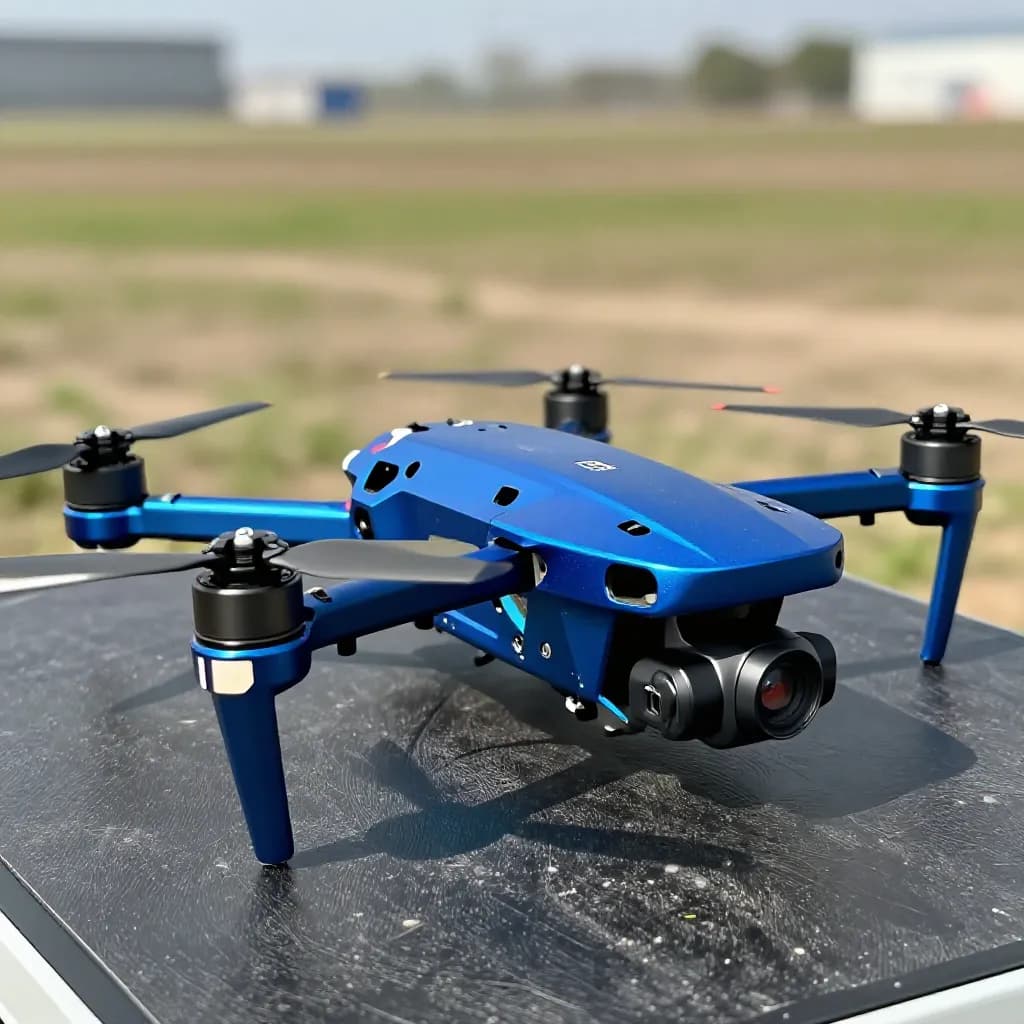
The drone ecosystem encompasses far more than the aircraft themselves. Commercial drone operations require landing pads, charging stations, storage enclosures, ground control housings, antenna mounts, and maintenance equipment — all of which benefit from powder coating's environmental resistance. The aircraft components that are candidates for powder coating include metal frame sections, motor mounts, landing gear, gimbal brackets, and payload attachment hardware. Carbon fiber airframe components, which dominate consumer and many commercial drones, are generally not suitable for standard powder coating due to temperature sensitivity.
Ready to Start Your Project?
From one-off customs to 15,000-part production runs — get precise pricing in 24 hours.
On This Page
The Growing Role of Powder Coating in Drone Technology
The weight sensitivity of drone applications exceeds even that of e-bikes and scooters. Every gram of coating weight directly reduces payload capacity or flight time, making coating specification a careful balance between protection and performance. For a commercial drone with a maximum takeoff weight of 25 kilograms and a payload capacity of 5 kilograms, even 50 grams of unnecessary coating weight represents 1 percent of payload capacity — a meaningful reduction for operators maximizing sensor or delivery payload.
This article examines powder coating applications across the drone ecosystem, from the aircraft components where ultra-lightweight specifications are critical to the ground infrastructure where standard industrial coating practices apply. The technical requirements vary dramatically between these applications, and understanding the distinction is essential for appropriate specification.
Lightweight Coating for Airborne Components
Drone airframe components that are candidates for powder coating are primarily metal parts — aluminum motor mounts, steel or titanium fastener hardware, aluminum landing gear struts, and magnesium alloy structural brackets. These components require corrosion protection and often benefit from the color coding and identification marking that powder coating provides, but the coating must be applied at the minimum effective thickness to preserve flight performance.
For drone motor mounts and structural brackets, target film builds of 25-40 microns represent the practical minimum for meaningful corrosion protection. At these thicknesses, the coating weight on a typical quadcopter motor mount is less than 2 grams per mount — a total of 8 grams for all four mounts. Ultra-fine powder formulations with D50 particle sizes of 20-25 microns are necessary to achieve smooth, uniform films at these low thicknesses. Standard powder with D50 of 35-40 microns cannot reliably produce films below 40 microns without pinholes and thin spots.
Landing gear components face the most demanding combination of weight sensitivity and durability requirements. Landing gear absorbs impact loads during every landing, contacts abrasive surfaces like gravel and concrete, and is exposed to moisture, mud, and salt in field operations. A film build of 40-60 microns on landing gear provides adequate impact and abrasion resistance while keeping weight addition below 10-15 grams for a typical commercial drone landing gear assembly.
Color coding of drone components serves both aesthetic and functional purposes. Motor mounts are often color-coded to indicate rotation direction — a convention that aids field maintenance and propeller installation. Red and black are the most common color pair, with red indicating clockwise rotation and black indicating counterclockwise. Powder coating provides durable color coding that withstands the vibration, heat, and chemical exposure of motor mount service without fading or peeling.
Thermal considerations are important for motor mounts, which must dissipate heat from the motor windings during flight. The thin powder coating film adds minimal thermal resistance, but dark colors improve radiative heat dissipation from the mount surface. For high-performance drones with sustained high-power motor operation, the thermal emissivity advantage of dark coatings can reduce motor mount temperatures by 3-5 degrees Celsius compared to bare aluminum.
Vibration Resistance and Fatigue Performance
Drones generate significant vibration from motor and propeller operation, and all airframe components experience continuous cyclic loading during flight. The powder coating on vibration-exposed components must maintain adhesion and integrity under these dynamic conditions without cracking, delaminating, or generating particles that could interfere with sensitive onboard electronics or camera systems.
Vibration frequencies on multirotor drones typically range from 50 to 500 hertz, with dominant frequencies corresponding to motor RPM and propeller blade pass frequency. These vibrations create cyclic stress in the coating film, particularly at stress concentration points such as fastener holes, sharp corners, and thickness transitions. A coating that performs well in static adhesion tests may fail under vibration if it lacks adequate flexibility and fatigue resistance.
Polyester powder coatings with good elongation properties — 3 millimeters or more on a conical mandrel test — provide the flexibility needed to accommodate vibration-induced substrate movement without cracking. Brittle coatings such as pure epoxy formulations are less suitable for vibration-exposed drone components because they tend to develop microcracks at stress concentration points that propagate under cyclic loading.
Adhesion under vibration is critically dependent on pretreatment quality. The conversion coating layer must form a strong chemical bond with both the substrate and the powder coating to resist the peeling forces generated by vibration. For aluminum drone components, zirconium-based conversion coatings at 30-50 milligrams per square meter provide excellent vibration-resistant adhesion. Inadequate pretreatment — particularly insufficient deoxidizing or contaminated conversion coating baths — is the most common root cause of vibration-induced coating failure.
Particle generation from coating degradation is a concern unique to drone applications. Loose coating particles can contaminate camera lenses, interfere with gimbal bearings, block cooling air passages, or cause electrical shorts on exposed circuit boards. For drones carrying sensitive optical or electronic payloads, the coating specification should include vibration testing with particle collection to verify that the coating does not generate debris under operational vibration conditions.
UV Protection and Outdoor Durability
Commercial drones spend significant time outdoors, both during flight operations and during field storage and transport. The powder coating must resist UV degradation that causes chalking, fading, gloss loss, and eventual film embrittlement. UV exposure is particularly intense for drone components because they operate at altitude where UV intensity is higher than at ground level, and they lack the shading that ground-based equipment receives from surrounding structures.
Polyester powder coatings are the standard choice for UV-exposed drone components, offering good color and gloss retention for 3-5 years of outdoor exposure. For drones with expected service lives of 5-10 years, super-durable polyester formulations extend UV resistance to 7-10 years. The additional UV stability comes from modified resin chemistry that resists photodegradation of the polymer backbone, combined with UV absorber and hindered amine light stabilizer additives that scavenge the free radicals generated by UV exposure.
Color stability under UV exposure varies significantly by pigment type. Organic pigments — particularly reds, oranges, and yellows — are more susceptible to UV fading than inorganic pigments. For drone components where color accuracy is functionally important, such as motor mount color coding or corporate branding on commercial fleet drones, inorganic pigments should be specified for maximum color stability. Carbon black provides the most UV-stable black, while titanium dioxide provides excellent UV stability in white and light-colored formulations.
Gloss retention is often the first visible sign of UV degradation. A high-gloss coating that becomes matte after a year of outdoor exposure may still provide adequate corrosion protection, but the appearance change can be unacceptable for commercial fleet operators who maintain brand standards. Specifying initial gloss levels in the satin range of 40-60 gloss units at 60 degrees makes UV-related gloss changes less visually apparent than starting with a high-gloss finish of 80-95 units.
For drone components that experience extreme UV exposure — such as fixed-wing drones used for agricultural surveying that fly for hours at altitude — fluoropolymer-modified powder coatings provide the ultimate UV resistance, maintaining color and gloss for 15-20 years. However, these premium formulations add weight and may be justified only for high-value, long-service-life aircraft.
Commercial Drone Infrastructure: Landing Pads and Charging Stations
The ground infrastructure supporting commercial drone operations represents a growing market for powder-coated metal fabrications. Drone landing pads, automated charging stations, drone-in-a-box systems, package delivery receptacles, and ground control equipment housings all require durable outdoor finishes that powder coating provides effectively.
Drone landing pads for automated operations are typically fabricated from aluminum or steel plate with raised edges, drainage features, and precision landing markers. The powder coating on landing pads must withstand repeated landing impacts from drone landing gear, resist abrasion from propeller wash blowing debris across the surface, and maintain high-visibility markings that guide automated landing systems. Anti-slip textures can be incorporated into the powder coating using textured formulations or post-coating anti-slip aggregate application to prevent drone skidding on wet surfaces.
Automated charging stations — often called drone-in-a-box systems — house the drone between missions and provide automated battery charging or swapping. These enclosures operate outdoors in all weather conditions and must protect sensitive charging electronics from rain, dust, temperature extremes, and UV radiation. The powder coating specification for charging station enclosures follows standard outdoor industrial practice: super-durable polyester at 70-90 microns over chromate-free pretreatment, with a minimum of 1000 hours salt spray resistance.
High-visibility markings on drone infrastructure serve both operational and safety functions. Landing zone boundaries, no-fly zone indicators, and equipment identification markings must remain visible and legible for years of outdoor exposure. Powder coating provides durable base colors, while critical markings may use retroreflective applied elements for nighttime visibility. The contrast between marking colors and background colors should meet minimum luminance contrast ratios for visibility under various lighting conditions.
Package delivery infrastructure — including rooftop landing pads, residential delivery receptacles, and logistics hub equipment — is an emerging application as drone delivery services expand. These installations must be aesthetically acceptable in residential and commercial settings while meeting the durability requirements of outdoor equipment. Architectural-grade powder coatings in colors that complement building design provide the combination of appearance and performance needed for customer-facing drone delivery infrastructure.
Pretreatment and Application for Small Drone Parts
Drone components are typically small, lightweight parts with complex geometries that present specific challenges for powder coating pretreatment and application. The small size means low thermal mass, which affects both pretreatment chemical reaction rates and powder curing behavior. The complex shapes — motor mounts with multiple bolt holes, gimbal brackets with thin flanges, and landing gear with tubular sections — create Faraday cage effects and edge coverage challenges that require skilled application technique.
Pretreatment of small aluminum drone parts is most effectively performed using immersion processes rather than spray systems. The small part size makes spray pretreatment impractical due to poor coverage of recessed features and excessive chemical waste. Immersion in sequential alkaline cleaner, deoxidizer, and conversion coating baths ensures complete surface coverage regardless of part geometry. Rack design for immersion processing must ensure that parts are oriented to allow complete drainage between stages, preventing chemical carryover that can contaminate subsequent baths.
Powder application on small drone parts requires careful electrostatic parameter management. The low mass and small surface area of drone components means they accumulate charge quickly, and excessive voltage can cause back-ionization — a condition where the electrostatic field at the part surface becomes so strong that it repels incoming powder and creates craters in the deposited film. Reducing gun voltage to 40-60 kilovolts, compared to the 60-100 kilovolts typical for larger parts, helps prevent back-ionization on small drone components.
Fixturing small parts for powder coating requires balancing electrical grounding, part orientation, and production efficiency. Custom fixtures that hold multiple small parts in optimal spray orientation maximize throughput while ensuring consistent coating quality. The fixture contact points must provide reliable electrical ground — poor grounding is the most common cause of thin or uneven coating on small parts. Fixture contact marks on the finished parts should be located in non-visible areas or at assembly interfaces where they will be covered by mating components.
Curing small parts requires attention to oven temperature ramp rate. Low-mass parts heat quickly and can overshoot the target cure temperature if the oven is set for larger, heavier parts. Dedicated cure schedules for small drone components — with reduced oven temperature or shorter cure times — prevent overcure that can cause yellowing, embrittlement, and reduced flexibility.
Regulatory and Identification Marking Requirements
Commercial drone operations are subject to aviation regulations that include requirements for aircraft identification, registration marking, and in some cases specific color or visibility standards. The powder coating specification must accommodate these regulatory requirements while meeting the technical performance standards discussed in previous sections.
Remote identification requirements, now mandated in most major aviation markets, require drones to broadcast identification information electronically. While this is primarily an electronic system requirement, the physical registration number or serial number must also be displayed on the aircraft in a manner that is legible and durable. Powder coating provides an excellent base surface for laser-engraved or chemically etched identification markings that are permanent, tamper-resistant, and legible throughout the aircraft's service life.
Visibility requirements for drones operating in shared airspace may include anti-collision lighting and high-visibility markings. While active lighting systems are separate from the coating, the coating color and finish can enhance or reduce the visibility of the aircraft against sky and ground backgrounds. White and bright colors provide better visual contrast against dark ground backgrounds, while dark colors are more visible against bright sky. Some operators use contrasting color schemes — dark upper surfaces and light lower surfaces — to maximize visibility from both above and below.
Military and government drone applications may have specific coating requirements including low-observable finishes that reduce visual, infrared, or radar signatures. These specialized coatings are outside the scope of standard commercial powder coating and typically involve classified formulations and application processes. However, standard matte powder coatings in appropriate colors can provide basic visual signature reduction for surveillance and security drones operating at altitude.
Export control regulations may apply to certain drone coating technologies, particularly those with radar-absorbing or infrared-suppressing properties. Manufacturers and coating applicators should verify that their coating specifications do not fall under export control restrictions before supplying coatings for drones intended for international sale or operation.
For commercial fleet operators, consistent branding across the drone fleet requires color specification management similar to any corporate identity program. Powder coating color standards should be documented with spectrophotometric data and physical reference panels, with batch-to-batch color verification ensuring fleet consistency.
Frequently Asked Questions
Can you powder coat a drone frame?
Metal drone frame components — aluminum motor mounts, steel hardware, and landing gear — can be powder coated effectively. Carbon fiber airframe components cannot be standard powder coated due to the 180-200 degree Celsius cure temperatures that would damage the composite matrix. Ultra-thin film builds of 25-40 microns minimize weight impact on flight performance.
How much weight does powder coating add to a drone?
At the ultra-thin film builds used for drone components (25-40 microns), coating weight on a typical quadcopter's metal parts is approximately 15-30 grams total. This includes motor mounts, landing gear hardware, and structural brackets. The weight impact on flight time is minimal but should be accounted for in payload calculations.
Does powder coating affect drone motor cooling?
The thin powder coating film adds minimal thermal resistance to motor mounts. Dark-colored coatings actually improve radiative heat dissipation compared to bare aluminum, potentially reducing motor mount temperatures by 3-5 degrees Celsius during sustained operation. The thermal impact is generally positive or neutral for drone motor cooling.
What powder coating is best for outdoor drone equipment?
Super-durable polyester powder coating at 70-90 microns over chromate-free pretreatment is recommended for outdoor drone infrastructure like landing pads and charging stations. This provides 7-10 years of UV resistance and a minimum of 1000 hours salt spray protection, suitable for year-round outdoor deployment.
Can powder coating withstand drone vibration?
Yes, when properly specified. Polyester powder coatings with good elongation properties (3mm or more on conical mandrel test) accommodate vibration-induced movement without cracking. Quality pretreatment is critical — zirconium-based conversion coatings provide the adhesion strength needed to resist vibration-induced peeling forces during flight.
Ready to Start Your Project?
From one-off customs to 15,000-part production runs — get precise pricing in 24 hours.