The 3D printing community has embraced powder coating as the finish of choice for custom printer frames, enclosures, and structural components. From hobbyist Voron builds to commercial printer manufacturers, powder coating delivers the combination of durability, heat resistance, and aesthetic quality that the 3D printing environment demands. The technology has become so closely associated with quality printer builds that a powder-coated frame is often considered a hallmark of a serious, well-engineered machine.
Consumer
Powder Coating for 3D Printer Frames: Heat Resistance, Precision, and Custom Builds
Sundial Powder Coating·April 23, 2026·11 min
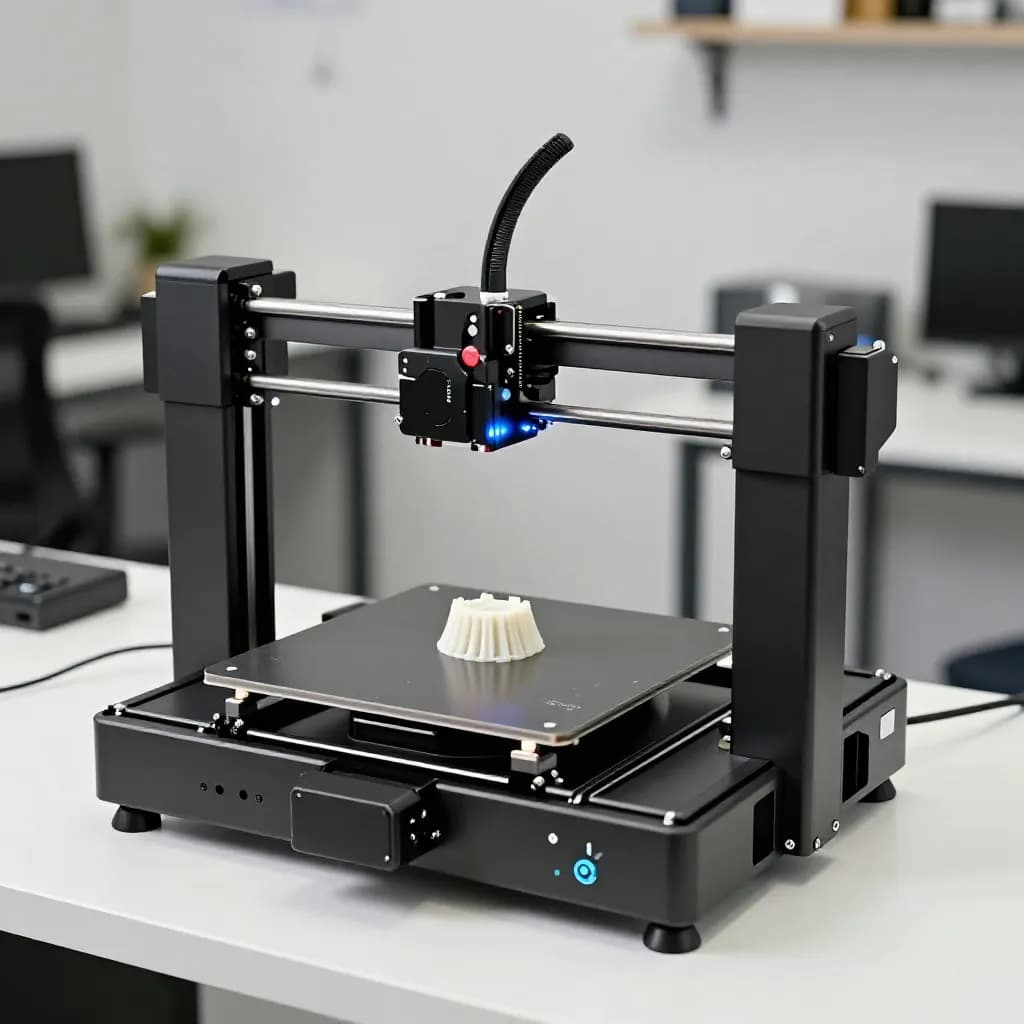
The 3D printer operating environment creates specific coating challenges. Heated beds generate sustained temperatures of 60-110 degrees Celsius, with enclosed printers reaching ambient chamber temperatures of 50-70 degrees Celsius. Extruder assemblies operate at 200-300 degrees Celsius, radiating heat to nearby frame members. Chemical exposure from cleaning solvents, adhesion promoters, and post-processing chemicals adds another dimension of stress. And the precision requirements of 3D printing mean that coating thickness on critical surfaces must be controlled to avoid interfering with linear rail alignment, belt tension, and component mounting.
Ready to Start Your Project?
From one-off customs to 15,000-part production runs — get precise pricing in 24 hours.
On This Page
Why Makers and Manufacturers Powder Coat 3D Printer Frames
For commercial 3D printer manufacturers, powder coating provides production advantages that liquid paint cannot match. The single-coat application achieves full film build without multiple passes, the overspray reclaim system minimizes material waste, and the cured finish is immediately ready for assembly without extended drying times. These efficiency advantages translate directly into production throughput and manufacturing cost.
The maker community has driven innovation in small-batch and single-piece powder coating for 3D printer frames. Online communities share detailed guides for DIY powder coating setups, discuss optimal powder selections for printer applications, and showcase custom color builds that transform utilitarian machines into workshop showpieces. This grassroots adoption has created a knowledgeable user base that demands technical substance in coating specification.
Heat Resistance Requirements for Printer Environments
The thermal environment inside a 3D printer enclosure is more demanding than many people realize, and the powder coating specification must account for both steady-state temperatures and thermal cycling patterns that occur during print operations. Understanding the thermal profile of different printer architectures is essential for selecting the right coating chemistry.
Open-frame printers — the most common configuration for PLA and PETG printing — generate relatively modest thermal loads on the frame. The heated bed operates at 60-80 degrees Celsius, but frame members are typically 20-40 degrees Celsius above ambient due to convective and radiative heat transfer from the bed. Standard polyester powder coatings, rated for continuous service at 120-150 degrees Celsius, provide ample thermal margin for open-frame printers.
Enclosed printers designed for ABS, ASA, nylon, and polycarbonate printing create significantly higher thermal demands. Chamber temperatures of 50-70 degrees Celsius are maintained during printing, with localized hot spots near the heated bed reaching 80-100 degrees Celsius on adjacent frame members. The frame coating must tolerate these temperatures continuously for print jobs that can last 24-72 hours. Polyester powder coatings remain suitable for most enclosed printers, but the coating should be tested at the specific chamber temperature to verify that it does not soften, discolor, or lose adhesion under sustained exposure.
High-temperature printers designed for PEEK, PEI, and other engineering polymers push chamber temperatures to 100-150 degrees Celsius or higher. At these temperatures, standard polyester powder coatings approach their continuous service limit, and some formulations may begin to yellow or lose hardness. For high-temperature printer frames, epoxy powder coatings offer better heat resistance — maintaining properties up to 180-200 degrees Celsius — though they sacrifice UV resistance, which is acceptable for an indoor printer application.
Thermal cycling is as important as peak temperature. Every print cycle heats the frame from ambient to operating temperature and back, creating expansion and contraction stresses in the coating. Over hundreds or thousands of print cycles, these thermal stresses can cause coating fatigue, particularly at joints and fastener points where differential expansion between the coating and substrate is concentrated.
Precision and Dimensional Considerations
3D printer frames require dimensional precision that is unusual for powder-coated fabrications. Linear rail mounting surfaces must be flat to within 0.05-0.1 millimeters over their length to ensure smooth carriage travel and accurate print positioning. Motor mount faces must be perpendicular to their respective axes. Belt idler and tensioner mounting points must maintain precise spacing. The powder coating must not compromise these dimensional requirements.
Powder coating adds 50-80 microns of material to coated surfaces — a significant dimension in the context of 3D printer precision. On a linear rail mounting surface, 60 microns of coating on each side of a mounting extrusion adds 0.12 millimeters to the total width, which can affect rail alignment if not accounted for in the design. The most common approach is to mask critical mounting surfaces before coating, leaving bare metal at precision interfaces and coating only the non-critical surfaces for corrosion protection and aesthetics.
Masking strategy for 3D printer frames requires detailed understanding of which surfaces are dimensionally critical and which are not. Linear rail mounting faces, motor mount surfaces, belt path contact points, and bearing seat bores should be masked. General frame surfaces, enclosure panels, and non-precision structural members can be coated without dimensional concern. A well-documented masking map specific to each printer design ensures consistent results across production runs or community builds.
For makers who want a fully coated appearance without masking, an alternative approach is to coat the entire frame and then machine critical surfaces after coating. CNC milling or surface grinding removes the coating from precision surfaces while leaving the surrounding areas coated. This approach produces a clean, professional appearance with sharp coating-to-bare-metal transitions, but it requires access to machining equipment and adds a post-coating processing step.
Aluminum extrusion frames — the most common construction method for both commercial and DIY 3D printers — present a specific consideration. The T-slot channels used for component mounting accumulate powder coating in their recesses, which can interfere with T-nut insertion and sliding. Light coating of T-slot channels is acceptable if the film build is kept below 40 microns, but heavy coating will require channel cleaning or reaming after cure.
Substrate Preparation for Common Printer Frame Materials
3D printer frames are constructed from a limited range of materials, each requiring appropriate preparation for powder coating adhesion. The three most common substrates are aluminum extrusion profiles, steel sheet metal for enclosure panels, and cast or machined aluminum for custom structural components.
Aluminum extrusion profiles — typically 2020, 2040, or 3030 series V-slot or T-slot profiles in 6063-T5 alloy — are the backbone of most 3D printer frames. These profiles arrive from the manufacturer with a thin natural oxide layer and residual drawing lubricant that must be removed before coating. The standard pretreatment sequence is alkaline cleaning at 50-60 degrees Celsius for 3-5 minutes, ambient rinse, acid etch or deoxidize for 1-2 minutes, rinse, and chromate-free conversion coating for 1-2 minutes. The conversion coating — typically zirconium-based — provides the adhesion foundation for the powder coating.
For makers performing DIY powder coating without access to chemical pretreatment lines, mechanical preparation is an acceptable alternative. Scotch-Brite abrasive pads or 180-220 grit sandpaper creates a mechanical adhesion profile on the aluminum surface. The abraded surface should be cleaned with acetone or isopropyl alcohol to remove abrasion debris and any remaining oils. While mechanical preparation does not provide the chemical bonding of a conversion coating, it produces acceptable adhesion for indoor printer applications where corrosion exposure is minimal.
Steel sheet metal panels for printer enclosures require iron phosphate or zinc phosphate conversion coating for optimal adhesion and corrosion protection. Cold-rolled steel panels should be degreased, pickled to remove mill scale, and conversion coated before powder application. For DIY builders using steel panels, sandblasting followed by immediate coating provides good adhesion without chemical pretreatment, though the corrosion protection is reduced compared to properly conversion-coated steel.
Cast aluminum components — such as custom motor mounts or gantry brackets produced by CNC machining from billet — may have residual machining oils and cutting fluid contamination that require thorough cleaning. Ultrasonic cleaning in alkaline solution is effective for removing contaminants from machined surfaces and blind holes. The machined surface finish typically provides adequate mechanical adhesion profile without additional etching, though conversion coating is still recommended for maximum adhesion and corrosion resistance.
Custom Builds and the Maker Community Approach
The maker community has developed a distinctive approach to powder coating 3D printer frames that combines industrial coating principles with the resourcefulness and creativity characteristic of the DIY movement. Online forums, Discord servers, and YouTube channels dedicated to printer building feature extensive discussions of powder coating technique, color selection, and quality optimization that have created a remarkably knowledgeable amateur coating community.
DIY powder coating setups for 3D printer frames typically center on a consumer-grade electrostatic powder gun, a converted kitchen oven or purpose-built curing oven, and basic masking supplies. These setups are capable of producing professional-quality results on printer-sized components when operated with attention to technique. The key limitations of DIY setups are oven size — which may not accommodate large printer frames in one piece — and the lack of chemical pretreatment, which limits long-term adhesion and corrosion performance.
The Voron community deserves special mention as a driving force in maker powder coating. The Voron series of open-source 3D printer designs specifies powder-coated aluminum extrusion frames as the standard construction, and the community has developed detailed guides for coating these frames. Color selection has become a significant aspect of Voron build culture, with builders showcasing custom color combinations that range from subtle industrial aesthetics to bold, eye-catching designs. Community group buys for powder coating services have emerged, where builders in a geographic area coordinate to have their frames coated together, achieving better quality and efficiency than individual DIY efforts.
Color trends in the 3D printer community follow their own trajectory, influenced by but distinct from broader design trends. Matte black remains the most popular choice for its industrial aesthetic and ability to hide minor imperfections. However, bold colors — particularly reds, blues, and greens in both matte and metallic finishes — have gained significant popularity as builders seek to personalize their machines. Two-tone color schemes using different colors for the frame and accent panels create visual depth and highlight the printer's mechanical architecture.
For builders who want the quality of professional powder coating without DIY equipment, local powder coating shops are increasingly familiar with 3D printer frame work. Bringing a complete masking diagram and clear specification of which surfaces to coat and which to mask helps ensure good results from shops that may not be familiar with the precision requirements of printer frames.
Enclosure Panels and Sheet Metal Coating
3D printer enclosures — whether factory-supplied or custom-built — use sheet metal panels that benefit from powder coating for both protection and aesthetics. Enclosure panels face different coating requirements than structural frame members, with emphasis on appearance quality, thermal performance, and ease of cleaning rather than dimensional precision.
Steel enclosure panels are the most common substrate, typically 0.8-1.5 millimeter cold-rolled steel or galvanized steel. Powder coating on steel panels provides corrosion protection that is essential for long-term durability, particularly in workshop environments where humidity, coolant spray from other machines, and general industrial contamination are present. A standard polyester powder coating at 60-80 microns over iron phosphate pretreatment provides excellent protection and appearance for steel enclosure panels.
Aluminum composite panels — aluminum skins bonded to a polyethylene or mineral-filled core — are used in some premium printer enclosures for their flatness, light weight, and thermal insulation properties. These panels can be powder coated, but the curing temperature must be carefully controlled to avoid delaminating the composite structure. The polyethylene core in standard aluminum composite panels begins to soften at 160-170 degrees Celsius, which is below the standard powder coating cure temperature of 180-200 degrees Celsius. Low-temperature cure powder coatings that cure at 140-160 degrees Celsius are necessary for these substrates.
Interior panel surfaces in heated enclosures should be coated with light-colored, high-emissivity finishes that reflect radiant heat from the heated bed back into the chamber, helping maintain uniform chamber temperature. White or light gray interior coatings with matte or satin finishes provide the best combination of reflectivity and emissivity for thermal management. Dark interior colors absorb radiant heat and can create temperature gradients within the enclosure that affect print quality.
Exterior panel surfaces should prioritize appearance and cleanability. Smooth finishes in the satin to semi-gloss range are easiest to clean and show the least fingerprint marking. Textured finishes hide minor dents and scratches but can accumulate dust and filament debris in the texture valleys. For workshop environments where panels will be handled frequently, a smooth satin finish at 40-60 gloss units provides the best balance of appearance and practicality.
Quality Verification and Common Defects
Achieving consistent, high-quality powder coating on 3D printer frames requires attention to several common defect modes that are particularly relevant to this application. Understanding these defects and their causes helps both professional applicators and DIY builders produce better results.
Orange peel — a textured surface resembling the skin of an orange — is the most common cosmetic defect on powder-coated printer frames. It results from insufficient powder flow during the melt and cure phase, caused by excessive film build, inadequate cure temperature, or powder formulation issues. For printer frames where a smooth finish is desired, film build should be kept in the 50-70 micron range, and the cure oven must reach the powder manufacturer's recommended temperature at the substrate surface — not just the oven air temperature. Infrared thermometer verification of substrate temperature during cure is the most reliable way to confirm adequate heating.
Outgassing defects — small pinholes or craters in the cured film — occur when gases trapped in the substrate escape through the molten powder during curing. Cast aluminum components are particularly susceptible because the casting process traps air in the metal's pore structure. Degassing the casting by pre-baking at 200-220 degrees Celsius for 20-30 minutes before powder application allows trapped gases to escape before the coating is applied. Extruded aluminum profiles rarely have outgassing issues because the extrusion process produces dense, pore-free material.
Coating thickness variation across the frame is common when multiple extrusion profiles are coated simultaneously. Profiles at the edges of the coating rack receive more powder than those in the center due to electrostatic field distribution. Rotating the rack during application or adjusting gun positioning to compensate for edge effects helps achieve uniform coverage. Film thickness should be verified at multiple points on each profile using an eddy current thickness gauge.
Color matching between components coated in different batches can be problematic, particularly for multi-color builds where frame and accent components may be coated at different times. Using powder from the same manufacturing lot for all components of a build ensures color consistency. If different lots must be used, spectrophotometric color verification before coating production parts confirms that the color difference is within acceptable limits — typically Delta E less than 1.0 for critical color matches.
Frequently Asked Questions
Can powder coating handle the heat inside a 3D printer enclosure?
Yes. Standard polyester powder coatings tolerate continuous temperatures of 120-150 degrees Celsius, well above the 50-70 degree Celsius chamber temperatures of most enclosed printers. For high-temperature printers running PEEK or PEI with chambers above 100 degrees Celsius, epoxy powder coatings provide heat resistance up to 180-200 degrees Celsius.
Does powder coating affect 3D printer frame precision?
Powder coating adds 50-80 microns to coated surfaces, which can affect linear rail alignment and component mounting. Critical precision surfaces — rail mounts, motor faces, bearing seats — should be masked before coating or machined after coating. Non-precision surfaces can be coated without dimensional concern.
Can I powder coat 3D printer frames at home?
Yes. Many makers successfully powder coat printer frames using consumer-grade electrostatic guns and converted or purpose-built ovens. Key requirements are thorough surface preparation, proper masking of precision surfaces, and accurate oven temperature control. The main limitation of DIY setups is oven size — large frames may need to be coated in sections.
What is the best powder coating color for a 3D printer?
Matte black is the most popular choice for its industrial aesthetic and ability to hide minor imperfections. However, the maker community increasingly favors bold colors and two-tone schemes. Light-colored interior enclosure panels are recommended for thermal management, as they reflect radiant heat back into the chamber for more uniform temperatures.
How do I prevent powder coating from clogging T-slot channels?
Keep film build below 40 microns in T-slot channels, or mask the channels before coating. If channels are coated, a T-slot cleaning tool or appropriately sized tap can clear excess coating after curing. Some builders prefer to mask all T-slots and coat only the external faces of the extrusion profiles.
Ready to Start Your Project?
From one-off customs to 15,000-part production runs — get precise pricing in 24 hours.