Firearms finishing demands a unique combination of coating properties that few applications can match — extreme heat resistance at the chamber and barrel (temperatures exceeding 370°C during rapid fire), exceptional abrasion resistance on surfaces that contact holsters, cases, and hands, chemical resistance to cleaning solvents, lubricants, and propellant residues, and corrosion protection in environments ranging from humid tropical climates to saltwater marine exposure. The coating must deliver all of these properties in a thin film (25-75 microns) that does not affect the dimensional tolerances critical to firearm function and safety.
Consumer
Powder Coating Firearms and Weapons Finishing: Heat Resistance, Abrasion Durability, and MIL-Spec Performance
Sundial Powder Coating·April 22, 2026·12 min
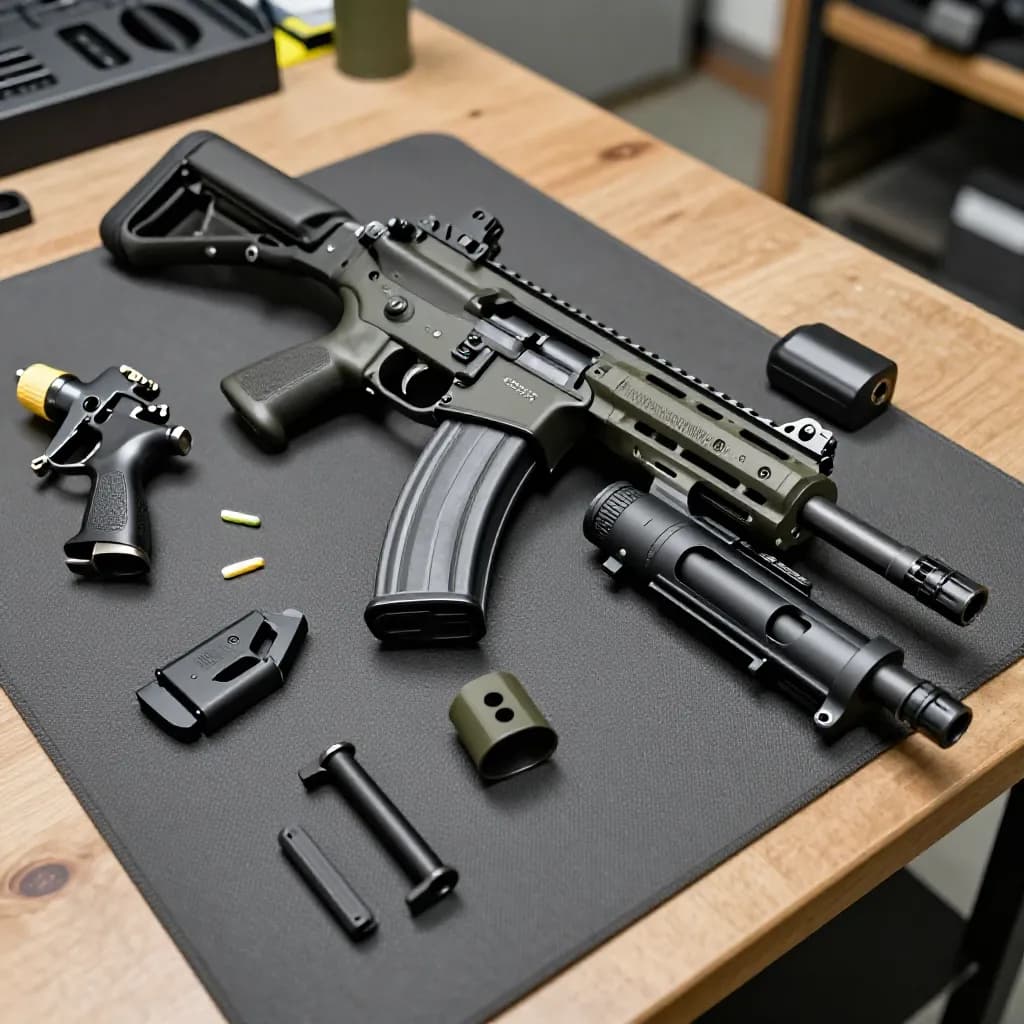
Powder coating has established a significant presence in the firearms finishing market as a durable, cost-effective alternative to traditional bluing, Parkerizing, and newer ceramic-polymer coatings. While powder coating does not match the extreme thin-film performance of specialized ceramic coatings like Cerakote for the highest-heat applications, it offers advantages in film build (providing better corrosion protection), color range (virtually unlimited options), cost efficiency (lower material and application cost per unit), and environmental compliance (zero VOC, no hazardous solvents).
Ready to Start Your Project?
From one-off customs to 15,000-part production runs — get precise pricing in 24 hours.
On This Page
Firearms Finishing: Performance Requirements and Coating Options
The firearms powder coating market spans a wide range of applications — from complete firearm refinishing by custom shops and individual enthusiasts to OEM production coating of receivers, frames, handguards, and accessories by firearms manufacturers. Each application has specific requirements for heat resistance, dimensional tolerance, and finish quality that must be addressed through appropriate powder selection and application technique.
Heat Resistance: Managing Barrel and Chamber Temperatures
The thermal environment of a firearm varies dramatically across different components. The chamber and barrel experience the most extreme temperatures — gas temperatures during firing can exceed 2,700°C, though the metal surface temperature is much lower due to the brief duration of each firing cycle. During sustained rapid fire, barrel surface temperatures can reach 370-480°C on semi-automatic rifles and even higher on automatic weapons. The receiver, frame, and external components experience much lower temperatures, typically remaining below 150°C even during extended firing sessions.
Standard TGIC-free polyester powder coatings are rated for continuous service at 150°C and can withstand intermittent exposure to 200°C, making them suitable for receivers, frames, handguards, trigger guards, magazine housings, and other external components that do not directly contact the chamber or barrel. These standard formulations provide the widest color range and best UV resistance of any powder chemistry, making them the preferred choice for the majority of firearm component surfaces.
For components exposed to higher temperatures — barrel extensions, gas blocks, gas tubes, muzzle devices, and suppressor housings — high-temperature powder coatings are required. Silicone-modified polyester powders rated to 315°C provide adequate performance for gas system components and barrel-adjacent parts. Ceramic-based high-temperature powders rated to 540-650°C are available for muzzle devices and suppressor housings that experience the highest thermal loads. These specialty formulations sacrifice color range (typically limited to black, grey, silver, and bronze) for thermal stability.
It is important to note that no organic coating — powder or liquid — can withstand direct, sustained exposure to the temperatures generated inside a firearm barrel during firing. The interior bore surface of barrels is protected by the steel's own hardness and, in some cases, by chrome lining or nitride treatment rather than organic coatings. Powder coating is applied to the exterior surfaces of barrels and barrel assemblies, where temperatures are significantly lower than the bore surface.
Powder Coating vs. Cerakote and Other Ceramic Coatings
The comparison between powder coating and Cerakote (a polymer-ceramic composite coating) is one of the most frequently discussed topics in firearms finishing. Both technologies have distinct advantages and limitations that make them suited to different applications and priorities within the firearms market.
Cerakote is a thin-film coating (12-25 microns per coat) that combines a polymer binder with ceramic particles to achieve exceptional hardness (9H pencil), heat resistance (up to 540°C for Cerakote C-Series), and chemical resistance in a very thin film. Its thin application allows coating of tight-tolerance components — trigger mechanisms, bolt carriers, and slide rails — without affecting function. Cerakote is applied by spray gun (similar to automotive paint) and cured at 120-150°C for air-cure formulations or 150°C for oven-cure formulations.
Powder coating applies a thicker film (50-75 microns typical for firearms) that provides superior corrosion protection due to the greater barrier thickness. Standard polyester powder coating achieves 500-1,000+ hours of salt spray resistance, compared to 200-500 hours for single-coat Cerakote. This makes powder coating the better choice for firearms used in marine, tropical, or other high-corrosion environments where long-term corrosion protection is the primary concern.
The color and effect range of powder coating significantly exceeds Cerakote. Powder coating is available in thousands of standard colors, metallics, textures, candy effects, and specialty finishes, while Cerakote offers approximately 100-200 standard colors. For custom firearms, hunting rifles, and sporting shotguns where distinctive color and finish are important, powder coating provides more design options.
Cost is another differentiator. Powder coating material cost is typically 30-50% lower than Cerakote per unit area, and the application process is faster for batch processing of multiple components. For OEM production coating of receivers and frames, powder coating's cost advantage and production efficiency make it the preferred choice. For individual custom firearms where maximum thin-film performance is required, Cerakote's superior hardness and heat resistance justify its higher cost.
Abrasion and Holster Wear Resistance
Firearms experience concentrated abrasion at specific contact points — holster wear on pistol slides and frames, sling attachment points on rifles, and the general handling wear from repeated use, cleaning, and storage. The coating must resist this abrasion without wearing through to expose bare metal, which would initiate corrosion and degrade the firearm's appearance and value.
Holster wear is the most common coating durability concern for pistol owners. The repeated drawing and holstering of a pistol creates concentrated abrasion on the slide's contact surfaces, muzzle end, and frame rails. Kydex and polymer holsters are particularly abrasive due to their rigid construction and the tight fit required for secure retention. Leather holsters are gentler on coatings but can trap moisture against the firearm surface, creating a corrosion risk.
Powder coating's abrasion resistance is measured by the Taber abrasion test (ASTM D4060), with firearms-grade polyester powders typically achieving weight loss of 40-80 mg per 1,000 cycles using CS-17 wheels at 1,000g load. This is comparable to or better than traditional Parkerizing and significantly better than standard bluing, though not as abrasion-resistant as Cerakote (typically 10-30 mg loss under the same test conditions) or hard chrome plating.
For maximum holster wear resistance, several strategies can be employed. Selecting a powder formulation with high cross-link density and hard filler particles improves abrasion resistance. Applying a thicker film (75-100 microns) provides more material to wear through before the substrate is exposed. Using a textured finish rather than smooth gloss hides early wear marks that would be visible on a smooth surface. And for the highest-wear contact points, supplementary protection with PTFE-impregnated coatings or DLC (diamond-like carbon) treatment provides extreme wear resistance at critical locations.
Corrosion Protection for Hunting, Marine, and Tactical Use
Corrosion protection is often the primary motivation for powder coating firearms, particularly for hunting rifles exposed to rain, snow, and humidity during field use, marine firearms exposed to saltwater spray, and tactical firearms that must remain functional after extended exposure to harsh environmental conditions. Powder coating's thick, continuous film provides a corrosion barrier that significantly exceeds traditional bluing and Parkerizing.
Traditional bluing — a controlled oxidation process that creates a thin (1-2 micron) magnetite layer on steel — provides minimal corrosion protection and is primarily an aesthetic treatment. Parkerizing (manganese or zinc phosphate conversion coating) provides better corrosion protection than bluing through its 10-25 micron porous phosphate layer that absorbs and retains oil, but it requires regular oiling to maintain its protective properties. Powder coating at 50-75 microns provides a continuous, non-porous barrier that does not require oil maintenance and provides 500-1,000+ hours of salt spray resistance — an order of magnitude better than bluing or Parkerizing.
For marine and coastal firearms use, the corrosion protection advantage of powder coating is particularly significant. Saltwater exposure can cause visible rust on blued steel within hours and can corrode Parkerized surfaces within days if the oil film is depleted. Powder-coated firearms resist saltwater corrosion for extended periods without maintenance, making powder coating the preferred finish for fishing, boating, and coastal hunting applications.
The pretreatment process for firearms powder coating is critical for achieving maximum corrosion protection. The standard process involves complete disassembly, solvent degreasing to remove all oils and lubricants, media blasting with aluminum oxide at 60-80 psi to create a 25-50 micrometer surface profile, and optional phosphate conversion coating for enhanced adhesion and corrosion resistance. All threaded holes, pin holes, and mating surfaces must be masked to maintain dimensional tolerances. The quality of this preparation directly determines the coating's adhesion and corrosion resistance performance.
Color Options and Custom Finishing for Sporting Firearms
The aesthetic dimension of firearms finishing has grown significantly as the sporting and hunting market embraces custom colors, camouflage patterns, and distinctive finishes that express individual style and serve functional purposes. Powder coating's virtually unlimited color range and effect options make it the most versatile finishing technology for custom firearms work.
Solid colors for firearms span the full spectrum, with matte black, flat dark earth (FDE), olive drab (OD green), grey, and tungsten being the most popular tactical and sporting colors. These colors are available in multiple gloss levels — matte (5-15 GU), satin (20-40 GU), and semi-gloss (40-60 GU) — with matte finishes preferred for tactical applications (reduced light reflection) and semi-gloss for sporting and hunting firearms (easier cleaning, more polished appearance).
Camouflage patterns can be achieved through several powder coating techniques. Multi-color stencil application uses masking to create geometric or organic camouflage patterns with 2-4 colors. Hydrographic (water transfer) printing over a base powder coat applies photorealistic camouflage patterns including Realtree, Mossy Oak, and Kryptek designs. Digital printing directly onto cured powder coat surfaces enables custom patterns and graphics with photographic detail. Each technique offers different levels of pattern complexity, durability, and cost.
Metallic and specialty finishes are popular for custom sporting firearms. Bonded metallic powders in silver, gold, bronze, copper, and colored metallic effects create distinctive finishes for competition firearms, presentation pieces, and collector items. Candy color effects (transparent color over metallic base) produce deep, lustrous finishes that are popular in the custom firearms community. Textured finishes — wrinkle, hammertone, and sand texture — provide both aesthetic distinction and functional grip enhancement.
Color matching for firearms restoration requires careful attention to original factory finishes. Many classic firearms were finished with specific colors and textures that are part of their historical identity. Powder coating manufacturers offer color matches for popular factory finishes, and custom color development can match any reference sample for restoration projects where historical accuracy is important.
Application Process: Disassembly, Masking, and Curing
The powder coating process for firearms requires meticulous attention to disassembly, masking, and dimensional control that goes beyond standard industrial powder coating practice. Firearms are precision mechanical devices where dimensional tolerances of 0.025-0.075 mm (0.001-0.003 inches) can affect function and safety. The coating process must protect and enhance the firearm without compromising these critical dimensions.
Complete disassembly is the first step in firearms powder coating. Every pin, spring, detent, and small part must be removed from the component being coated. Coating over assembled components risks trapping powder in mechanisms, bonding parts together during cure, and creating dimensional interference that prevents reassembly. The disassembly process also provides an opportunity to inspect components for wear, damage, or defects that should be addressed before coating.
Masking is the most time-consuming and critical step in firearms powder coating. All surfaces that interface with other components must be masked to maintain dimensional tolerances — barrel threads, receiver threads, pin holes, rail interfaces, trigger mechanism cavities, magazine wells, and any surface where coating buildup would affect function. High-temperature silicone plugs and tape rated for the 190-200°C cure cycle are used for masking, with plug sizes precisely matched to hole diameters. A single missed masking point can result in a firearm that will not reassemble or function correctly.
The cure cycle for firearms powder coating follows standard parameters — typically 190-200°C for 10-20 minutes at metal temperature — but requires careful attention to the thermal mass of the component. Thick steel receivers and barrels require longer heat-up times to reach cure temperature throughout the part, while thin sheet metal components (trigger guards, magazine floorplates) reach temperature quickly and risk over-cure if left in the oven too long. Monitoring actual metal temperature with thermocouples or temperature-indicating labels ensures that each component receives the correct cure regardless of its thermal mass.
Post-coating reassembly and function testing complete the process. Every firearm must be fully reassembled and function-tested after coating to verify that the coating has not affected mechanical operation. Trigger pull, safety function, slide or bolt operation, magazine insertion and release, and all other mechanical functions must operate correctly before the firearm is returned to the customer or shipped from the manufacturer.
MIL-Spec Compliance and Duty-Grade Finishing
Military and law enforcement firearms require coatings that meet specific performance standards defined by military specifications and agency procurement requirements. These duty-grade finishing requirements go beyond the aesthetic and basic protection needs of sporting firearms, demanding verified performance in standardized tests for corrosion resistance, chemical resistance, abrasion resistance, and adhesion.
MIL-PRF-32348 (Powder Coating, Epoxy and Polyester) is the primary military specification for powder coatings on weapons and military equipment. Type II (polyester) and Type IV (TGIC-free polyester) formulations are most commonly used for firearms exterior surfaces, with requirements including 500+ hours of salt spray resistance (ASTM B117), chemical resistance to CLP (cleaner, lubricant, protectant), Mil-C-372 bore cleaner, and MIL-PRF-63460 lubricant, and adhesion retention after thermal cycling (-54°C to +71°C for 10 cycles).
MIL-C-13924 (Coating, Oxide, Black, for Ferrous Metals) defines the traditional Parkerizing specification that powder coating is increasingly replacing on military small arms. The transition from Parkerizing to powder coating on military firearms is driven by powder coating's superior corrosion protection (10-20x improvement in salt spray resistance), elimination of the hazardous waste generated by phosphating processes, and reduced maintenance requirements (no oil application needed to maintain corrosion protection).
Law enforcement agency specifications vary by department but typically reference MIL-PRF-32348 or establish equivalent performance requirements. Many agencies specify specific colors — typically matte black, FDE, or OD green — with maximum gloss levels (usually below 20 GU at 60°) to minimize light reflection that could compromise officer concealment. The coating must also withstand the specific chemicals used in the agency's weapons maintenance program, including the specific CLP, bore solvent, and lubricant products in use.
Quality assurance for duty-grade firearms coating includes batch testing of coated test panels for adhesion (ASTM D3359, 5B rating required), hardness (ASTM D3363, minimum 2H), salt spray resistance (ASTM B117, minimum 500 hours), and chemical resistance (spot testing with specified chemicals). These tests verify that each production batch meets the specification requirements, providing documented evidence of coating performance for the procuring agency's quality records.
DIY Firearms Powder Coating: Equipment and Techniques
The DIY firearms powder coating community has grown substantially, driven by the availability of affordable powder coating equipment, the wide selection of firearms-specific powder formulations, and the satisfaction of customizing personal firearms with professional-quality finishes. While professional-grade results require practice and attention to detail, the basic powder coating process is accessible to hobbyists with moderate mechanical skills and a modest equipment investment.
The essential equipment for DIY firearms powder coating includes an electrostatic powder gun (corona or tribo-charging type), a curing oven large enough to accommodate the largest component being coated (a standard kitchen oven or purpose-built powder coating oven), an air compressor (minimum 3 CFM at 30 psi), media blasting equipment for surface preparation, and high-temperature masking supplies. Purpose-built powder coating ovens with digital temperature control provide more consistent results than kitchen ovens, which may have temperature variations of ±15°C across the oven cavity.
Surface preparation is the most critical step for DIY firearms coating and the area where most failures originate. Thorough degreasing with acetone or dedicated powder coating pre-cleaner, followed by media blasting with aluminum oxide at 60-80 psi, creates the clean, profiled surface needed for powder adhesion. Any residual oil, grease, or fingerprint contamination will cause adhesion failure — wearing nitrile gloves after blasting and handling components only by masked areas prevents contamination of the prepared surface.
Application technique for firearms requires practice to achieve consistent film thickness across complex geometries. The electrostatic gun should be set to 50-70 kV (lower than the 80-100 kV used for flat panels) to reduce Faraday cage effects in the recesses and cavities typical of firearm components. Gun-to-part distance of 150-200 mm, powder flow rate of 30-50 g/min, and slow, overlapping passes produce the most uniform coverage. Multiple thin coats (building to 50-75 microns total) provide better results than a single heavy coat, which can cause orange peel, sagging, and poor edge coverage.
Common DIY mistakes include insufficient surface preparation (leading to adhesion failure), over-application of powder (causing orange peel and poor edge coverage), inadequate masking (resulting in coating in threaded holes and mating surfaces), and incorrect cure temperature or time (causing under-cure with poor chemical resistance or over-cure with brittleness and discoloration). Starting with non-critical components (magazine floorplates, trigger guards, accessory rails) before progressing to receivers and slides allows the DIY coater to develop technique on lower-stakes parts.
Frequently Asked Questions
Can powder coating withstand the heat of firing a gun?
Standard polyester powder handles up to 150°C continuously, suitable for receivers, frames, and handguards. Silicone-modified polyester (315°C) works for gas blocks and barrel extensions. Ceramic-based powders (540-650°C) protect muzzle devices and suppressors. No organic coating survives bore temperatures — barrel interiors use chrome lining or nitride treatment.
How does powder coating compare to Cerakote for firearms?
Powder coating provides thicker film (50-75 vs 12-25 microns), better corrosion protection (500-1,000+ vs 200-500 hours salt spray), more color options, and lower cost. Cerakote offers superior hardness (9H vs 2H-3H), thinner application for tight tolerances, and higher heat resistance. Powder coating suits OEM production and corrosion-critical use; Cerakote suits precision components and extreme heat.
Is powder coating better than bluing or Parkerizing?
For corrosion protection, significantly yes. Powder coating provides 500-1,000+ hours of salt spray resistance versus minutes for bluing and 50-100 hours for Parkerizing. Powder coating requires no oil maintenance. However, bluing and Parkerizing are thinner (1-25 microns vs 50-75) and don't affect dimensions, which matters for tight-tolerance components.
What surfaces must be masked when powder coating a firearm?
All functional interfaces: barrel threads, receiver threads, pin holes, rail surfaces, trigger mechanism cavities, magazine wells, bolt carrier raceways, and any surface where 50-75 microns of coating would affect fit or function. High-temperature silicone plugs and tape rated for 190-200°C cure are used. Missing a single masking point can prevent reassembly.
What MIL-spec applies to powder-coated military firearms?
MIL-PRF-32348 is the primary specification, requiring 500+ hours salt spray resistance, chemical resistance to CLP and bore cleaners, and adhesion retention after thermal cycling (-54°C to +71°C). It's replacing MIL-C-13924 (Parkerizing) on many military small arms due to 10-20x better corrosion protection and elimination of hazardous phosphating waste.
Can I powder coat a firearm at home?
Yes, with proper equipment: electrostatic gun, curing oven with digital temperature control, media blaster, and high-temperature masking supplies. Critical success factors are thorough surface preparation (degreasing + media blasting), precise masking of all functional surfaces, correct gun settings (50-70 kV, 150-200 mm distance), and accurate cure temperature monitoring. Start with non-critical parts to develop technique.
Ready to Start Your Project?
From one-off customs to 15,000-part production runs — get precise pricing in 24 hours.