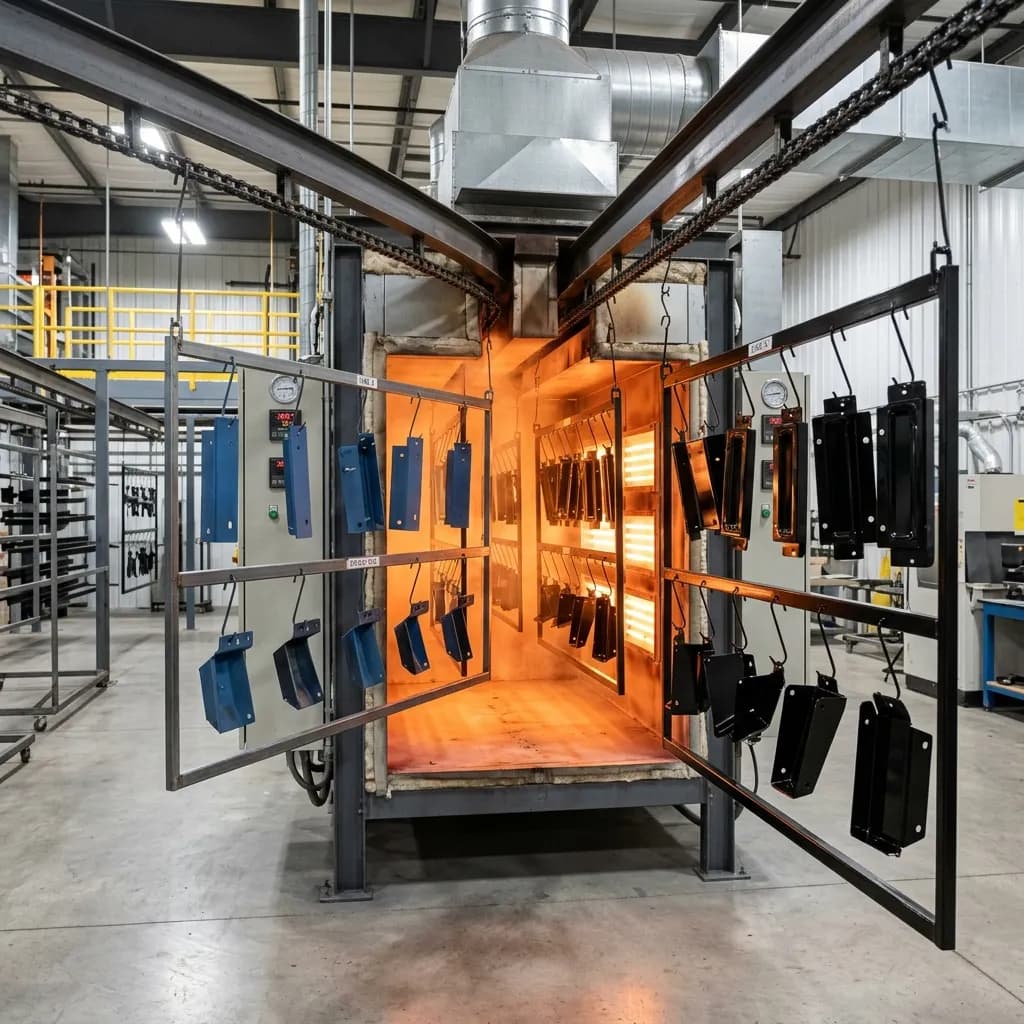
Curing is the chemical reaction that transforms loose powder particles into a hard, continuous, cross-linked film. It is not simply a matter of melting the powder. During the cure cycle, the resin and hardener components in the powder react at elevated temperatures to form molecular bonds that give the coating its hardness, flexibility, chemical resistance, and adhesion. If this reaction does not complete properly, the coating will underperform regardless of how well everything else was done.
Consumer
Powder Coating Cure Temperature and Time: Getting It Right
Sundial Powder Coating·April 20, 2026·8 min
An under-cured powder coating remains soft and vulnerable. It may look acceptable at first glance, but it will scratch easily, have poor chemical resistance, and may peel or flake under stress. The cross-linking reaction was not given enough time or temperature to complete, leaving the film in a partially reacted state that lacks the mechanical properties of a fully cured coating.
Ready to Start Your Project?
From one-off customs to 15,000-part production runs — get precise pricing in 24 hours.
On This Page
Why Curing Matters
Over-curing brings its own set of problems. Excessive time or temperature causes the already-cured film to degrade. Colors shift, particularly whites and light shades, which yellow noticeably when over-cured. The film can become brittle, losing the flexibility it needs to withstand thermal expansion, vibration, and impact. Over-curing essentially bakes the life out of the coating.
Standard Cure Schedules
Most thermoset powder coatings cure at a metal temperature of 180 to 200 degrees Celsius, held for 10 to 20 minutes. This is the window where the cross-linking reaction proceeds at the correct rate to produce a fully cured film with optimal properties. The exact schedule depends on the specific powder chemistry, and the manufacturer's technical data sheet is always the definitive reference.
Polyester and polyester-TGIC powders, the most common types for general and outdoor use, typically cure at 190 degrees Celsius metal temperature for 10 to 15 minutes. Epoxy powders often cure at slightly lower temperatures, around 180 degrees Celsius, while hybrid epoxy-polyester powders fall in between. Some specialty low-temperature cure powders are designed to cure at 150 to 160 degrees Celsius for heat-sensitive substrates.
It is important to understand that cure schedules are specified as metal temperature and hold time, not oven set point and total time in the oven. The metal must actually reach the specified temperature and stay there for the full duration. A heavy steel part takes much longer to heat through than a thin aluminum bracket, even in the same oven at the same setting.
Metal Temperature vs Oven Temperature
This distinction trips up more people than almost any other aspect of powder coating. The oven air temperature and the actual temperature of the metal part inside the oven are not the same thing, and the difference can be significant. The cure schedule is always based on the metal temperature, which is what matters for the chemical reaction happening in the coating.
When a cold part enters a hot oven, the air temperature may read 200 degrees Celsius, but the metal itself starts at room temperature and gradually heats up. How quickly it reaches oven temperature depends on its thermal mass. A thin sheet metal bracket might reach 200 degrees in five to eight minutes, while a thick cast iron part could take 20 to 30 minutes or more. The cure clock does not start until the metal reaches the specified temperature.
The best way to monitor metal temperature is with a thermocouple attached directly to the part or with a data logging oven profiler that travels through the oven with the parts. These tools give you an accurate picture of what the metal is actually experiencing, as opposed to what the oven thermostat says. For DIY setups, an inexpensive oven thermometer placed on or near the part provides a reasonable approximation.
How to Verify Proper Cure
The most widely used field test for cure verification is the MEK (methyl ethyl ketone) rub test. A cloth soaked in MEK solvent is rubbed firmly across the cured surface for a specified number of double rubs, typically 50 to 100. A fully cured coating will resist the solvent with minimal color transfer or softening. An under-cured coating will soften, smear, or show significant color transfer onto the cloth.
For more precise analysis, Differential Scanning Calorimetry (DSC) can measure the degree of cure by detecting any remaining unreacted components in a small sample of the coating. This laboratory method provides a quantitative cure percentage and is used for quality assurance in production environments and when investigating coating failures.
Visual indicators can also provide clues, though they are less reliable than chemical testing. A properly cured coating should have the expected gloss level, color, and surface texture specified by the powder manufacturer. Significant deviations from the expected appearance, such as unusually low gloss, color shift, or a rough texture that should be smooth, may indicate cure problems. However, visual inspection alone cannot confirm full cure, so chemical testing is recommended for critical applications.
Troubleshooting Cure Problems
Yellowing is the most visible symptom of over-cure and is especially obvious on white, cream, and light-colored powders. If your light-colored parts are coming out with a yellow or amber tint, the cure temperature is too high, the time is too long, or both. Reduce the oven temperature or shorten the cycle, and verify with a thermocouple that the metal temperature matches the powder manufacturer's specification.
A soft or easily scratched finish after cooling indicates under-cure. The coating did not reach the required temperature for the required time, so the cross-linking reaction is incomplete. This can happen when parts are too heavy for the oven to heat them adequately, when the oven temperature is set too low, or when parts are removed too early. Verify your oven temperature with an independent thermometer and ensure you are timing the cure from when the metal reaches temperature, not from when the part enters the oven.
Inconsistent gloss across a batch of parts often points to temperature variation within the oven. Hot spots and cold spots are common in convection ovens, and parts positioned in different locations may experience different cure conditions. Rotate parts during the cure cycle if possible, or map your oven's temperature profile to identify and avoid problem areas. Poor adhesion after cure can also indicate contamination that was not removed during preparation, so do not assume every post-cure problem is a curing issue.
Frequently Asked Questions
Can I cure powder coating with a heat gun?
A heat gun does not provide the uniform, sustained temperature needed for proper curing. Powder coating requires the entire part to reach and hold a specific temperature for 10 to 20 minutes. A heat gun creates localized hot spots and cannot maintain consistent temperature across a surface. For proper results, an oven is necessary.
What happens if I open the oven door during curing?
Opening the oven door causes a significant temperature drop that interrupts the cure cycle. If the metal temperature falls below the cure threshold, the cross-linking reaction slows or stops. Brief door openings for inspection are generally acceptable, but prolonged openings can result in under-cure. Minimize door openings and add extra time to compensate if needed.
Can I cure different powder types at the same time?
Only if they share the same cure schedule. Different powder chemistries may require different temperatures and times. Curing a low-temperature powder at a high-temperature schedule will over-cure it, while curing a high-temperature powder at a low-temperature schedule will under-cure it. Always group parts by cure schedule when loading the oven.
How do I know the exact cure schedule for my powder?
The cure schedule is listed on the powder manufacturer's Technical Data Sheet, often abbreviated as TDS. This document specifies the required metal temperature and hold time, along with acceptable ranges. If you do not have the TDS, contact the manufacturer or supplier with the powder product name and batch number, and they can provide it.
Ready to Start Your Project?
From one-off customs to 15,000-part production runs — get precise pricing in 24 hours.