Powder coating is cured in an oven at 180-200 degrees Celsius, which leads many people to assume it can handle high temperatures in service. The reality is more nuanced. Standard powder coatings are designed to withstand moderate heat — up to about 150-200 degrees Celsius in continuous service — but they will discolor, degrade, and eventually fail at temperatures significantly above their cure temperature. For applications involving higher heat, specialized high-temperature powder coatings are available that can withstand temperatures from 300 to over 600 degrees Celsius.
Consumer
Is Powder Coating Heat Resistant? Temperature Ratings, High-Temp Powders, and Applications
Sundial Powder Coating·April 22, 2026·11 min
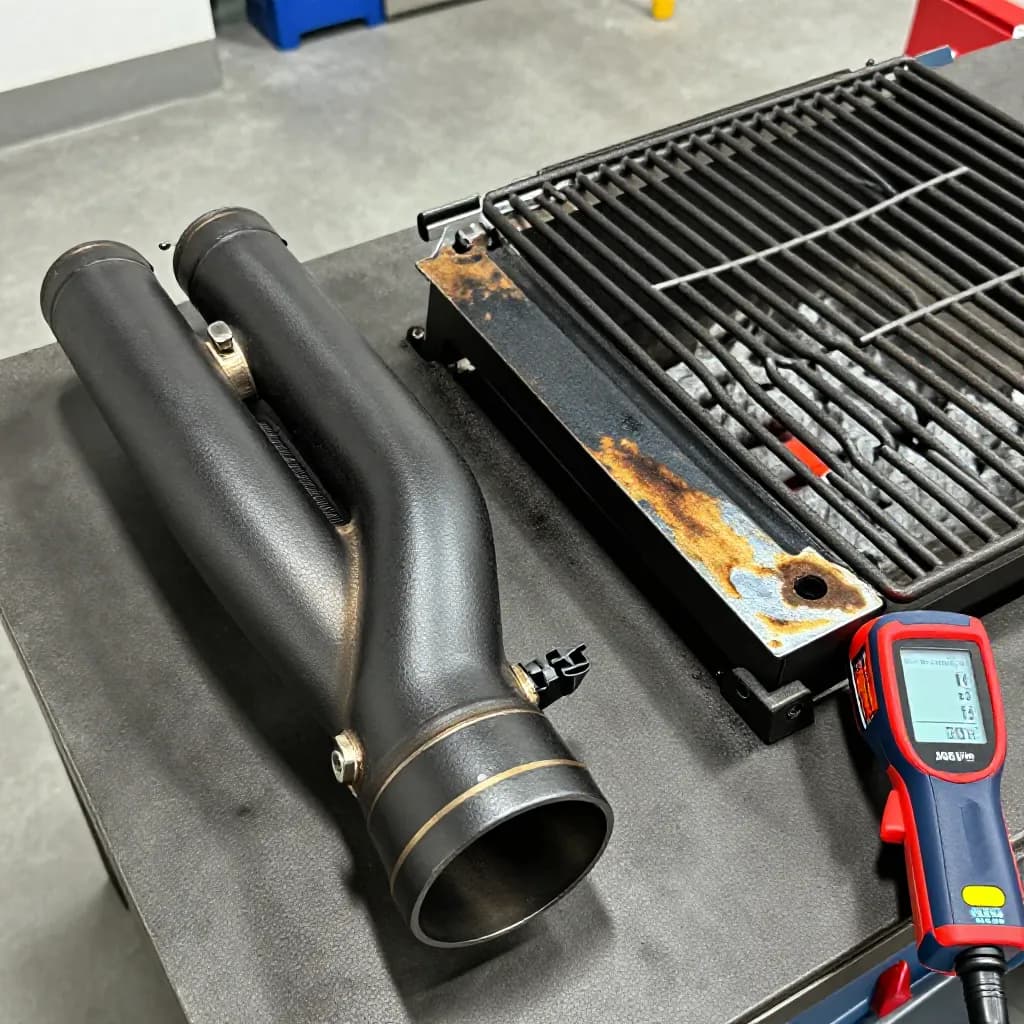
Understanding the heat resistance of powder coating matters for a wide range of consumer applications. Barbecue grills, fire pits, exhaust systems, engine components, wood stoves, fireplace accessories, and industrial equipment all expose coatings to elevated temperatures. Using the wrong powder coating on a high-heat application will result in discoloration, chalking, cracking, and premature failure — sometimes within the first use.
Ready to Start Your Project?
From one-off customs to 15,000-part production runs — get precise pricing in 24 hours.
On This Page
Powder Coating and Heat: What You Need to Know
The key to success is matching the powder coating formulation to the actual temperatures the part will experience in service. This requires knowing both the maximum temperature the part will reach and the duration of heat exposure, because a coating that handles brief temperature spikes may not survive continuous exposure at the same temperature. This article explains the temperature capabilities of different powder coating types and guides you toward the right product for your specific high-heat application.
Standard Powder Coatings: Temperature Limits
Standard powder coatings — the polyester, epoxy, and hybrid formulations used for the vast majority of powder coating applications — have a continuous service temperature limit of approximately 150-200 degrees Celsius, depending on the specific chemistry. Understanding these limits helps you determine whether a standard powder coating is adequate for your application or whether a high-temperature formulation is needed.
Polyester powder coatings, the most common type for exterior and decorative applications, typically withstand continuous temperatures up to 150-170 degrees Celsius. Above this range, the coating begins to yellow, lose gloss, and eventually chalk and degrade. Brief exposure to higher temperatures — such as a hot object placed on a powder-coated surface — may not cause visible damage, but sustained exposure above the rated temperature will progressively degrade the coating.
Epoxy powder coatings have slightly better heat resistance than polyester, tolerating continuous temperatures up to 170-200 degrees Celsius. Epoxy's superior chemical and heat resistance makes it the preferred choice for under-hood automotive applications and industrial equipment that operates at moderate elevated temperatures. However, epoxy yellows and chalks when exposed to UV light, so it is limited to interior or concealed applications.
Hybrid (epoxy-polyester) powder coatings fall between the two, with continuous temperature resistance of approximately 150-180 degrees Celsius. They offer a balance of properties suitable for interior applications with moderate heat exposure.
For context, these temperature limits are adequate for most everyday applications. Outdoor furniture, fences, railings, automotive body panels, appliance exteriors, and architectural elements rarely experience temperatures above 80-100 degrees Celsius even in direct sunlight in hot climates. Standard powder coatings are more than sufficient for these applications. The temperature limitation only becomes relevant for parts that are intentionally heated or are in close proximity to heat sources.
High-Temperature Powder Coatings: 300-650°C and Beyond
High-temperature powder coatings are specialty formulations designed to withstand temperatures far above what standard powders can handle. These products use modified resin chemistry — typically silicone-based, silicone-polyester, or ceramic-modified systems — that maintains integrity at temperatures that would destroy conventional organic coatings.
Silicone-polyester powder coatings represent the entry level of high-temperature performance, handling continuous temperatures of 250-350 degrees Celsius. These coatings are used for applications like oven exteriors, heating equipment housings, and industrial equipment that operates at moderately elevated temperatures. They offer a wider color range than pure silicone coatings and provide good aesthetic quality.
Pure silicone powder coatings push the temperature rating to 400-500 degrees Celsius for continuous exposure. These coatings are used for exhaust manifolds, engine components, barbecue grill bodies, wood stove components, and industrial furnace exteriors. The color range is more limited than standard powders — black, silver, grey, and a few other colors are typical — because many pigments cannot withstand these temperatures.
Ceramic-modified and inorganic powder coatings can withstand temperatures of 500-650 degrees Celsius or higher. These products are used for the most demanding high-temperature applications, including exhaust headers, turbocharger housings, and industrial process equipment. The color options are very limited, typically black and a few metallic shades, and the coating appearance differs from standard powder coatings — often with a slightly rougher, more matte texture.
An important characteristic of many high-temperature powder coatings is that they require a heat cure cycle to reach their full performance. Unlike standard powders that are fully cured in the oven, some high-temperature formulations undergo an initial oven cure that partially cross-links the coating, with the final cure occurring during the first exposure to service temperature. This means the coating may appear slightly different — softer, less glossy, or with a different texture — until it has been through its first high-temperature service cycle.
Exhaust Systems: Headers, Manifolds, and Pipes
Exhaust system components are among the most popular consumer applications for high-temperature powder coating. Headers, exhaust manifolds, downpipes, and exhaust tips all operate at temperatures that require specialty coatings, and powder coating provides both thermal protection and aesthetic appeal for these parts.
Exhaust headers and manifolds experience the highest temperatures in the exhaust system, typically 400-650 degrees Celsius depending on the engine type and operating conditions. These components require ceramic-modified or pure silicone powder coatings rated for continuous exposure at these temperatures. The coating serves multiple purposes: it protects the metal from oxidation and corrosion, reduces radiant heat transfer to surrounding components, and provides a clean, uniform appearance.
Mid-pipe and tailpipe sections operate at lower temperatures — typically 200-400 degrees Celsius — as the exhaust gases cool as they travel through the system. Silicone or silicone-polyester powder coatings are appropriate for these components, offering a wider color range than the ceramic coatings needed for headers.
Exhaust tips, the visible end of the exhaust system, experience relatively moderate temperatures of 100-250 degrees Celsius and can often be coated with standard high-temperature polyester or silicone-polyester powders. This allows for a broader range of colors and finishes, including the popular black, chrome-look, and burnt titanium effects.
For consumers having exhaust components powder coated, it is critical to communicate the specific component and its location in the exhaust system to the coating shop. A coating that works perfectly on an exhaust tip will fail catastrophically on a header. The shop needs to know the expected operating temperature to select the appropriate high-temperature powder formulation.
Surface preparation for exhaust components typically involves media blasting to remove existing coatings, rust, and scale, followed by a thorough cleaning. Some high-temperature coatings require a specific surface profile for optimal adhesion, so the blasting media and technique should follow the powder manufacturer's recommendations.
BBQ Grills, Fire Pits, and Wood Stoves
Outdoor cooking equipment and heating appliances are common consumer applications for high-temperature powder coating. Understanding the temperature requirements of each component helps ensure the right coating is specified.
Barbecue grill bodies and lids experience temperatures of 200-350 degrees Celsius during normal cooking, with potential spikes to 400 degrees or higher during high-heat grilling or self-cleaning cycles. Silicone-polyester or pure silicone powder coatings are appropriate for these components. Most commercial barbecue grills use high-temperature powder coating for their exterior surfaces, which is why they maintain their appearance through years of cooking use.
Grill grates and cooking surfaces that directly contact food require food-safe high-temperature coatings — a specialized subset of high-temperature powders that meet FDA requirements for food contact at cooking temperatures. Standard high-temperature powder coatings are not food safe and should not be used on cooking surfaces. Porcelain enamel is the traditional coating for grill grates, though food-safe high-temperature powder coatings are available as an alternative.
Fire pits and outdoor fireplaces expose their coatings to temperatures of 300-500 degrees Celsius, depending on the design and the proximity of the coated surface to the fire. The firebox and immediate surround require pure silicone or ceramic-modified coatings, while the outer shell and decorative elements may be adequately served by silicone-polyester formulations if they are sufficiently insulated from the heat source.
Wood stoves and fireplace inserts operate at surface temperatures of 200-400 degrees Celsius during normal use. High-temperature powder coating is the standard finish for modern wood stoves, providing a durable, attractive surface that withstands years of heating cycles. The coating must handle not only the high temperatures but also the thermal cycling — repeated heating and cooling — that can cause coating cracking if the formulation does not have adequate flexibility.
Chimney pipes and flue components operate at 150-350 degrees Celsius and are commonly powder coated with silicone-polyester or silicone formulations. The coating protects the metal from corrosion caused by acidic flue gas condensation and provides a clean appearance for exposed chimney sections.
Engine Components and Under-Hood Applications
Automotive enthusiasts frequently powder coat engine components for both appearance and protection. The under-hood environment presents a combination of heat, chemical exposure, and vibration that demands careful coating selection.
Valve covers, intake manifolds, and timing covers are popular candidates for powder coating because they are visible in the engine bay and benefit from both the aesthetic upgrade and the corrosion protection that powder coating provides. These components typically experience temperatures of 100-200 degrees Celsius, which is within the range of standard epoxy or high-temperature polyester powder coatings. The wide color range available at these temperatures allows for custom engine bay color schemes.
Exhaust manifolds and turbocharger housings, as discussed earlier, require high-temperature ceramic or silicone coatings due to their extreme operating temperatures. These components are often powder coated in heat-dissipating black or metallic finishes that help manage thermal radiation in the engine bay.
Brake calipers are a popular powder coating application that involves moderate heat exposure. Brake calipers can reach temperatures of 150-300 degrees Celsius during hard braking, with track use pushing temperatures even higher. High-temperature powder coatings rated for at least 300 degrees Celsius are recommended for brake calipers. Standard powder coatings will discolor and degrade under hard braking conditions.
Alternator housings, power steering brackets, and accessory mounting hardware operate at moderate temperatures of 80-150 degrees Celsius and can be coated with standard powder coatings. These components benefit from the corrosion protection and clean appearance that powder coating provides in the engine bay environment.
For any engine component, the coating must also resist automotive fluids — oil, coolant, brake fluid, and fuel — that may contact the surface. Epoxy and epoxy-polyester hybrid powders offer the best chemical resistance for under-hood applications, while polyester powders are preferred when UV exposure is a factor (for visible engine bay components in open-engine vehicles).
Consumers should discuss the specific component, its location, and the expected operating conditions with their coating shop to ensure the correct high-temperature formulation is selected.
Choosing the Right High-Temperature Powder Coating
Selecting the correct high-temperature powder coating requires matching the coating's temperature rating to the actual service conditions. Here is a practical guide to help consumers make the right choice.
First, determine the maximum temperature the part will experience in service. This is not always obvious — a barbecue grill lid may reach higher temperatures than you expect, and an exhaust component's temperature varies significantly depending on its position in the system. When in doubt, measure the temperature using an infrared thermometer or temperature-indicating paint during actual operation. It is always better to specify a coating rated above the expected temperature than to risk failure by cutting it too close.
Add a safety margin. If your part reaches 300 degrees Celsius in service, specify a coating rated for at least 350-400 degrees. This margin accounts for temperature spikes, measurement uncertainty, and the difference between average and peak temperatures. Running a coating at its maximum rated temperature continuously will shorten its service life compared to operating well within its rated range.
Consider the duration of heat exposure. A part that reaches high temperatures briefly during operation and then cools down is less demanding than a part that operates continuously at elevated temperature. Some coatings are rated for intermittent exposure at higher temperatures than their continuous rating. Discuss the duty cycle with the coating supplier to ensure the product is appropriate.
Accept the color and finish limitations of high-temperature coatings. As temperature ratings increase, the available color range narrows. Standard-temperature powders offer thousands of colors; silicone-polyester powders offer dozens; pure silicone and ceramic powders may offer fewer than ten. If color is important, verify availability before committing to a specific high-temperature product.
Ensure proper surface preparation. High-temperature powder coatings require the same thorough surface preparation as standard powders — clean, blasted, and pretreated metal. Some high-temperature formulations have specific preparation requirements that differ from standard powders, so follow the manufacturer's recommendations.
Verify the cure schedule. High-temperature powders often have different cure requirements than standard powders, and some require a post-cure or initial heat-up cycle to reach full performance. Ensure the coating shop follows the manufacturer's specified cure schedule for the specific high-temperature product being used.
Frequently Asked Questions
What temperature can standard powder coating withstand?
Standard polyester powder coatings withstand continuous temperatures up to 150-170 degrees Celsius. Epoxy powders handle up to 170-200 degrees Celsius. Above these temperatures, the coating will discolor, lose gloss, and eventually degrade. For higher temperatures, specialized high-temperature powder coatings are required.
What is the highest temperature powder coating can handle?
Ceramic-modified and inorganic high-temperature powder coatings can withstand continuous temperatures of 500-650 degrees Celsius or higher. Pure silicone powders handle 400-500 degrees Celsius. These specialty formulations are used for exhaust headers, furnace components, and other extreme-heat applications.
Can you powder coat exhaust headers?
Yes, using ceramic-modified or pure silicone high-temperature powder coatings rated for 400-650 degrees Celsius. Standard powder coatings will fail on exhaust headers. The coating protects against oxidation, reduces radiant heat, and provides a clean appearance. Communicate the specific component and expected temperatures to your coating shop.
Is powder coating on a BBQ grill heat resistant?
Commercial BBQ grills use high-temperature silicone or silicone-polyester powder coatings rated for 250-400 degrees Celsius on exterior surfaces. These coatings withstand normal grilling temperatures. Cooking grates that contact food require separate food-safe high-temperature coatings. Standard decorative powder coatings are not suitable for any grill component.
Can you powder coat brake calipers?
Yes, but use a high-temperature powder coating rated for at least 300 degrees Celsius. Brake calipers can reach 150-300 degrees during normal driving and higher during aggressive braking. Standard powder coatings will discolor and degrade under braking heat. Many coating shops offer brake caliper coating as a specific service with appropriate high-temperature products.
Ready to Start Your Project?
From one-off customs to 15,000-part production runs — get precise pricing in 24 hours.