Powder coating is ready to handle as soon as it cools to room temperature after coming out of the curing oven. There is no wet paint to smudge, no tacky surface to avoid, and no drying period to wait through. Once the part has cooled enough to touch comfortably — typically 30 to 60 minutes after leaving the oven, depending on the size and mass of the part — the finish is fully hardened and can be picked up, moved, and inspected.
Consumer
How Long After Powder Coating Can You Use or Assemble Parts?
Sundial Powder Coating·April 20, 2026·8 min
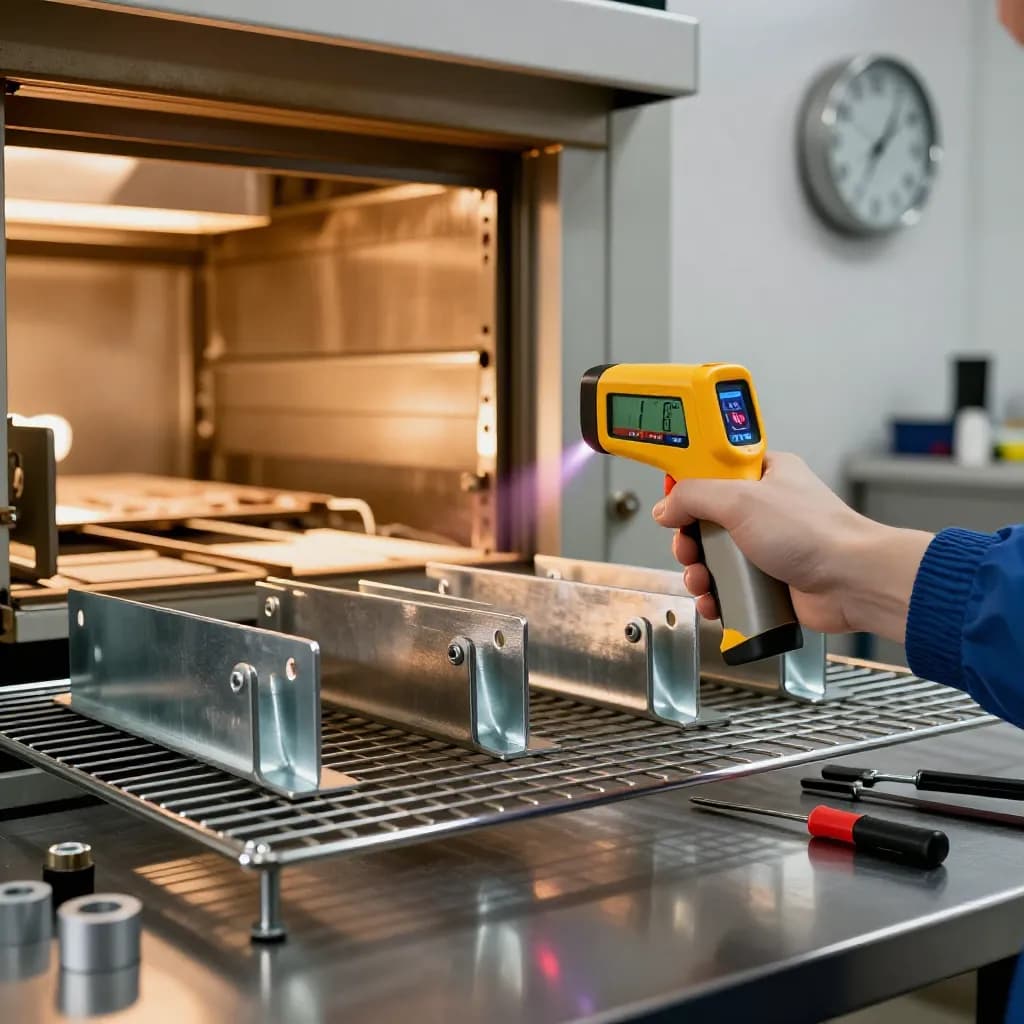
This is one of the practical advantages of powder coating over liquid paint. A freshly painted part may need hours or even days before it can be handled without risking fingerprints, smudges, or damage to the soft film. Powder coating skips this waiting period entirely because the curing process happens in the oven, not in the open air. The chemical cross-linking reaction that hardens the coating is complete before the part ever leaves the oven.
Ready to Start Your Project?
From one-off customs to 15,000-part production runs — get precise pricing in 24 hours.
On This Page
When Is Powder Coating Ready to Handle?
For large or thick metal parts like heavy steel frames or cast iron components, cooling may take longer simply because the metal retains heat. These parts should be allowed to cool naturally rather than being quenched with water, as rapid cooling can stress both the metal and the coating. Patience during the cooling phase ensures the best result, but once cool, the part is immediately ready for the next step.
Is There an Off-Gassing or Extended Curing Period?
No. Unlike liquid paint, which releases solvents as it dries and may continue to harden and off-gas for days or weeks after application, powder coating completes its entire chemical reaction inside the curing oven. The heat triggers a cross-linking reaction that transforms the melted powder into a fully cured, chemically stable polymer film. When the part comes out of the oven, the reaction is done.
This means there is no lingering chemical smell, no solvent fumes, and no need to ventilate a room after installing powder-coated parts. You can bring a freshly coated part indoors, install it in an enclosed space, or place it in a vehicle interior without any concern about off-gassing. This is a significant advantage for applications in homes, offices, hospitals, and food service environments where air quality matters.
The absence of an extended curing period also means that powder-coated parts achieve their full performance properties immediately. The hardness, chemical resistance, adhesion, and flexibility that the coating was designed to deliver are all present from the moment the part cools. There is no gradual improvement over days or weeks as there is with many liquid paint systems.
When Can You Assemble Coated Parts?
Assembly can begin as soon as the parts have cooled to room temperature. Bolting, riveting, pressing, and fastening powder-coated components together is perfectly safe immediately after cooling. The coating is at full hardness and will not be damaged by normal assembly operations. This allows powder-coated parts to move directly from the coating shop to the assembly line or installation site without any holding period.
However, while the coating is fully cured, it is still a fresh finish that deserves reasonable care during assembly. Avoid dragging parts across rough surfaces, clamping directly onto coated areas with bare metal clamps, or using excessive force that could scratch or chip the finish. Use soft jaw clamp covers, protective padding, and clean work surfaces to keep the finish pristine during assembly.
For parts that require press-fitting or interference fits, be aware that the powder coating adds thickness to the part. A typical powder coat adds 60 to 100 microns per side, which can affect tight tolerances. Critical mating surfaces, bearing seats, and threaded holes should be masked before coating to maintain dimensional accuracy. If masking was not done, these areas may need to be carefully cleaned up after coating before assembly.
Does Powder Coating Need to Harden Over Time?
No. This is a common misconception that carries over from experience with liquid paints. Many liquid paint systems, particularly single-pack enamels and lacquers, continue to harden for days or even weeks after application as residual solvents evaporate and the polymer chains slowly rearrange. During this period, the paint is softer and more vulnerable to damage than it will be once fully hardened.
Powder coating works on a completely different principle. The curing oven provides the energy needed to drive the cross-linking reaction to completion in minutes. The polymer chains form their permanent bonds while the coating is hot, and by the time the part cools, the molecular structure is fully locked in place. There is no residual reaction, no solvent evaporation, and no gradual hardening process.
This means that a scratch resistance test, chemical resistance test, or adhesion test performed on a powder-coated part one hour after cooling will produce the same results as the same tests performed one month later. The coating does not improve with age, but it also does not need to. It is engineered to reach its full performance specification in a single, controlled oven cure cycle.
Tips for Handling Freshly Coated Parts
Even though powder coating is fully cured and hardened after cooling, a few simple handling practices will keep your freshly coated parts looking perfect. Wear clean cotton or nitrile gloves when handling coated parts to prevent fingerprints and skin oils from marking the surface. While these marks do not damage the coating, they can be visible on gloss and satin finishes and are easier to prevent than to clean.
When stacking or storing coated parts, place protective padding between them to prevent contact marks and scratches. Foam sheets, clean cardboard, or soft cloth work well as separators. Avoid stacking heavy parts directly on top of coated surfaces, as the weight can cause impression marks or scratches where the parts contact each other. Store parts in a clean, dry area away from grinding dust, welding spatter, and other shop debris.
During transport, secure parts so they cannot shift and rub against each other or against the vehicle. Wrap individual parts in moving blankets or bubble wrap for added protection. A little care during the first handling and transport ensures that the finish arrives at its destination in the same perfect condition it left the coating shop. Once installed, the coating's inherent toughness takes over and normal use will not damage it.
Frequently Asked Questions
Can I install powder-coated parts the same day I pick them up?
Yes. Powder-coated parts are fully cured and ready for installation as soon as they have cooled to room temperature. There is no waiting period, no drying time, and no off-gassing concern. You can pick up parts from the coating shop and install them immediately.
Will the powder coating smell go away?
Fully cured powder coating has no smell at all. If you detect an odor, it may indicate the coating was not fully cured, or you may be smelling residual heat from the metal itself, which dissipates quickly as the part cools. A properly cured powder coat is completely odor-free.
How soon can I wash a powder-coated part?
You can wash a powder-coated part as soon as it has cooled to room temperature. There is no curing period to wait through. Use mild soap and water with a soft cloth or sponge. The coating is fully hardened and will not be affected by washing.
Do I need to let powder coating cure in the sun like some paints?
No. Powder coating is cured entirely in the oven during the coating process. Sun exposure does not contribute to curing and is not needed. In fact, for long-term preservation, minimizing unnecessary UV exposure helps maintain the coating's appearance over time, though polyester powder coatings are formulated to handle outdoor UV exposure.
Ready to Start Your Project?
From one-off customs to 15,000-part production runs — get precise pricing in 24 hours.