Powder coating engine parts is one of the most popular applications in automotive restoration and customization, and many engine components are excellent candidates for the process. However, the engine bay is a complex thermal environment where different components operate at vastly different temperatures, and not every part can be safely or effectively powder coated. The key is understanding which parts fall within the temperature limits of available powder coatings and which require alternative finishing methods.
Consumer
Can You Powder Coat Engine Parts? What Works and What Doesn't
Sundial Powder Coating·April 22, 2026·9 min
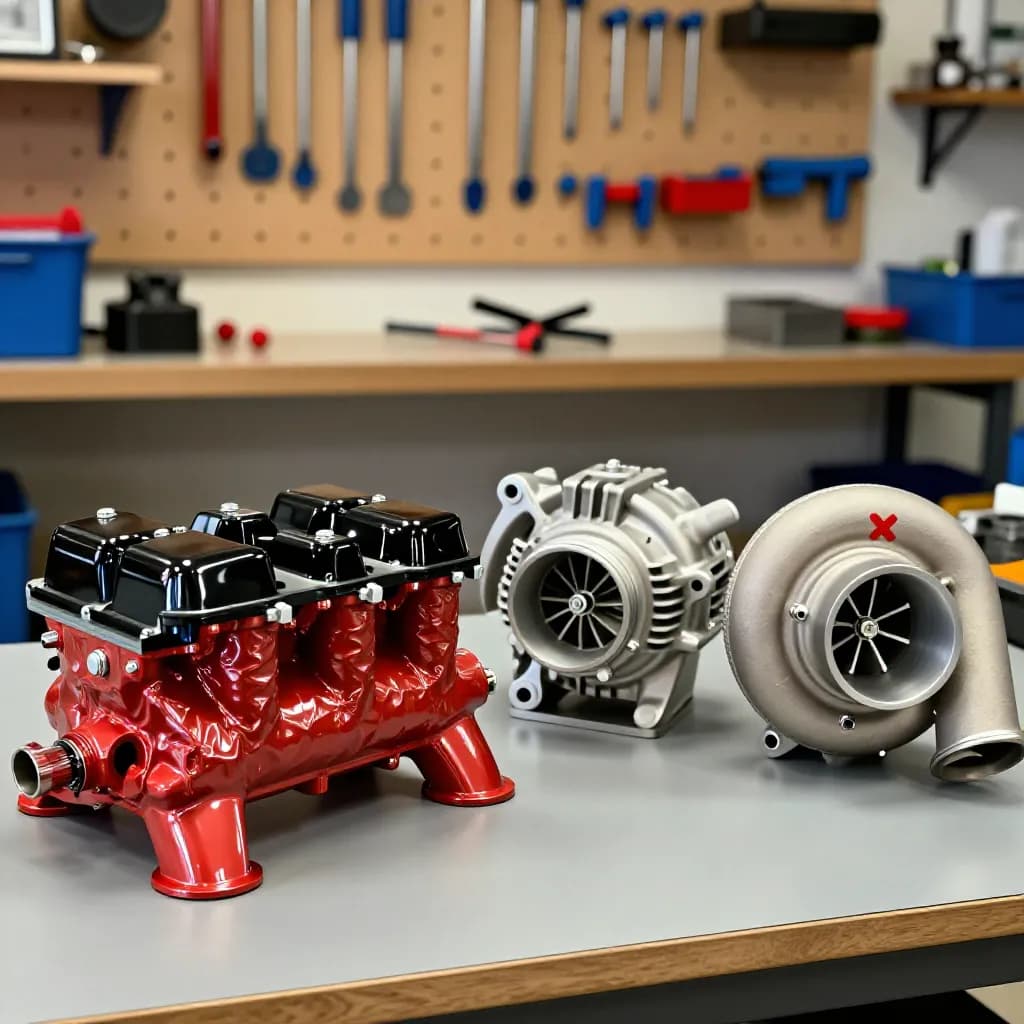
Components that operate at moderate temperatures — generally below 200 degrees Celsius — can be coated with standard powder coatings. Parts that reach higher temperatures may require high-temperature powder formulations or ceramic-based coatings. And some components should not be coated at all due to functional requirements, such as the need for heat dissipation or precise dimensional tolerances.
Ready to Start Your Project?
From one-off customs to 15,000-part production runs — get precise pricing in 24 hours.
On This Page
Many Engine Parts Can Be Powder Coated — But Not All
The appeal of powder coating engine parts is clear: it provides a durable, chemical-resistant finish that withstands the oil, fuel, coolant, and cleaning chemicals found in the engine bay far better than conventional spray paint. A properly powder-coated engine bay maintains its appearance for years, making it the finish of choice for show cars, restorations, and enthusiast builds where engine bay presentation matters.
Engine Parts That Are Great Candidates
Several engine components are ideal for powder coating because they operate at moderate temperatures and benefit significantly from the durable, chemical-resistant finish. Valve covers are perhaps the most commonly powder-coated engine part — they operate at relatively low temperatures, are highly visible, and are easy to remove and reinstall. Powder-coated valve covers in custom colors are a signature element of many engine bay builds.
Intake manifolds are another popular choice, particularly for port fuel injection and carbureted engines where the intake manifold runs relatively cool. The manifold's large surface area and prominent position in the engine bay make it a high-impact visual component. Oil pans, timing covers, thermostat housings, and water pump housings are also excellent candidates — they operate at moderate temperatures and are exposed to oil and coolant that would quickly degrade conventional paint.
Accessory brackets, alternator housings, power steering pump reservoirs, and air conditioning compressor housings can all be powder coated for a clean, coordinated engine bay appearance. Engine mounts, transmission bellhousings, and differential covers are additional components that respond well to powder coating. For cast iron or cast aluminum parts, the pre-bake process described for cast iron should be followed to prevent outgassing defects.
Parts That Need High-Temperature Coatings
Some engine components operate at temperatures that exceed the limits of standard powder coatings but can be finished with high-temperature formulations. Exhaust manifolds and headers are the most obvious examples — these parts reach 400 to 700 degrees Celsius and require ceramic-based coatings rather than powder coating. Turbocharger housings and exhaust-side turbo piping also fall into this category.
Components in the intermediate temperature range — 200 to 350 degrees Celsius — may be suitable for high-temperature powder coatings. These include some intake manifold designs on turbocharged engines where heat soak from the turbo raises manifold temperatures, as well as oil filter housings and oil cooler brackets that are located near exhaust components. High-temperature silicone-based powder coatings rated for 300 to 550 degrees Celsius can handle these applications.
When in doubt about a component's operating temperature, it is better to err on the side of caution and choose a higher-rated coating. A high-temperature powder coating used on a moderate-temperature part will perform perfectly well, while a standard powder coating used on a part that exceeds its temperature rating will fail quickly. If you are unsure about the temperature a specific component reaches, consult with your vehicle's manufacturer specifications or use a temperature-indicating paint or infrared thermometer to measure actual operating temperatures before choosing a coating.
Parts That Should Not Be Powder Coated
Certain engine components should not be powder coated due to functional requirements that the coating would compromise. Cylinder heads and engine blocks are generally not recommended for powder coating on their machined mating surfaces — the gasket surfaces, cylinder bores, and bearing surfaces must remain bare metal for proper sealing and function. However, the exterior surfaces of blocks and heads can be powder coated if all machined surfaces are carefully masked.
Heat sinks and components that rely on surface area for heat dissipation — such as oil coolers, transmission coolers, and some alternator housings — may have their cooling efficiency reduced by the insulating effect of a powder coating layer. While the thermal insulation of a 60 to 100 micron powder film is modest, it can be significant for components operating near their thermal limits. Consult with the component manufacturer before coating any part that serves a heat dissipation function.
Threaded fasteners, precision-machined shafts, and components with tight dimensional tolerances should generally not be powder coated, as the coating thickness will alter the dimensions. Powder coating adds 50 to 100 microns per surface, which can prevent proper thread engagement, bearing fit, or assembly clearances. If these components must be coated for appearance, the coating should be applied only to non-functional surfaces with all critical dimensions masked.
Preparation for Engine Components
Engine parts require thorough preparation before powder coating, and the specific approach depends on the material and condition of the part. Cast aluminum components — which make up the majority of modern engine parts — should be cleaned with alkaline degreaser to remove oil and grease, then blasted with aluminum oxide or glass bead media to remove oxidation and create surface profile. A pre-bake at 200 degrees Celsius for 20 to 30 minutes is recommended for cast parts to prevent outgassing.
Cast iron components — such as older engine blocks, heads, and exhaust manifolds — require more aggressive preparation due to their porous nature. Heavy degreasing, possibly including a hot tank soak, followed by abrasive blasting and an extended pre-bake of one to two hours is typical. Cast iron that has spent decades absorbing engine oil will outgas aggressively if not thoroughly pre-baked.
Steel and stamped metal components — such as brackets, covers, and sheet metal heat shields — are the easiest to prepare. Standard degreasing and blasting with steel grit or aluminum oxide is usually sufficient, with no pre-bake needed unless the parts are heavily contaminated with oil. For all engine components, thorough masking of threaded holes, gasket surfaces, bearing surfaces, and any area that interfaces with another component during assembly is essential before coating.
Color and Finish Options for Engine Bays
The color and finish choices for engine bay components are virtually unlimited with powder coating, and the selection should consider both aesthetics and practicality. For a factory-correct restoration, matching the original engine colors is important — many manufacturers used specific colors for engine components, and powder coating suppliers can match these colors precisely. Common factory engine colors include various shades of blue, orange, red, black, and silver, depending on the manufacturer and era.
For custom builds, the full RAL color range and beyond is available. Popular custom engine bay color schemes include all-black for a stealthy appearance, matching the vehicle's exterior color for a coordinated look, or contrasting colors that highlight specific components. Wrinkle and texture finishes are popular for valve covers and intake manifolds because they complement the industrial aesthetic of engine components and are more forgiving of surface imperfections on cast parts.
Gloss levels range from high gloss to dead matte, with satin and semi-gloss being popular middle-ground options for engine bays. High-gloss finishes show fingerprints and oil spots more readily, while matte and satin finishes are more forgiving of everyday engine bay grime. Metallic and pearl-effect powders add visual depth and are particularly striking on large, flat surfaces like valve covers and intake manifolds. Clear coats can be applied over metallic base coats for additional depth and protection.
Reassembly Considerations After Coating
Reassembling engine components after powder coating requires attention to detail to ensure proper function and avoid damaging the new finish. All masking materials must be removed and the masked surfaces inspected to verify they are clean and free of any coating overspray. Threaded holes should be chased with the appropriate tap to ensure clean threads, as even small amounts of coating in threads can affect torque values and fastener engagement.
Gasket surfaces must be perfectly clean and flat for proper sealing. If any coating has migrated onto a gasket surface despite masking, it must be carefully removed without damaging the surrounding coated surface. Using a razor blade or fine abrasive pad on the gasket surface only — not the coated areas — can clean up minor overspray. New gaskets should always be used during reassembly, as the disassembly process typically damages the original gaskets.
When torquing fasteners against powder-coated surfaces, be aware that the coating can compress slightly under clamping force, which may require re-torquing after the initial assembly has settled. Using flat washers between fastener heads and coated surfaces distributes the clamping force and reduces the risk of the fastener head cracking or chipping the coating. Anti-seize compound on threads and bolt heads helps prevent galling and makes future disassembly easier without damaging the coating.
Professional vs. DIY Engine Part Coating
Powder coating engine parts is one of the more accessible DIY powder coating projects, and many automotive enthusiasts have invested in home powder coating setups specifically for engine bay work. The relatively small size of most engine components means they can be cured in a dedicated toaster oven or small powder coating oven, and the electrostatic application process is straightforward to learn with practice.
The main advantage of DIY coating is the ability to coat parts on your own schedule and experiment with colors and finishes without the per-part cost of professional coating. For a multi-component engine bay project, the cumulative savings can be significant. However, DIY coating requires an initial investment in equipment and a learning curve to achieve consistent, professional-quality results.
Professional coating offers several advantages: industrial-grade equipment produces more consistent results, experienced coaters know how to handle outgassing and adhesion challenges, and professional shops have access to a wider range of powder formulations including specialty high-temperature and textured finishes. For high-value restoration projects or show cars where finish quality is paramount, professional coating is usually the better choice. For enthusiast builds where the process is part of the enjoyment, DIY coating can be both satisfying and cost-effective.
Frequently Asked Questions
Can you powder coat an engine block?
The exterior surfaces of an engine block can be powder coated, but all machined surfaces — cylinder bores, deck surfaces, bearing saddles, and gasket surfaces — must be carefully masked. The block must be thoroughly degreased and pre-baked to prevent outgassing from the cast material. This is a complex masking job best handled by an experienced coater.
Will powder coating valve covers cause them to overheat?
No. Valve covers operate at moderate temperatures well within the range of standard powder coatings. The thin powder film adds minimal thermal insulation and does not significantly affect heat dissipation from the valve cover. Powder-coated valve covers are one of the most common and trouble-free engine bay coating applications.
Can you powder coat aluminum intake manifolds?
Yes, aluminum intake manifolds are excellent candidates for powder coating. They operate at moderate temperatures on naturally aspirated and port-injected engines. For turbocharged engines, verify that the manifold temperature stays within the coating's rated range, as heat soak from the turbocharger can raise manifold temperatures. All gasket surfaces and port openings must be masked.
How do you prevent outgassing on cast engine parts?
Pre-baking is the primary method for preventing outgassing on cast engine parts. After cleaning and blasting, the bare part is placed in the curing oven at 200 to 230 degrees Celsius for 30 minutes to two hours, depending on the casting's porosity and contamination level. This drives out trapped gases before the powder is applied.
Should engine parts be powder coated or painted?
Powder coating is superior to conventional paint for engine parts in almost every respect — it provides a thicker, harder, more chemical-resistant finish that withstands oil, fuel, coolant, and cleaning solvents far better than spray paint. The only advantage of paint is convenience, as it can be applied without an oven. For any project where durability matters, powder coating is the better choice.
Ready to Start Your Project?
From one-off customs to 15,000-part production runs — get precise pricing in 24 hours.