Firearms can be powder coated, and the process has become increasingly popular among gun owners, custom builders, and gunsmiths who want a durable, attractive finish that provides excellent corrosion and wear protection. Powder coating offers a thicker, more impact-resistant finish than traditional gun bluing and is available in a virtually unlimited range of colors, making it a popular choice for both functional protection and aesthetic customization.
Consumer
Can You Powder Coat a Gun? Durability, Safety, and Process
Sundial Powder Coating·April 22, 2026·9 min
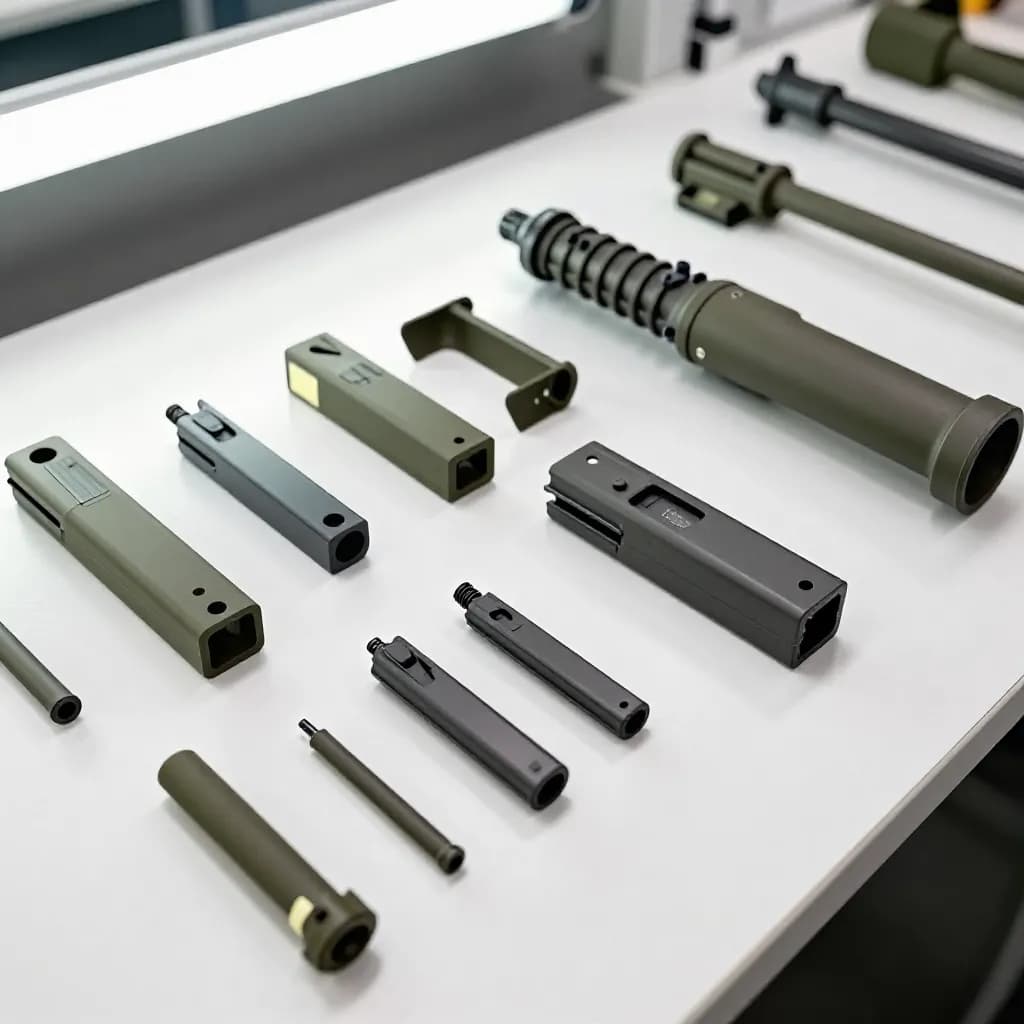
The metal components of a firearm — receivers, frames, slides, barrels, trigger guards, magazine housings, and accessories — are all candidates for powder coating. These parts are typically made from steel, aluminum, or stainless steel, all of which accept electrostatic powder application and withstand the curing temperature without concern. The key consideration is not whether the metal can be coated, but whether the coating will interfere with the firearm's function.
Ready to Start Your Project?
From one-off customs to 15,000-part production runs — get precise pricing in 24 hours.
On This Page
Yes, Firearms Can Be Powder Coated
Firearms are precision mechanical devices where dimensional tolerances matter. The coating thickness added by powder coating — typically 50 to 100 microns per surface — can affect the fit and function of closely toleranced parts. This means that careful masking of critical surfaces, or post-coating fitting work, is essential to ensure the firearm operates safely and reliably after coating. Working with a coater who has specific firearms experience is strongly recommended.
Critical Safety and Function Considerations
Safety is the paramount concern when coating any firearm component, and the coating process must not compromise the weapon's ability to function safely and reliably. Several areas of a firearm have tight dimensional tolerances that cannot accommodate the additional thickness of a powder coating layer without affecting function.
The bore and chamber of a barrel must never be coated — any material inside the bore would affect accuracy and could create a dangerous obstruction. The bolt face, locking lugs, and any surface involved in the locking and unlocking cycle must be kept free of coating to maintain proper headspace and lockup. The firing pin channel, trigger mechanism surfaces, and safety mechanism contact points must also remain uncoated to ensure reliable function.
Slide rails on semi-automatic pistols, bolt carrier group contact surfaces on rifles, and any surface where metal-to-metal sliding contact occurs during the firing cycle should be carefully evaluated. Coating on these surfaces can increase friction, cause binding, and prevent reliable cycling. Some gunsmiths choose to coat these surfaces and then hand-fit the parts by removing coating from contact areas until proper function is achieved. Others prefer to mask these surfaces before coating to avoid the fitting work entirely.
Masking Requirements for Firearms
Proper masking is the most critical aspect of powder coating a firearm, and it requires detailed knowledge of the weapon's design and function. Every surface that interfaces with another component during operation must be evaluated for masking. The specific masking requirements vary by firearm type and design, but several areas are universally critical.
The barrel bore and chamber must be completely plugged to prevent any powder from entering. High-temperature silicone plugs sized to the specific caliber are used for this purpose. The muzzle and chamber end of the barrel are both plugged, and the exterior of the barrel is coated. Thread protector threads on threaded barrels should be masked to maintain proper thread engagement for muzzle devices.
Receiver pin holes, trigger pin holes, and any holes that accept pins or fasteners during assembly should be plugged to maintain proper fit. The magazine well interior on pistols and rifles should be masked to ensure magazines insert and release properly. Scope mounting surfaces and rail attachment surfaces should be masked to maintain proper fit and alignment. The serial number area must remain legible after coating — some coaters mask this area, while others coat over it and then carefully remove the coating from the engraved characters to maintain legibility.
Best Powder Types for Firearms
The choice of powder coating for firearms should prioritize hardness, wear resistance, chemical resistance, and thin film capability. Not all powder coatings are equally suitable for firearms — the coating must be hard enough to resist holster wear and handling abrasion, chemically resistant to solvents and cleaning products, and capable of being applied in a thin enough film to minimize dimensional impact on critical tolerances.
Epoxy powder coatings are a popular choice for firearms because of their excellent hardness, chemical resistance, and adhesion properties. Epoxy provides a tough, durable finish that resists solvents, oils, and cleaning chemicals commonly used in firearm maintenance. The main limitation of epoxy is its poor UV resistance — epoxy coatings will chalk and fade with prolonged sunlight exposure. For firearms that are primarily used and stored indoors, this is not a significant concern.
For firearms that will see significant outdoor use and UV exposure, polyester or hybrid epoxy-polyester powders provide better color retention and UV resistance. Some powder manufacturers offer formulations specifically designed for firearms applications, optimized for thin film application, high hardness, and chemical resistance. These specialty formulations may be worth seeking out for firearms work, as they address the specific performance requirements of this application better than general-purpose powders.
Powder Coating vs. Cerakote for Firearms
The most common comparison in firearms finishing is between powder coating and Cerakote, a thin-film ceramic coating that has become extremely popular in the firearms industry. Both provide excellent protection and customization options, but they differ in important ways that affect which is better suited for specific applications.
Cerakote is applied as a very thin film — typically 12 to 25 microns — which is significantly thinner than powder coating's 50 to 100 microns. This thin application is a major advantage for firearms, where dimensional tolerances are tight and additional coating thickness can affect function. Cerakote can be applied to closely toleranced parts with minimal impact on fit, reducing the need for extensive masking or post-coating fitting work.
Powder coating provides a thicker, more impact-resistant film that offers better protection against heavy mechanical abuse — drops, impacts, and abrasion. It is also generally less expensive per part than Cerakote and is available from a wider network of coating shops. However, the thicker film requires more careful masking and may require post-coating fitting on tight-tolerance parts. For firearms where maximum protection against rough handling is the priority, powder coating has an advantage. For precision firearms where maintaining exact tolerances is critical, Cerakote's thinner film is often preferred.
Common Firearms Applications
The most commonly powder-coated firearm components are receivers, frames, and other large structural parts where the coating thickness has minimal impact on function. AR-15 upper and lower receivers are among the most popular powder coating projects — these parts have relatively generous tolerances and large flat surfaces that coat evenly. The receiver provides the primary visual surface of the rifle, making it the highest-impact component for color customization.
Pistol frames and slides are also frequently powder coated, though slides require more careful masking due to the tight fit between the slide and frame rails. Some gunsmiths coat the frame and slide separately and then hand-fit them to ensure smooth cycling. Trigger guards, magazine base plates, scope rings, and accessory rails are straightforward coating projects with minimal tolerance concerns.
Shotgun receivers, lever-action rifle receivers, and revolver frames are all suitable for powder coating. Bolt-action rifle actions can be coated on the exterior, with the bolt raceway and locking lug surfaces masked. For any firearm, the general principle is the same: coat the exterior surfaces that benefit from protection and customization, mask the interior surfaces and contact points that must remain bare for proper function.
The Coating Process for Firearms
The powder coating process for firearms begins with complete disassembly. Every pin, spring, detent, and small part must be removed from the components to be coated. The parts are then cleaned to remove oils, carbon fouling, and any existing coating or finish. For parts with existing bluing, parkerizing, or other chemical finishes, these must be removed by blasting or chemical stripping to ensure proper adhesion of the new powder coating.
Abrasive blasting with fine aluminum oxide at moderate pressure is the standard preparation method for firearm components. The blast pressure and media must be appropriate for the material — aluminum receivers require gentler treatment than steel parts. After blasting, all critical surfaces are masked as described above, and the parts are ready for powder application.
The powder is applied electrostatically, with careful attention to achieving uniform coverage without excessive film build. For firearms, thinner application is generally better — a film build of 50 to 75 microns provides adequate protection while minimizing dimensional impact. The parts are cured according to the powder manufacturer's specifications, typically 15 to 20 minutes at 190 to 200 degrees Celsius. After curing and cooling, all masking is removed, and the parts are inspected for coverage, finish quality, and dimensional accuracy before reassembly.
Finding a Qualified Firearms Coater
Choosing a coater for firearms work requires more due diligence than selecting a coater for general metal parts. The coater must understand firearms function well enough to know which surfaces must be masked, must have experience with the thin film application needed for tight-tolerance parts, and must be comfortable handling firearms safely and legally.
Look for coaters who specifically advertise firearms coating services and can show examples of their previous work. Ask about their masking process — a knowledgeable firearms coater should be able to describe in detail which surfaces they mask on common firearm types and why. Ask whether they test-fit coated parts before returning them to the customer, and whether they offer any warranty on the coating's adhesion and durability.
Legal considerations vary by jurisdiction. In some areas, coaters who handle firearms may need specific licenses or permits. The serial number must remain legible after coating — defacing or obscuring a firearm serial number is a federal offense in the United States. A reputable firearms coater will be aware of these legal requirements and will ensure compliance. If a coater seems unfamiliar with firearms handling, masking requirements, or legal considerations, look elsewhere for a more qualified provider.
Frequently Asked Questions
Will powder coating affect how a gun functions?
If critical surfaces are not properly masked, the added coating thickness can cause binding, cycling issues, or safety concerns. Proper masking of the bore, chamber, bolt face, slide rails, trigger mechanism, and other functional surfaces prevents these issues. Working with a coater experienced in firearms ensures that function is not compromised.
Is powder coating more durable than gun bluing?
Yes, powder coating provides significantly more corrosion and wear protection than traditional bluing. Bluing is a thin chemical conversion that provides minimal barrier protection, while powder coating creates a thick, cross-linked polymer film that resists moisture, chemicals, and mechanical damage. Powder coating also offers color options that bluing cannot provide.
Can you powder coat a gun barrel?
The exterior of a gun barrel can be powder coated for protection and appearance. The bore and chamber must be completely plugged during the process to prevent any coating from entering. The barrel's exterior surface is not a critical tolerance area, making it a straightforward coating application. Thread areas for muzzle devices should be masked.
Is Cerakote better than powder coating for guns?
Each has advantages. Cerakote's thinner film (12 to 25 microns vs. 50 to 100 microns for powder) is better for tight-tolerance parts and requires less masking. Powder coating provides a thicker, more impact-resistant film and is generally less expensive. For precision firearms, Cerakote is often preferred. For maximum durability against rough handling, powder coating has an edge.
Does powder coating a gun void the warranty?
Modifying the finish of a firearm may void the manufacturer's warranty, depending on the manufacturer's policy. Check your warranty terms before proceeding. Most manufacturers consider aftermarket finishing to be a modification that voids cosmetic warranty coverage, though it typically does not affect warranty coverage for mechanical defects unrelated to the coating.
Can you powder coat polymer-framed pistols?
The polymer frame itself cannot be powder coated because the curing temperature of 180 to 200 degrees Celsius would melt or deform the plastic. Only the metal components — slide, barrel, trigger, and metal accessories — can be powder coated. The polymer frame can be finished with Cerakote or other low-temperature coatings designed for plastic substrates.
Ready to Start Your Project?
From one-off customs to 15,000-part production runs — get precise pricing in 24 hours.