Powder coating an entire car body is technically possible — the metal body shell is electrically conductive, it can accept electrostatic powder application, and it can be cured in an oven. However, in practical terms, powder coating a full car body is extremely challenging and rarely done. The obstacles are significant enough that conventional liquid automotive paint remains the overwhelmingly preferred method for finishing vehicle bodies, even among enthusiasts who use powder coating extensively for smaller components.
Consumer
Can You Powder Coat a Car Body? Challenges and Realities
Sundial Powder Coating·April 22, 2026·9 min
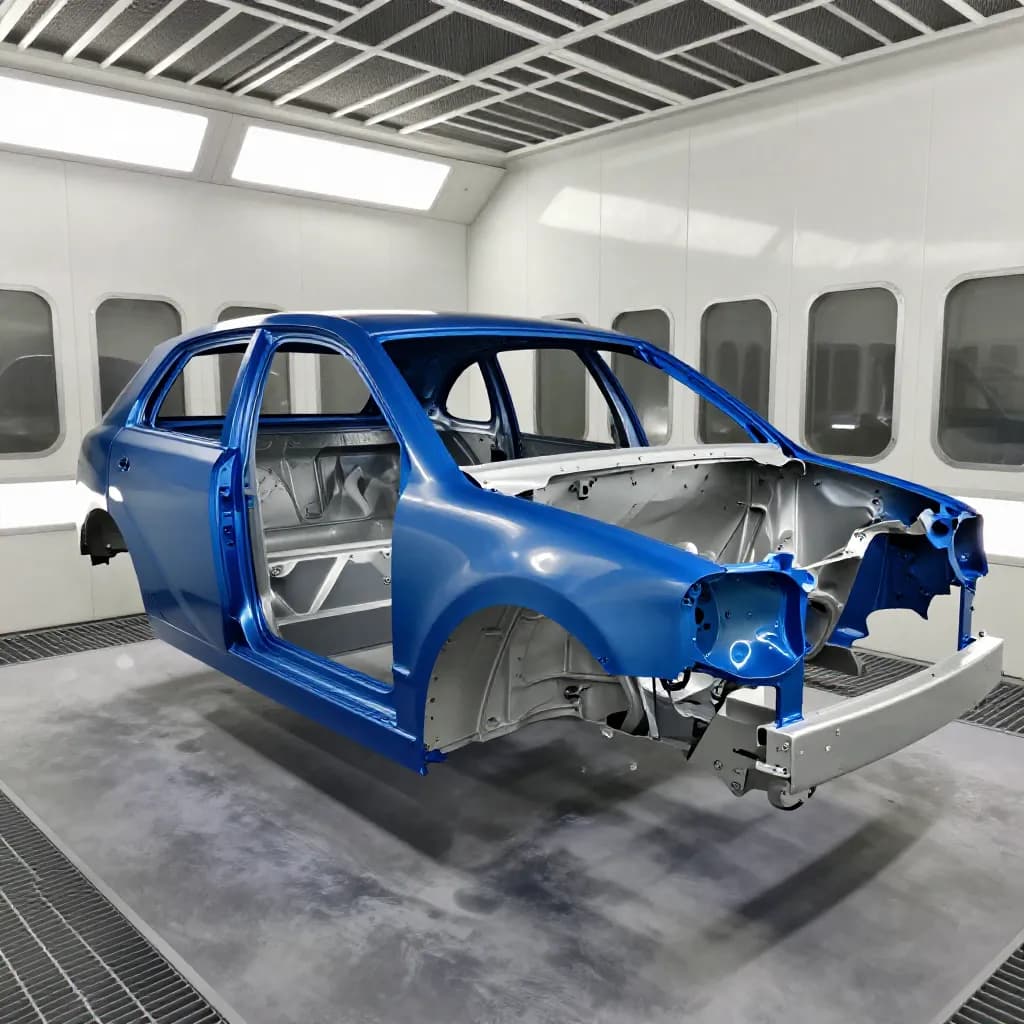
The fundamental challenge is size. A car body shell is far larger than the parts typically processed in powder coating operations. The curing oven must be large enough to accommodate the entire body — roughly 5 meters long, 2 meters wide, and 1.5 meters tall — and must maintain a uniform temperature of 180 to 200 degrees Celsius throughout this volume. Ovens of this size exist in industrial settings, but they are rare in the custom and aftermarket coating world. Most powder coating shops simply do not have an oven large enough for a car body.
Ready to Start Your Project?
From one-off customs to 15,000-part production runs — get precise pricing in 24 hours.
On This Page
Technically Yes, But It Is Extremely Impractical
Beyond the oven size, there are concerns about heat exposure to the body structure itself. Modern car bodies contain adhesive-bonded joints, seam sealers, sound deadening materials, and other non-metallic components that may not survive the curing temperature. Older vehicles with all-metal construction are better candidates, but even these present challenges related to heat distribution, coating uniformity, and the sheer volume of powder required.
The Oven Size Problem
The curing oven is the single biggest barrier to powder coating a car body. Standard powder coating ovens are designed for parts ranging from small hardware to large industrial components like guardrails or structural steel members. While some industrial ovens can accommodate objects the size of a car body, these are typically found in manufacturing facilities rather than custom coating shops.
Building or acquiring an oven large enough for a car body is a major capital investment. The oven must not only be physically large enough but must also be capable of heating the entire interior uniformly to the curing temperature. Hot spots and cold spots within the oven will result in uneven curing — some areas of the body may be over-cured while others are under-cured, leading to inconsistent color, gloss, and durability across the surface.
The energy consumption of curing a car body is also substantial. Heating a large oven to 200 degrees Celsius and maintaining that temperature for the 20 to 30 minutes needed to cure the powder requires significant electrical or gas energy. The thermal mass of the car body itself — which must absorb enough heat for the metal to reach curing temperature throughout — adds to the energy requirement. These practical and economic factors explain why powder coating car bodies remains a niche activity rather than a mainstream finishing method.
Heat Sensitivity of Body Components
Modern car bodies are not simple metal shells — they are complex assemblies containing a variety of materials that may not tolerate powder coating curing temperatures. Structural adhesives used in modern body construction can soften or degrade at temperatures above 150 to 180 degrees Celsius, potentially compromising the structural integrity of bonded joints. Seam sealers, cavity waxes, and sound deadening materials will melt, burn, or off-gas at curing temperatures, creating a mess inside the oven and potentially contaminating the coating.
Plastic and composite body panels — increasingly common on modern vehicles — cannot be cured at standard powder coating temperatures. Bumper covers, fender liners, mirror housings, and other plastic components must be removed before the body enters the oven. On some modern vehicles, a significant portion of the exterior panels are plastic or composite, limiting the amount of the body that can actually be powder coated.
For older vehicles with all-metal construction and no structural adhesives, the heat sensitivity issue is less of a concern. Classic cars from the era before adhesive bonding and plastic panels are the most viable candidates for body powder coating, as their simple metal construction can withstand the curing temperature without structural compromise. Even so, all non-metallic components — wiring, rubber seals, glass, trim — must be completely removed before the body enters the oven.
Coating Uniformity and Finish Quality
Achieving the finish quality expected of an automotive body panel is extremely challenging with powder coating. Automotive paint finishes are held to very high standards — uniform color, consistent gloss, smooth surface free of orange peel, and the ability to blend repairs invisibly. While powder coating can achieve excellent finishes on flat and moderately curved surfaces, the complex compound curves, deep recesses, and tight corners of a car body make uniform powder deposition difficult.
Electrostatic powder application relies on the attraction between charged powder particles and the grounded metal surface. On complex shapes like a car body, the Faraday cage effect can prevent powder from reaching into deep recesses, inside door jambs, and around tight corners. These areas may receive insufficient powder, resulting in thin spots or bare areas. Overcoming this requires careful gun technique, multiple passes, and potentially manual touch-up of difficult areas — a time-consuming process on a surface as large as a car body.
The orange peel texture that is characteristic of many powder coatings is another concern. While acceptable on industrial components and even on wheels and engine parts, orange peel is not acceptable on automotive body panels where a smooth, mirror-like finish is expected. Achieving a smooth finish with powder coating requires precise control of powder particle size, film thickness, and curing parameters — all of which become more difficult to maintain consistently across the large surface area of a car body.
Repair and Touch-Up Limitations
One of the most significant practical limitations of powder coating a car body is the difficulty of repair. Automotive paint can be spot-repaired, blended, and touched up relatively easily — a skilled painter can repair a scratch, dent, or chip and make the repair virtually invisible. Powder coating does not offer this flexibility. If a powder-coated body panel is damaged, the repair options are limited and none are as seamless as automotive paint repair.
Small chips and scratches can be touched up with liquid paint matched to the powder coating color, but the touch-up will never perfectly match the texture and sheen of the original powder coating. For larger damage, the affected panel would ideally need to be stripped and recoated — which means removing the panel, blasting it, recoating it, and curing it in the oven. This is far more involved than a conventional paint repair and may not be practical for panels that are welded to the body structure.
This repair limitation is perhaps the strongest argument against powder coating a car body for a vehicle that will be driven regularly. Daily drivers inevitably accumulate door dings, parking lot scratches, stone chips, and other minor damage that is easily repaired with conventional paint. On a powder-coated body, each of these incidents becomes a more significant repair challenge. For show cars or garage queens that will not be exposed to daily driving hazards, this limitation is less of a concern.
When Powder Coating a Car Body Makes Sense
Despite the challenges, there are specific scenarios where powder coating a car body can be a viable and even advantageous choice. The most common scenario is a bare-metal restoration of a classic car where the body has been completely stripped, all non-metallic components have been removed, and the owner has access to an oven large enough to accommodate the body shell. In this situation, powder coating can provide a more durable and chemical-resistant finish than conventional paint.
Race cars and off-road vehicles are another potential application. These vehicles prioritize durability over cosmetic perfection and are less concerned with the smooth, show-quality finish that automotive paint provides. A powder-coated race car body can withstand the abrasion, chemical exposure, and mechanical stress of competition better than paint, and the slightly textured surface is acceptable in this context.
Some custom builders and hot rod shops have invested in large ovens specifically for body coating and offer this as a specialty service. These shops have developed techniques for achieving acceptable finish quality on car bodies and understand the preparation and masking requirements. If you are determined to powder coat a car body, seeking out one of these specialized shops is the best approach — a general-purpose powder coating shop is unlikely to have the equipment or experience for this type of work.
Better Alternatives for Vehicle Body Finishing
For most vehicle owners, conventional automotive paint systems offer a better combination of finish quality, repairability, and practicality than powder coating for body panels. Modern automotive basecoat-clearcoat paint systems provide excellent durability, UV resistance, and color depth, with the added advantage of being repairable and blendable.
Two-stage urethane paint systems — consisting of a colored basecoat and a clear urethane topcoat — are the industry standard for automotive refinishing. These systems produce the smooth, deep, glossy finish that is expected on vehicle bodies and can be applied in a standard paint booth without the need for a curing oven. The clear coat provides UV protection and chemical resistance, while the basecoat provides color and coverage.
For owners who want enhanced durability beyond what standard paint provides, ceramic coatings applied over conventional paint offer excellent protection against scratches, chemical etching, and UV damage. Paint protection film (PPF) provides a physical barrier against stone chips and abrasion on high-impact areas. These aftermarket protection products can be applied over conventional paint to achieve durability that approaches or exceeds powder coating, without the practical limitations of powder coating a car body.
The Hybrid Approach: Powder Coat Components, Paint the Body
The most practical approach for enthusiasts who want the benefits of powder coating on their vehicle is a hybrid strategy: powder coat the individual components that benefit most from the process, and use conventional paint for the body panels. This approach leverages the strengths of each finishing method where they are most appropriate.
Powder coat the chassis, suspension components, subframes, engine bay parts, wheels, brackets, and hardware — all components that benefit from the superior chemical resistance, chip resistance, and durability of powder coating. These parts are exposed to road debris, salt, oil, and mechanical stress, and powder coating handles these conditions better than paint. They are also easy to remove, coat individually, and reinstall.
Paint the body panels with a quality automotive paint system that provides the smooth finish, color depth, and repairability that body panels require. This hybrid approach gives you the best of both worlds — a show-quality body finish that can be repaired if damaged, combined with powder-coated underpinnings and components that will resist corrosion and wear for years. This is the approach used by most professional restoration shops and custom builders, and it represents the most practical path to a durable, attractive vehicle finish.
Frequently Asked Questions
Why don't car manufacturers use powder coating on car bodies?
Some manufacturers do use powder coating for primer and clearcoat layers in their production processes, but the full body finish typically uses liquid paint for its superior flow, leveling, and color-matching properties. The automotive industry also requires easy repairability for warranty and collision work, which liquid paint provides and powder coating does not.
Can you powder coat individual car body panels?
Individual removable panels — such as hoods, trunk lids, doors, and fenders — can be powder coated more easily than a complete body because they fit in standard-sized ovens. However, matching the powder-coated panels to conventionally painted adjacent panels can be challenging, as the texture and sheen may differ.
Is powder coating more durable than car paint?
Powder coating is generally more resistant to chipping, chemicals, and abrasion than conventional automotive paint. However, automotive paint systems offer better UV resistance in some formulations, superior finish smoothness, and much easier repairability. For body panels, the practical advantages of paint typically outweigh the durability advantages of powder coating.
How much does it cost to powder coat a car body?
Powder coating a complete car body is a specialty service with limited availability. The cost is typically significantly higher than a quality conventional paint job due to the specialized oven requirements, extensive preparation, and the large volume of powder needed. The limited number of shops offering this service also affects availability and pricing.
Can you clear coat over powder coating on a car?
Yes, a clear powder coat can be applied over a colored powder base coat for additional depth and protection. Liquid clear coat can also be applied over cured powder coating with proper preparation. Some builders use a powder color base with a liquid automotive clear coat to combine the durability of powder with the smooth finish of liquid clear.
Ready to Start Your Project?
From one-off customs to 15,000-part production runs — get precise pricing in 24 hours.