Engineering controls - particularly local exhaust ventilation in spray booths - are the cornerstone of occupational protection for spray painters. Booths are designed to capture overspray and maintain airborne contaminant concentrations below permissible exposure limits. But a substantial body of evidence demonstrates that spray booth ventilation often fails to protect workers adequately. Peak solvent concentrations during spraying routinely exceed OSHA permissible limits, even in properly designed booths, due to the physics of aerosol generation, the limitations of airflow patterns, and the realities of production work. For government specifications that rely on engineering controls to manage coating hazards, understanding these limitations is essential.
paint-and-liquid-coatings-risks
Spray Booth Ventilation: Why Engineering Controls Fail to Protect Painters
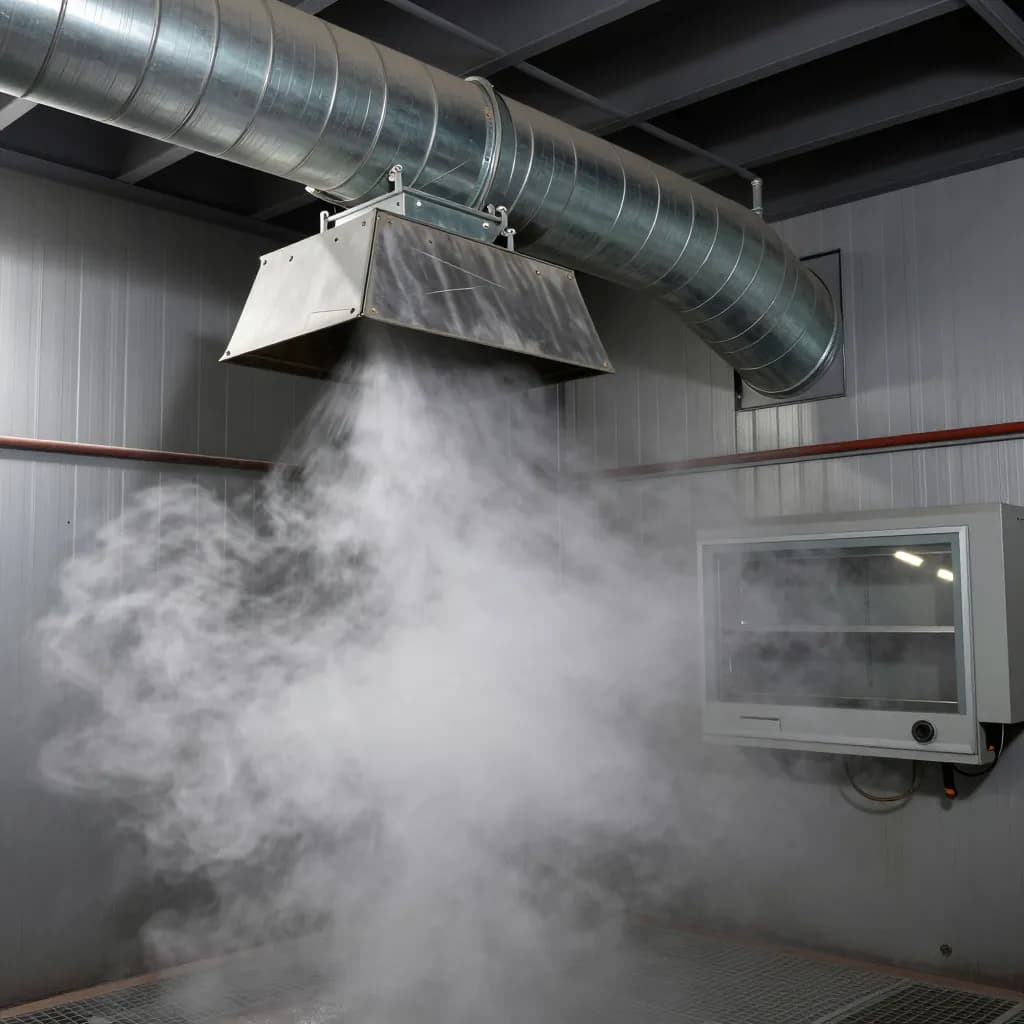
| Booth Type | Airflow Direction | Typical Velocity |
|---|---|---|
| Crossdraft | Horizontal (side to side) | 50-100 ft/min |
| Downdraft | Vertical (top to bottom) | 50-150 ft/min |
| Semi-downdraft | Angled (top to side) | 50-100 ft/min |
| Paint mixing room | General exhaust | 10-20 air changes/hour |
Ready to Start Your Project?
From one-off customs to 15,000-part production runs — get precise pricing in 24 hours.
On This Page
Spray Booth Ventilation: Why Engineering Controls Fail to Protect Painters
How Spray Booths Are Designed to Work
Airflow Patterns
Design Assumptions
Booth design calculations assume:
- Uniform airflow: Even distribution across booth cross-section
- No turbulence: Smooth laminar flow from inlet to exhaust
- Proper maintenance: Clean filters, functioning fans, unobstructed ducts
- Correct operation: Parts positioned properly, adequate booth size
- Adequate makeup air: Sufficient replacement air for exhausted volume
Why Real-World Performance Falls Short
1. Peak Exposures During Spraying
Air monitoring studies consistently find that peak concentrations during spray application exceed time-weighted average limits:
| Scenario | TWA Concentration | Peak Concentration | Ratio |
|---|---|---|---|
| Automotive refinishing booth | 50-100 ppm | 500-2,000 ppm | 10-20x |
| Industrial spray booth | 30-80 ppm | 300-1,500 ppm | 10-20x |
| Wood finishing booth | 20-50 ppm | 200-1,000 ppm | 10-20x |
These peaks may last only seconds to minutes, but they represent the actual exposure experienced by the painter's respiratory system.
2. Turbulence and Dead Zones
Real booths have turbulent airflow:
- Part obstruction: The painted part blocks and redirects airflow
- Spray gun turbulence: The spray jet creates local air currents
- Operator movement: The painter's body disrupts flow patterns
- Booth geometry: Corners, edges, and transitions create dead zones
Computational fluid dynamics studies show that actual airflow patterns in operating booths bear little resemblance to the idealized laminar flow assumed in design calculations.
3. Part Geometry Effects
Complex parts create ventilation challenges:
| Part Feature | Ventilation Problem |
|---|---|
| Enclosed cavities | No airflow inside; solvent accumulates |
| Internal corners | Dead zones with minimal air movement |
| Back sides | Opposite from spray direction; poor capture |
| Small parts on racks | Overspray between parts not captured |
| Large flat panels | Deflect airflow; create turbulent wake |
The painter spraying inside a box section, behind a structural member, or into a recess receives minimal ventilation benefit.
4. Maintenance Deficiencies
| Maintenance Item | Failure Mode | Effect |
|---|---|---|
| Overspray filters | Clogged; not replaced | Reduced airflow; increased pressure |
| Exhaust fans | Belt slip; motor wear | Insufficient exhaust volume |
| Ductwork | Blocked; leaks | Reduced capture efficiency |
| Makeup air units | Not functioning | Negative pressure; poor airflow |
| Air velocity monitors | Not calibrated; absent | No verification of performance |
In practice, booth maintenance is often deferred due to production pressure, cost, or lack of awareness.
5. Operator Position
The painter's position relative to the spray plume determines exposure:
| Position | Exposure Level |
|---|---|
| Upwind of spray | Lowest (but often impractical) |
| Perpendicular to spray | Moderate |
| Downwind of spray | Highest (most common position) |
| Inside booth with part | Very high (confined space) |
Painters typically work downwind of the spray plume to see their work and avoid overspray on themselves - precisely the position of highest exposure.
Documented Exposure Studies
Study Findings
Multiple studies have documented spray booth exposure failures:
| Study | Finding | Implication |
|---|---|---|
| Lillienberg (2010) | Isocyanate concentrations exceeded limits in spray booths | Sensitization risk persists |
| Reeb-Whitaker (2012) | Spray painters exceed solvent PELs despite booths | Engineering controls insufficient |
| Flynn (2006) | Booth airflow often inadequate in small shops | Small employers at highest risk |
| Heitbrink (1995) | Overspray not adequately captured by conventional booths | Respirable aerosol exposure |
| Nordic studies | Chronic solvent encephalopathy occurs in booth painters | Long-term exposure despite controls |
The Regulatory Context
OSHA Standards
OSHA recognizes ventilation limitations:
| Standard | Ventilation Requirement | Limitation |
|---|---|---|
| 1910.94 (Ventilation) | General requirements | Does not guarantee protection |
| 1910.107 (Spray finishing) | Specific booth requirements | Minimum standards; may be inadequate |
| Individual chemical PELs | Air concentration limits | Based on TWA, not peaks |
The Hierarchy of Controls
OSHA and NIOSH emphasize that engineering controls, while preferred over PPE, are not as effective as elimination or substitution:
| Control Level | Effectiveness | Reliability |
|---|---|---|
| Elimination | 100% | Absolute |
| Substitution | Near 100% | High |
| Engineering controls | 70-90% | Variable |
| Administrative controls | 50-70% | Dependent on behavior |
| PPE | 30-50% | Dependent on compliance |
Ventilation falls in the middle - better than PPE but far from elimination.
The Powder Coating Alternative
Why Powder Coating Booths Are Different
Powder coating booths share the same airflow principles but eliminate the chemical hazard:
| Factor | Liquid Spray Booth | Powder Coating Booth |
|---|---|---|
| Airborne contaminant | Toxic solvents, isocyanates | Non-toxic powder particles |
| Peak concentration risk | Health hazard | Nuisance dust |
| Odor warning | Inadequate | Not applicable |
| Sensitization risk | High (isocyanates) | Minimal |
| Fire hazard | High (flammable solvents) | Moderate (dust explosion) |
| Cleanup hazard | Solvent exposure | Dust exposure (manageable) |
Powder Booth Safety
Powder coating booths do have hazards - primarily dust explosion risk if powder concentration exceeds the minimum explosive concentration (MEC). However:
- Explosion risk is manageable: Proper ventilation, grounding, spark avoidance
- No chronic toxicity: Powder particles do not cause cancer, neurotoxicity, or sensitization
- No solvent peaks: Airborne concentrations are not acutely toxic
The Honest Assessment
An honest evaluation of spray booth ventilation must acknowledge:
What Ventilation Can Do
- Reduce average exposures
- Remove visible overspray
- Provide a controlled application environment
- Support regulatory compliance for TWA measurements
What Ventilation Cannot Do
- Eliminate peak exposures during spraying
- Protect painters in dead zones or enclosed spaces
- Overcome poor maintenance or operation
- Prevent long-term cumulative effects
- Substitute for hazard elimination
Conclusion
Spray booth ventilation is a necessary but insufficient protection for painters. The physics of aerosol generation, the realities of booth maintenance, and the variability of work practices ensure that peak exposures exceed safe levels even in properly designed systems. The painter who trusts the booth to protect him is trusting a technology that was never designed to eliminate exposure - only to reduce it.
For government specifications, relying on ventilation as the primary protection strategy is a gamble with workers' health. The 35% increased lung cancer risk, the 3.5x dementia risk, the irreversible isocyanate asthma - these outcomes occur in painters who worked in spray booths. The booths reduced their exposure but did not prevent their disease.
Powder coating eliminates the chemicals that make spray booths hazardous. The booth that previously contained benzene vapor now contains only benign powder particles. The ventilation that struggled to maintain safe solvent levels now merely prevents dust accumulation. The engineering control that was the best available option becomes unnecessary because the hazard it was designed to control no longer exists.
The hierarchy of controls is clear: elimination is the most effective strategy. For spray painting, elimination means specifying powder coating.
Ready to Start Your Project?
From one-off customs to 15,000-part production runs — get precise pricing in 24 hours.